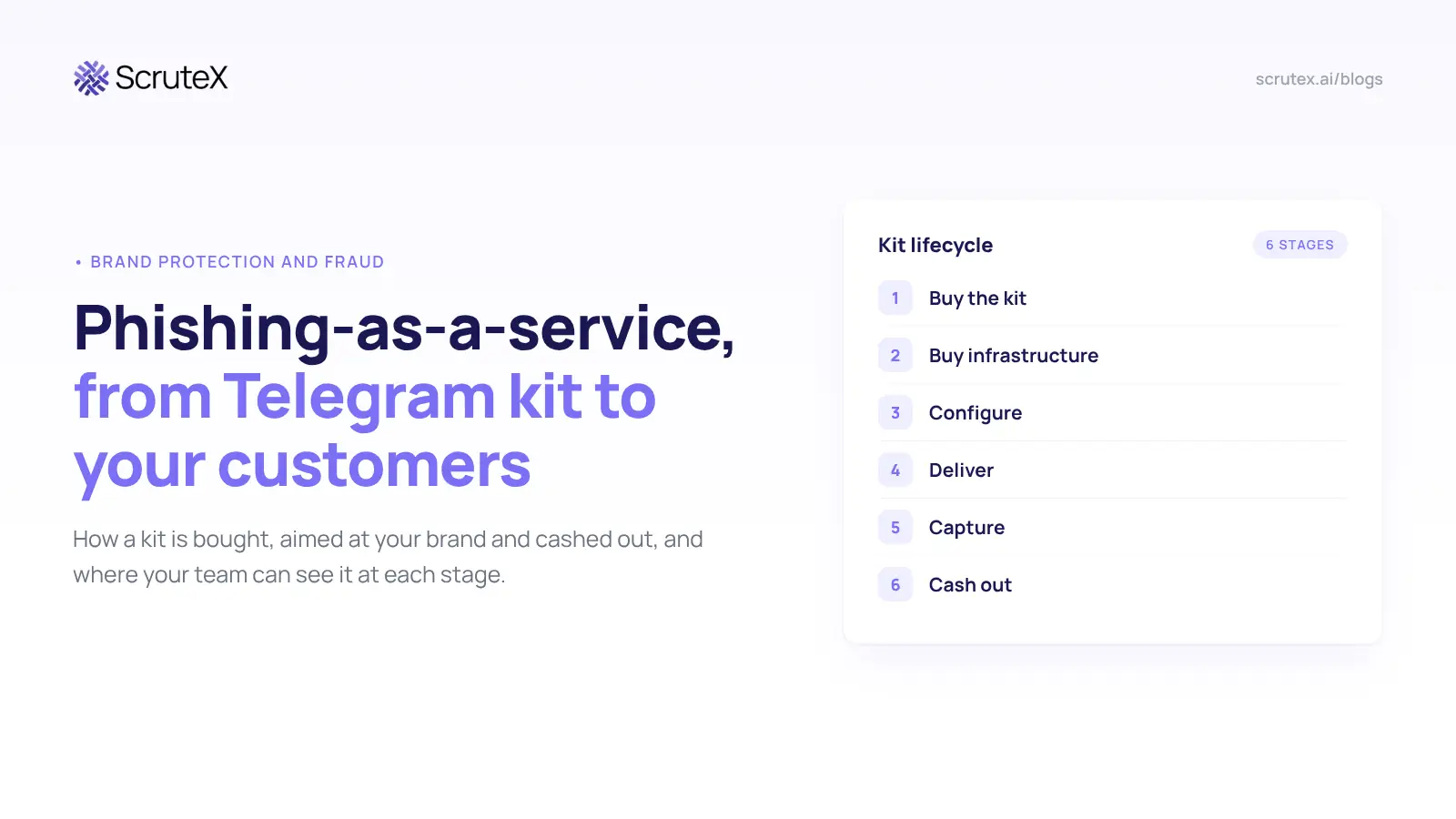
Phishing-as-a-Service: How a Kit Moves From Telegram to Your Customers
By ScruteXPublished Updated
A criminal can buy a phishing kit aimed at your brand, configure it and start sending traffic in an afternoon. None of it touches your network. Often the first sign is a customer calling to ask why their card was charged after they "renewed" a service you never billed for.
Phishing-as-a-service (PhaaS) is a criminal subscription model. Developers sell ready-made phishing kits, templates, hosting and support to other criminals, who then run campaigns against a brand's customers or staff. Telegram is one of the busiest storefronts, and often the channel the stolen data travels back through.
The model runs at industrial scale. On 14 October 2026, Microsoft reported on three kits from one Chinese-speaking developer cluster it tracks as Storm-2990, each with its own Telegram sales channel. Since January 2026, these kits had helped send more than one billion phishing emails and SMS messages to over 75,000 organisations. One of them, Iron Man System, ships more than 2,335 templates covering over 139 countries, including Australia, Japan, India and the United States.
This post follows one kit from its Telegram listing to the cash-out, marks where a defender can see it at each stage, and sets out how to get the page taken down.
What is phishing-as-a-service?
A phishing kit is a bundle of files: a cloned login page, a script that captures what the victim types, and a config file. Phishing-as-a-service wraps that bundle in a business. The buyer pays a subscription and gets prebuilt brand templates, delivery by email, SMS or QR code, and live dashboards that show each campaign and the credentials it has captured.
Price is not the barrier. Kits can cost as little as US$10, while full platforms charge modest monthly fees. At the higher end, BlackForce sells on Telegram forums for €200 to €300, and a Telegram channel of about 1,300 members advertises InboxPrime AI for $1,000, source code included.
For a defender, the price matters less than the format. These are products. They have names, storefronts, version notes and customer lists. Anyone who watches the store can see a product.
How does a phishing kit move from Telegram to your customers?
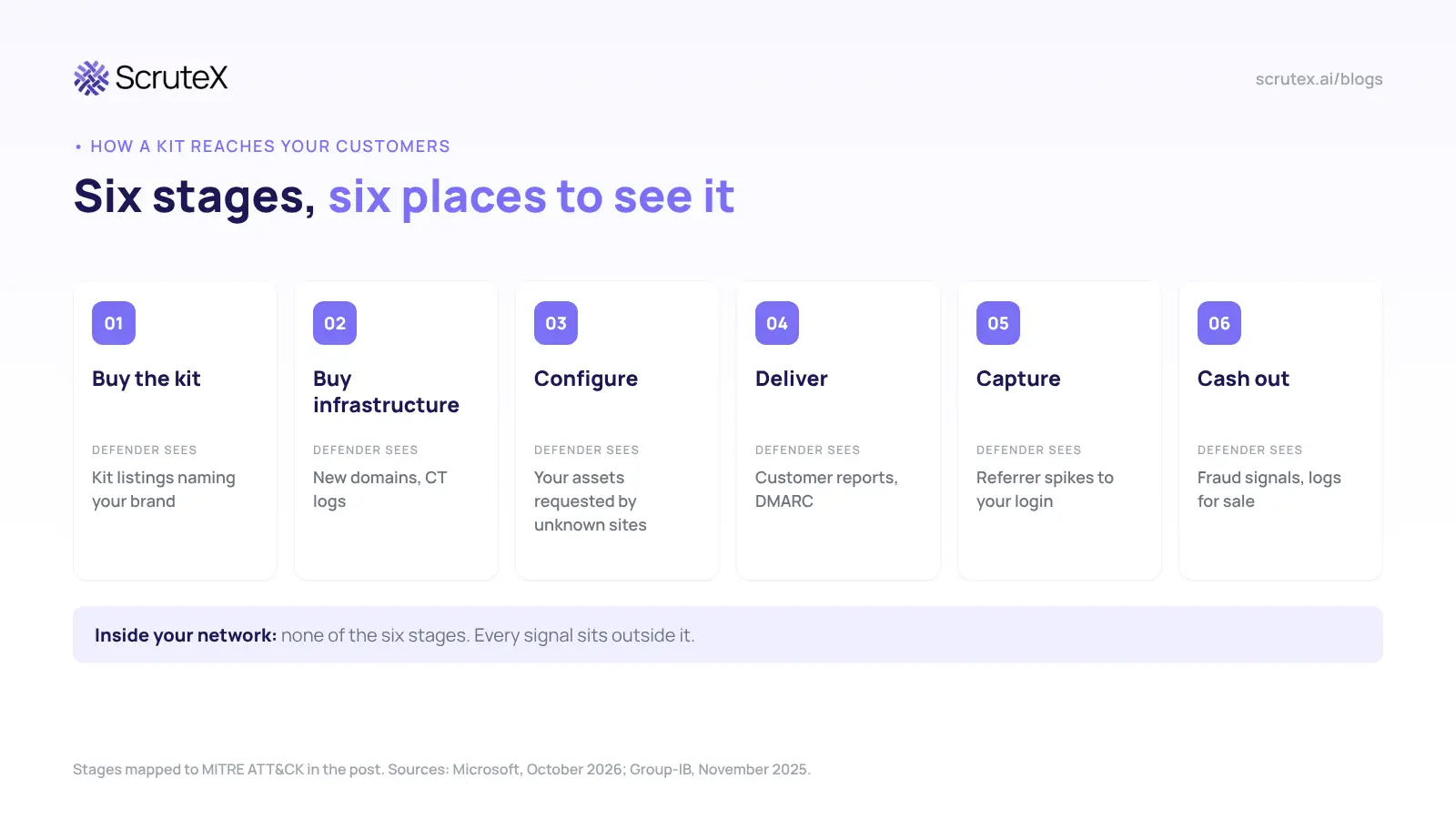
A PhaaS campaign passes through six stages. The table maps each one to a MITRE ATT&CK technique and to the place a defender can observe it.
| Stage | What the operator does | ATT&CK technique | Where a defender can see it |
|---|---|---|---|
| 1. Buy the kit | Joins a Telegram sales channel, pays in crypto, gets a licence | T1588 Obtain Capabilities | Kit listings and template lists naming your brand |
| 2. Buy infrastructure | Registers lookalike domains or rents hijacked cloud tenants | T1583.001 Acquire Infrastructure: Domains; T1584 Compromise Infrastructure | New domain registrations, Certificate Transparency logs |
| 3. Configure | Picks your brand's template, target country and Telegram bot | T1608.005 Stage Capabilities: Link Target | Live cloned pages, your assets requested by unknown sites |
| 4. Deliver | Sends SMS or email lures | T1566.002 Spearphishing Link | Customer reports, DMARC reports for spoofed mail |
| 5. Capture | Filters bots, takes logins, card data and OTPs | T1056.003 Web Portal Capture; T1557 Adversary-in-the-Middle | Inbound referrer spikes to your real login page |
| 6. Exfiltrate and cash out | Data goes to a Telegram bot, then fraud or resale | T1567 Exfiltration Over Web Service | Fraud signals, logs offered for sale in channels |
Stage 1: The kit is sold on Telegram
The operators of a kit impersonating Aruba S.p.A., an Italian hosting provider, used Telegram for three jobs: selling and distributing the kit, supporting buyers, and running the bots that receive stolen data. The developer even gave that kit away free in at least one channel.
Free kits are bait. The pattern runs like this: a newcomer tries a free kit or bot, pulls off a first scam, then gets offered paid products. A kit’s developer can also configure it to send them a copy of whatever the buyer steals. The sellers behind the CoGUI, Haozi and Iron Man System kits, one of the largest kit ecosystems documented this year, took payment in cryptocurrency, including USDT and Ethereum.
Stage 2: The operator buys infrastructure
The cheap option is a lookalike domain and a free TLS certificate. The advanced option borrows someone else's reputation. Microsoft describes YAM Store (Storm-3119) as an access broker that hijacks Microsoft 365 and Azure for Education tenants and resells the accounts, licences and storage to phishing operations. A lure can arrive from a domain with a clean history, and reputation scores will not flag it.
Stage 3: The kit is pointed at your brand
The buyer selects your brand's template, the countries to target and the Telegram bot that should receive results. Microsoft lists the evasion features in these kits as geofencing, fake CAPTCHA gates, IP block and allow lists, anti-detection settings, and fields for a Telegram bot token and chat ID, so the operator is notified each time a victim submits credentials, card data or a verification code.
Because of geofencing, your security team, testing from an office network in another country, may see a blank page while your customers see a perfect copy of your login screen.
Stage 4: The lure reaches your customer
Lures follow a script: a missed toll, a traffic fine, a held parcel, an expiring service, an account that needs re-verification. In the Aruba campaign, each login link carried the victim's email address, so the form opened already filled in.
Criminals run SMS gateway services that send bulk messages through APIs, and some actors seek spoofing tools to get past SPF, DKIM and DMARC. Our catalogue recorded a worldwide SMS sender service with custom sender IDs advertised on a cracking forum on 6 and 7 November 2026. Your email authentication protects mail that claims to come from your domain. It does nothing about an SMS or a lookalike domain.
Stage 5: The page captures everything it can
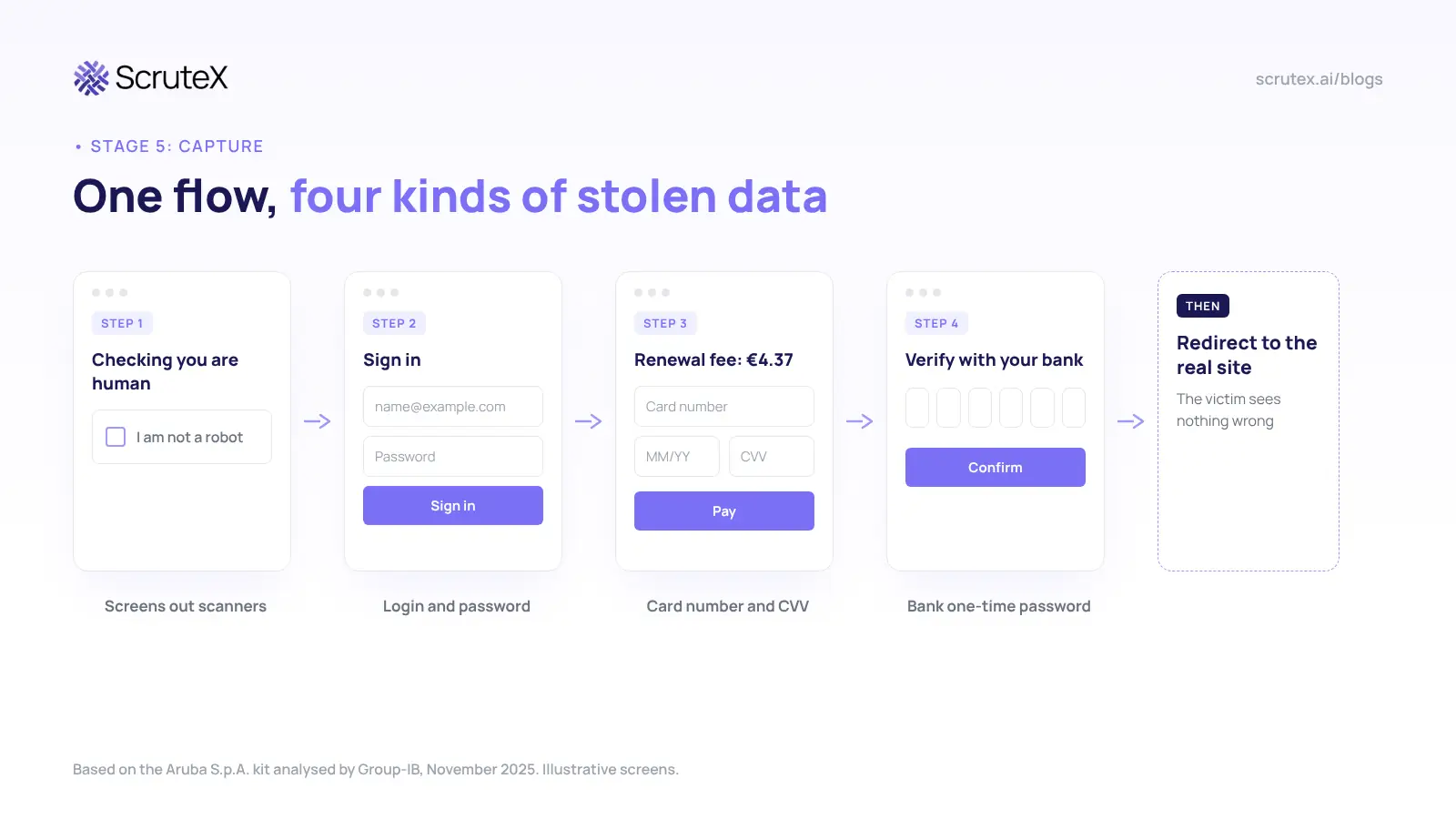
The Aruba kit ran four stages: a CAPTCHA to screen out scanners, a cloned login page, a fake payment page charging a small fee (€4.37 in one example) to collect card details, then a fake 3-D Secure page to capture the bank's one-time password. The victim then lands on the genuine Aruba website, unaware of the theft.
More capable kits put a human in the loop. Some pass victim data to the operator over a live connection, so the operator watches each victim and decides which screen they see next. Adversary-in-the-middle kits proxy the real site and capture MFA tokens and session cookies along with the password. Telegram vendors also rent OTP bots that phone victims while posing as their bank.
An SMS one-time password does not save a customer who is dealing with a live operator. The OTP is the last thing the kit needs.
Stage 6: Data flows back through Telegram and turns into money
Exfiltration is often a single HTTPS call to Telegram's bot API, tracked in ATT&CK as T1567. The traffic looks like ordinary messaging.
Then comes fraud. Researchers saw downstream actors use stolen card data to buy high-end goods and run device code phishing to take over accounts. Unused logins get resold. In 2023, one Telegram channel priced bank credentials by balance: $110 for an account holding $1,400, and $700 for one holding $49,000.
Why do phishing kit sellers use Telegram?
Telegram gives a seller reach without a dark web forum, a free bot API for delivery and exfiltration, group chats that work as a help desk, and a quick way to reopen under a new name after a ban.
The same features cut the other way. A seller has to advertise to sell, and kit listings often name the brands their templates copy. That makes Telegram one of the earliest places your brand shows up in a campaign, sometimes before the lookalike domain exists. Private invite-only groups and direct messages stay out of view for anyone who is not inside them.
What does a PhaaS campaign cost?
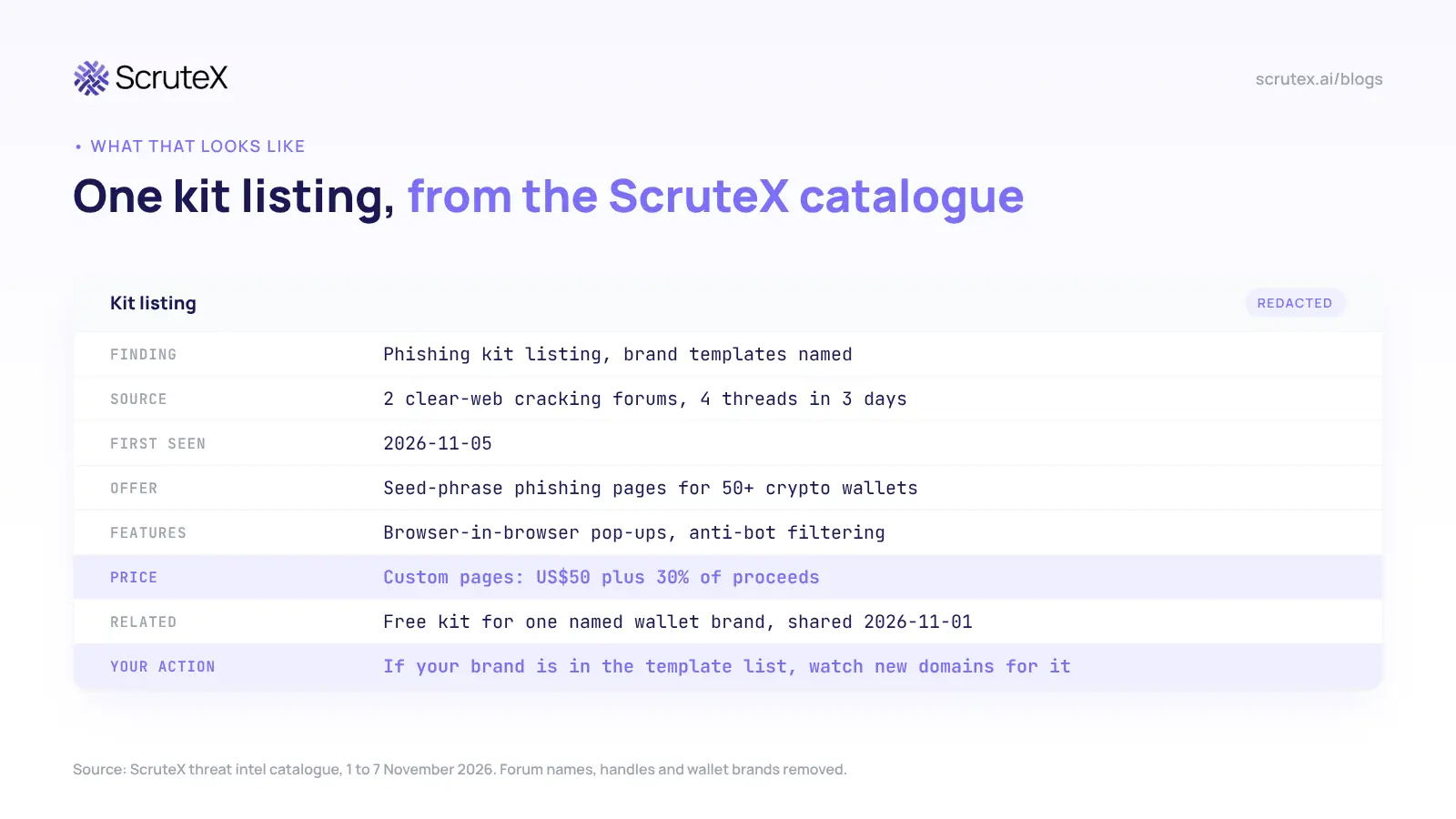
The entry price is low, and it is falling. In the first week of November 2026, the ScruteX catalogue recorded a seller offering custom crypto wallet phishing pages for $50 plus 30% of whatever the pages steal. The same week, someone shared a free kit for a major wallet brand on a public forum. Revenue share means the seller only earns when your customers lose money.
The customer pays first. They lose card funds, lose account access, or have their identity documents stolen. The brand then pays in reimbursements, chargebacks, contact centre volume and fraud investigation hours.
The second-order costs are harder to see. Customers reuse passwords, so credentials stolen from a fake version of your site get tried against the real one, and an impersonation problem becomes an account takeover problem. Over time, customers learn to distrust your genuine messages, which raises the cost of every legitimate alert and payment reminder you send.
How do you detect a phishing kit targeting your brand?
Work backwards through the six stages. Each one leaves a trace you can look for.
- Kit listings. Watch public Telegram sales channels and forums for template lists that name your brand. This is the earliest signal you can get.
- New domains and certificates. Lookalike domains need TLS certificates, and certificates appear in public Certificate Transparency logs. Monitor both for strings containing your brand.
- Your own web logs. Some cloned pages load your logo, favicon, fonts or stylesheets straight from your servers. Requests for those files with a referrer you do not own point to a copy of your site.
- Inbound referrers to your real login page. Kits like the Aruba one send victims to the genuine site after the theft. A burst of traffic to your login or payment page from an unfamiliar domain is a strong sign that someone just finished stealing from those visitors.
- Customer and staff reports. Give customers a dedicated page for reporting abuse, and route those reports to someone who records the URL.
- DMARC aggregate reports. These show who sends mail claiming to come from your domain. They cover email spoofing only.
To confirm a suspected page, test from a mobile network in the target country, because a geofenced kit hides from anything that looks like a scanner.
Large teams often run separate tools for email, takedown and threat intelligence, and that suits a mature programme with analysts for each. Smaller teams get more from one view that links a Telegram listing, a new domain and a leaked credential to the same campaign.
How do you take down a phishing page targeting your brand?
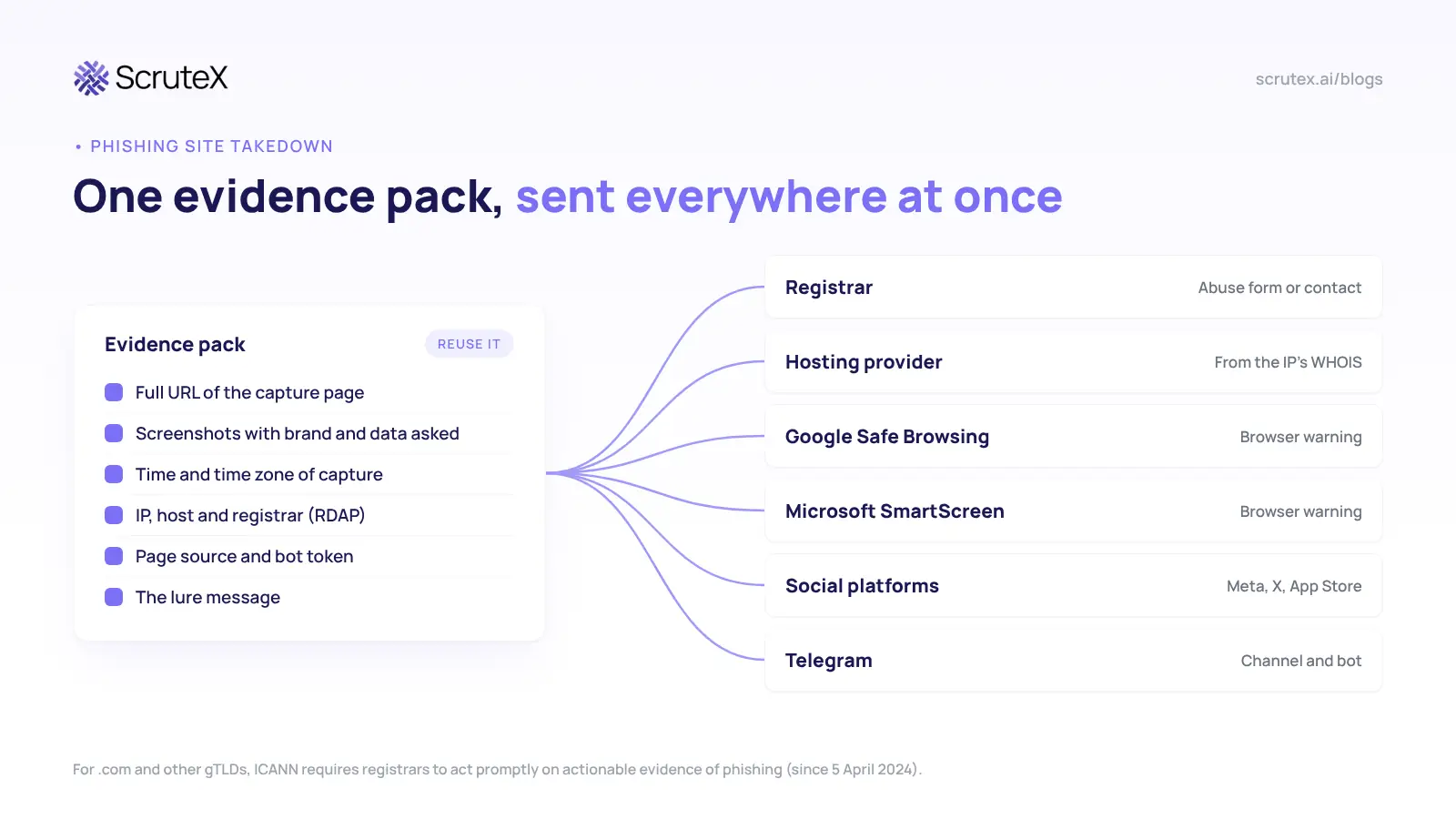
Takedown is mostly an evidence problem. The party that can remove the page acts faster when your report proves the abuse without making them investigate from scratch.
For generic top-level domains such as .com, ICANN's rules now help. Since 5 April 2024, a registrar with actionable evidence that a domain it sponsors is being used for DNS abuse, including phishing, must promptly take appropriate action to stop or disrupt it. ICANN's guidance gives an example of actionable evidence: a screenshot of the phishing attempt that shows what it targets, plus the complete URL of the abusive page. Registrars must accept web form reports without requiring a login, and must confirm receipt. These rules cover gTLDs. Country-code domains such as .in, .au and .uk follow their own registry's abuse policy.
Build one evidence pack and reuse it:
- The full URL of the capture page, not only the homepage
- Screenshots showing your brand and what the page asks for
- Time and time zone of each capture
- IP address, hosting provider and registrar (from RDAP or WHOIS)
- Page source, including any Telegram bot token
- The lure message that led to the page
Send it to every party that can act:
| Where the abuse lives | Where to report | Note |
|---|---|---|
| Domain (gTLD) | Registrar abuse contact or web form | ICANN's actionable-evidence standard applies |
| Domain (ccTLD) | Registrar, then the country registry | Registry policy applies, not ICANN |
| Hosting | Host's abuse contact | Find it from the IP's WHOIS record |
| Browsers | Google Safe Browsing report form; Microsoft SmartScreen report | Warns users while removal is pending |
| Facebook and Instagram | In-app report or Meta's impersonation forms | Forms work without an account; Brand Rights Protection suits repeat abuse |
| X | Impersonation report in the Help Center | No X account needed; trademark policy for brand misuse |
| Apple App Store | App Store Content Dispute form | Apple contacts the developer and asks them to resolve the claim |
| Telegram | In-app report on the channel and the bot | Include the bot handle from the page source |
File with several parties at once. Speed matters more than any single route. The DNS Research Federation found that the share of phishing and malware domains mitigated within 24 hours rose only from 13% in September 2024 to 20% in early 2025, while 55% were mitigated within seven days. The first day is when customers click. A browser warning protects them during the days a domain stays live.
Who do you have to tell?
In India, CERT-In's Directions list identity theft, spoofing and phishing attacks among the incidents that service providers, intermediaries, data centre operators, companies and government bodies must report within six hours. Reports go to incident@cert-in.org.in or the toll-free line 1800-11-4949. Ask counsel whether a campaign against your customers, on infrastructure you do not own, triggers the duty for you. Settle it before the first incident.
Elsewhere, national reporting routes double as takedown channels. In the UK, the NCSC assesses sites reported through its Suspicious Website Reporting Service and can have them removed, and suspicious emails go to report@phishing.gov.uk. In Australia, cybercrime goes to ReportCyber and scams to Scamwatch.
Key takeaways
- Phishing-as-a-service sells a full campaign as a subscription. Telegram is where kits are sold and supported, and where stolen data often ends up.
- Modern kits filter out scanners, geofence by country, and capture logins, cards and OTPs in one flow, with a live operator watching.
- Your network never sees the attack. The signals sit outside it: kit listings, new domains and certificates, your own asset logs and inbound referrers.
- A takedown moves at the speed of your evidence. Build one evidence pack and file it with the registrar, host, browsers and platforms at the same time.
Are you exposed?
You can check these today without any new tooling:
- ☐ Search 30 days of web server or CDN logs for requests to your logo, favicon or login stylesheet with a referrer domain you do not own.
- ☐ Pull referrer data for your login and payment pages and look for inbound traffic from unfamiliar domains.
- ☐ Search Certificate Transparency logs (crt.sh) for certificates issued to names containing your brand that you did not request.
- ☐ Check whether you have a ready evidence template and a named owner for takedown requests.
- ☐ Ask your contact centre how many "small renewal fee" or "OTP request" complaints arrived this quarter, and whether anyone logged the URLs.
What ScruteX finds here
ScruteX flags typosquats and lookalike domains registered against your brand, and live pages, social accounts and mobile apps that impersonate it. It watches Telegram, dark web forums and paste sites for mentions of your brand, including kit listings and shared logs. It matches your domains against stealer logs and leaked credential sets, so a stolen login shows up next to the page that took it. When a page is confirmed, ScruteX keeps the captured evidence with the finding and coordinates the takedown request.
At one ASX-listed financial services client, ScruteX detected seven lookalike domains in twelve months. Three were live phishing pages with mail records configured. All seven were found, and takedown averaged five business days.
What that looks like
A kit listing from the ScruteX catalogue, first week of November 2026. Forum names, handles and the targeted wallet brands are removed.
Check your brand
Are lookalike domains or live pages impersonating your brand right now? Run the lookalike and impersonation check. Enter your domain only.
ScruteX is external only. It does not see private Telegram groups it has no access to, SMS messages sent to your customers' phones, or anything inside your network. Takedown is coordinated, not guaranteed: registrar and host response times vary by jurisdiction.
Where to go next
- Brand Insights: start here if a kit is impersonating you to your customers.
- Threat Insights: start here if you want the actor and Telegram side of the campaign.
- What is Brand Protection in Cybersecurity?: the wider programme this detection and takedown work belongs to.
- Typosquatting and Lookalike Domains: The Full Threat Map: stage 2 of this pipeline in depth.
FAQ
Q: What is phishing-as-a-service?
A: Phishing-as-a-service is a criminal subscription model. Developers sell ready-made phishing kits, brand templates, hosting help and support to other criminals, who run the campaigns. Buyers need almost no technical skill, so one kit can power many campaigns against the same brand.
Q: Why do phishing kits send stolen data to Telegram?
A: Telegram's bot API is free, delivers each stolen login to the operator's phone in real time, and blends with ordinary messaging traffic. The same platform also hosts the channels where the kit was sold and supported.
Q: Does MFA stop phishing-as-a-service attacks?
A: SMS and app-based one-time codes do not stop kits that ask the victim for the code or proxy the real login page. Phishing-resistant methods such as passkeys and FIDO2 keys hold up far better, because they are bound to the genuine website.
Q: How do I know if a phishing kit is targeting my brand?
A: Look outside your network. Check Telegram kit listings, newly registered lookalike domains, Certificate Transparency logs, requests for your site's assets from unknown referrers, and inbound traffic to your login page from unfamiliar domains.
Q: How do I get a phishing site taken down?
A: Build an evidence pack with the full URL, screenshots showing your brand and the data requested, and the hosting and registrar details. Send it to the registrar, the host and Google Safe Browsing at the same time, and report any linked social accounts or apps to the platform. For .com and other gTLDs, ICANN requires registrars to act promptly on actionable evidence of phishing.