DRP vs Threat Intelligence vs EASM: Which One Does Your Organisation Need First?
By ScruteXPublished
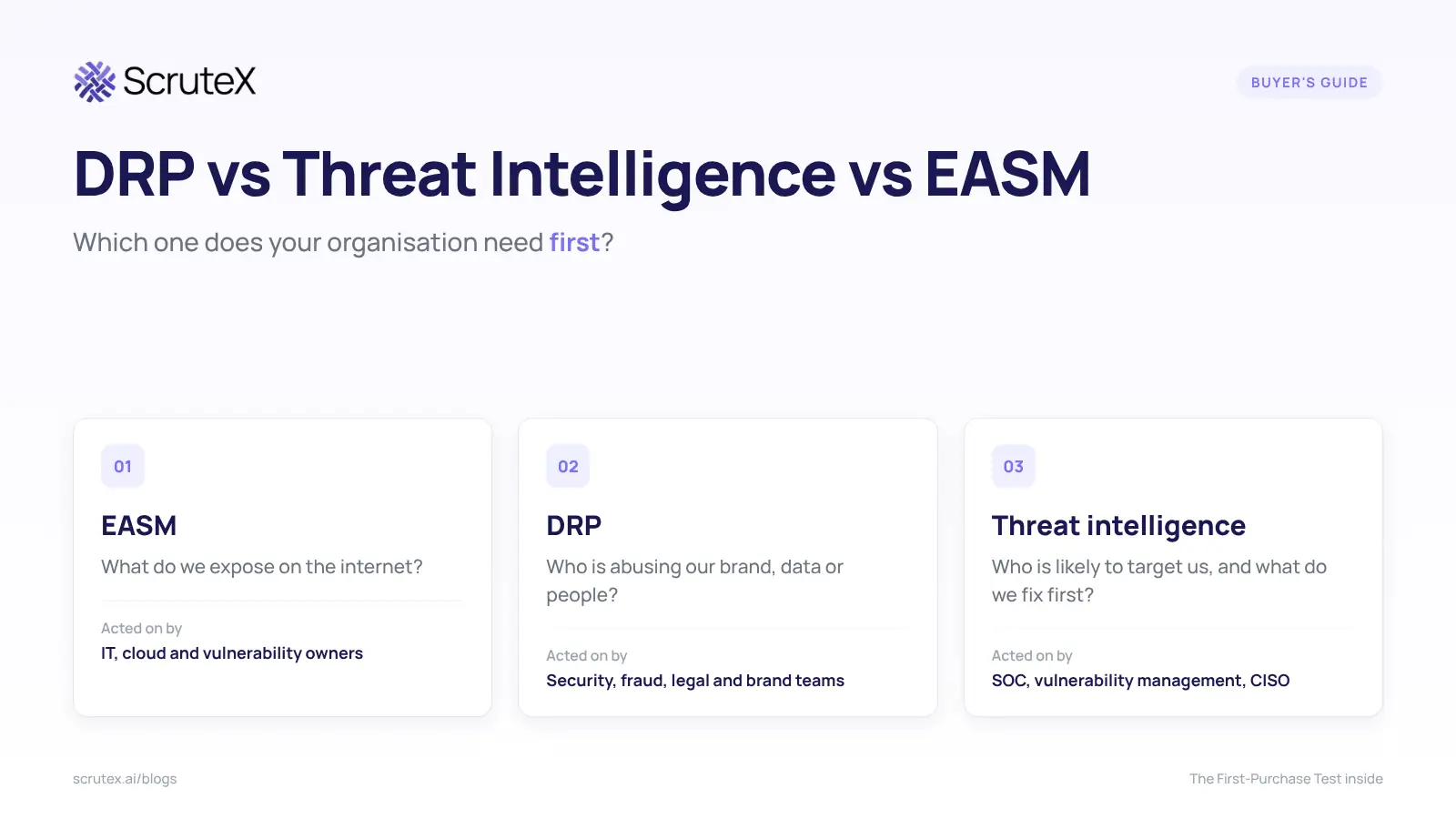
Most security teams buy their first external security tool to fix the last incident. A bank ends up with a threat intelligence subscription while its customers are phished on a lookalike domain. A SaaS company ends up with brand monitoring while an unpatched VPN sits open on the internet. Each purchase makes sense on its own. The problem is the order.
The short answer:
- External attack surface management (EASM) finds what you own on the internet and what is exposed on it.
- Digital risk protection (DRP) finds where your brand, data and people are being abused outside your perimeter.
- Threat intelligence explains which adversaries matter to you, and helps you decide what to fix first and how to respond.
The three overlap and work best together, but most teams have to start somewhere. Start where your biggest visibility gap meets the risk that would hurt your business most, and buy only what someone on your team will act on.
What is the difference between DRP, threat intelligence and EASM?
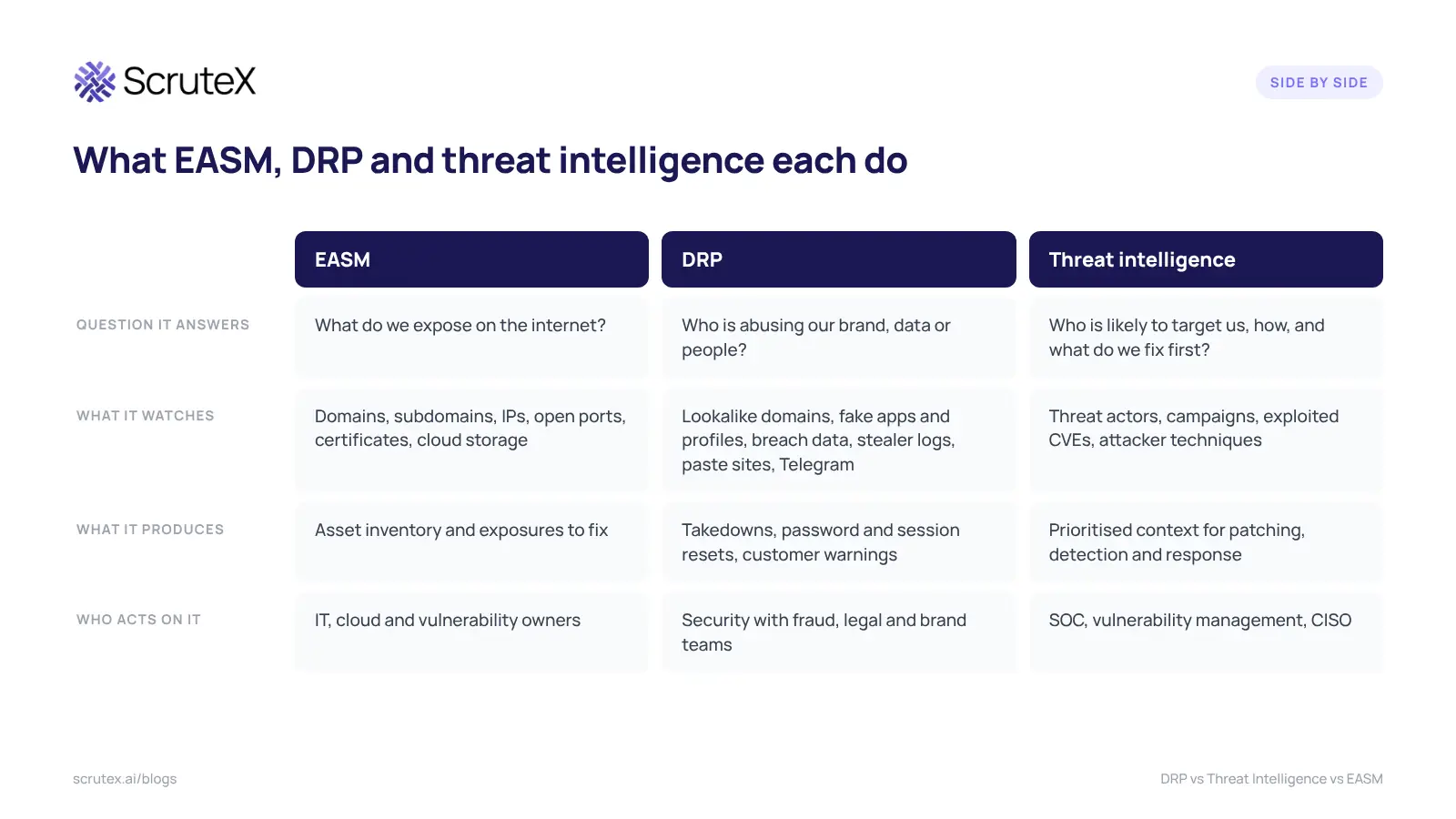
| EASM | DRP | Threat intelligence | |
|---|---|---|---|
| Question it answers | What do we expose on the internet? | Who is abusing our brand, data or people? | Who is likely to target us, how, and what should we do first? |
| What it watches | Your domains, subdomains, IPs, open ports, certificates, cloud storage | Lookalike domains, fake apps and profiles, breach data, stealer logs, paste sites, dark web forums, Telegram | Threat actor activity, campaigns, exploited CVEs, attacker techniques |
| What it produces | An asset inventory and exposures to fix | Takedowns, password and session resets, customer warnings | Prioritised context for patching, detection and response |
| Who usually acts on it | IT, cloud and vulnerability owners | Security with fraud, legal and brand teams | SOC, vulnerability management, CISO |
DRP and threat intelligence often read the same sources, such as dark web forums, for different reasons. DRP looks for your stolen credentials and data. Threat intelligence looks for what attackers plan, buy and exploit.
Why do analysts now group DRP, threat intelligence and EASM together?
If the lines look blurry, the analyst categories have blurred them too.
DRP now sits inside threat intelligence. Gartner published its Magic Quadrant for Cyberthreat Intelligence Technologies on 4 May 2026. Its market definition makes two capabilities mandatory:
- DRP monitoring and alerting, covering deep and dark web coverage, domain abuse, brand protection, third-party risk, social media, and geopolitical or physical security monitoring.
- Tailored vulnerability and exposure intelligence that highlights actively exploited vulnerabilities and links them to indicators, attacker techniques and threat actors.
EASM now sits inside exposure management. Gartner published its Magic Quadrant for Exposure Assessment Platforms on 10 November 2025. Its market definition describes platforms that continuously identify and prioritise exposures across many asset types, using threat intelligence and business context to point remediation at the highest risks.
These categories describe how products are packaged and evaluated. They don't tell you which problem is costing your organisation money right now.
When should you start with EASM?
Start with EASM when nobody can say with confidence what the organisation runs on the internet.
Signs EASM comes first:
- You have acquired companies or brands, or run subsidiaries with their own IT.
- Teams create cloud services without a central approval step.
- Someone updates your asset register by hand.
- You run VPNs, firewalls or file transfer appliances that face the internet.
The patching data shows why visibility matters. Verizon found organisations fully remediated only 26% of critical vulnerabilities listed in CISA's Known Exploited Vulnerabilities (KEV) catalogue in 2025, down from 38% the year before. The median time to full resolution was 43 days, up from 32.
Mandiant makes the same point about edge devices. Teams often deploy them and forget them, and an organisation cannot patch or monitor an asset it doesn't know exists.
A recent example: CISA added the Ivanti Connect Secure flaw CVE-2026-104935 to its KEV catalogue on 13 October 2026. For more on this pattern, read Your VPN Is the Front Door.
When should you start with digital risk protection?
Start with DRP when attackers are already profiting from your name or your logins, or when you have no way of knowing whether they are.
Signs DRP comes first:
- Fraud, support or legal teams already report fake domains, apps, social profiles or helpline numbers using your brand.
- Impersonation leads directly to customer losses or regulatory complaints, which is common in banking, insurance, retail and telecoms.
- You don't know whether staff or customer credentials for your domains appear in breach data or stealer logs.
Social engineering is moving off email. Verizon found that in phishing simulations, the median click rate for mobile-centric channels such as voice and text messages was 40% higher than for email. Mandiant reports financially motivated groups calling IT help desks while posing as employees to get past controls. It also advises very short session lifetimes so that stolen cookies sold on the dark web lose their value quickly.
When handoffs between attackers take seconds, a stolen session found a week later is evidence of an attack that has already happened.
DRP is also the capability whose payoff lands outside the company. The customer who never types a password into a lookalike login page, or never calls a fake helpline number, is the person a takedown protects.
Outside monitoring is often how leaks come to light. State Bank of India told regulators it received alerts on 16 October 2026 from its threat intelligence service provider, the Defence Cyber Agency and CERT-In about suspected exposure of customer data on the dark web. Its preliminary analysis identified 3,897 customer records containing personal information.
For how one infected laptop becomes a corporate breach, read Infostealer Malware.
When does threat intelligence come first?
Threat intelligence comes first when you need to know who is targeting you and which of your many exposures to fix first.
Signs threat intelligence comes first:
- Specific groups are targeting your sector, region or supply chain.
- You have more open vulnerabilities than you can patch and need a way to rank them.
- A SOC or vulnerability management team can turn intelligence into actions.
Threat intelligence is not only for teams that write detection rules every week. A small team can use curated, prioritised intelligence, such as a short list of exploited CVEs that match its technology, without running a full CTI programme.
The risk is buying intelligence nobody acts on. SANS's 2026 CTI survey drew on 401 security professionals and a CISO module answered by 67 security executives, collected between November 2025 and January 2026. It found:
- 91% of CISOs rate CTI as valuable or extremely valuable, but only 26% say it significantly influences their decisions.
- Most formal CTI teams have fewer than four full-time staff.
- 49% of programmes do not gather systematic feedback on effectiveness.
What executives want is intelligence tied to action. Their top priorities for the next 12 months are information on vulnerabilities attackers are actively targeting (79%) and specific adversary techniques (77%). That kind of intelligence is easiest to act on once you know which of those vulnerable products you actually run.
The First-Purchase Test
Answer all five questions. Each one gives a signal, not a verdict.
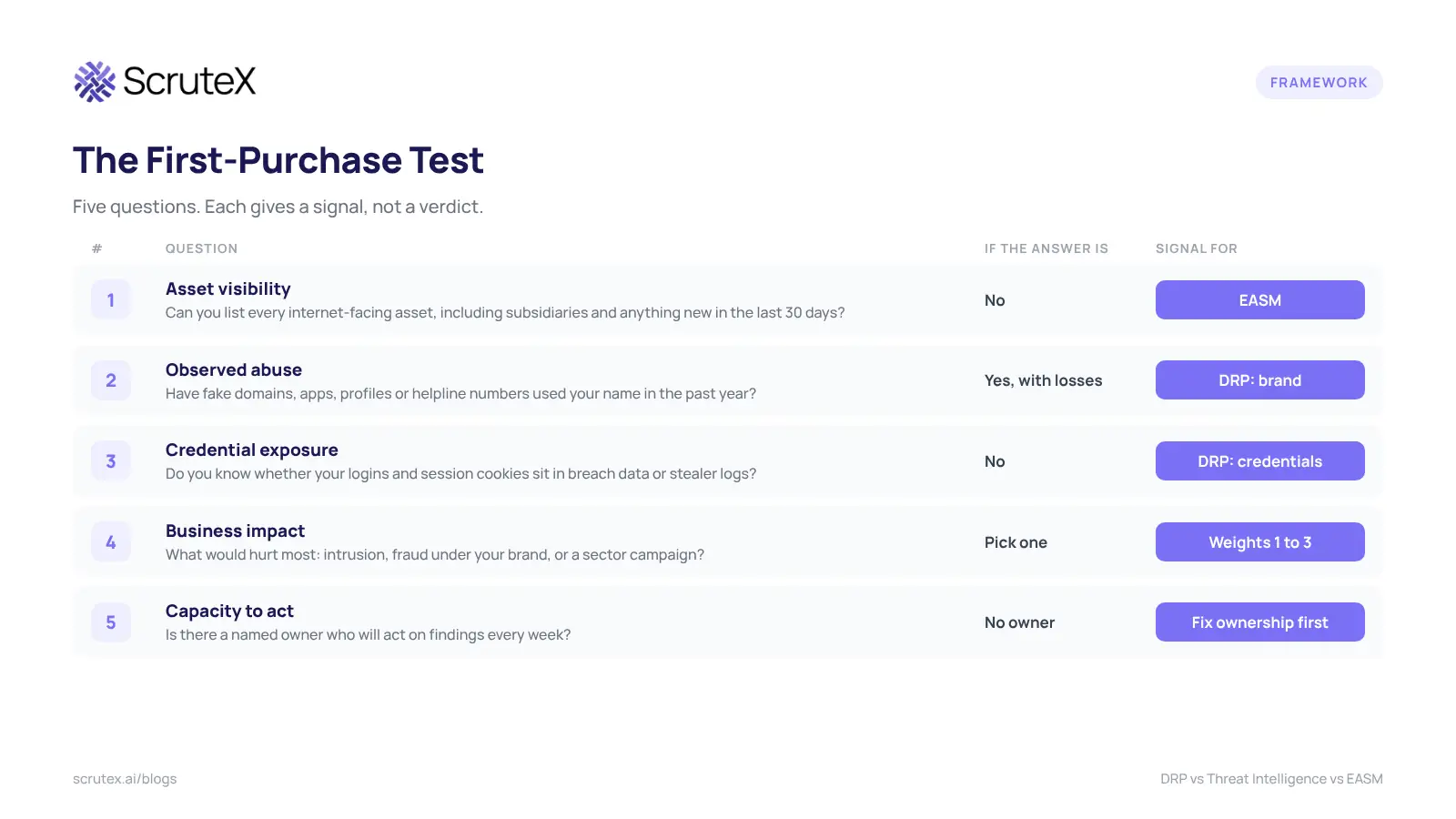
| # | Question | If the answer is... | Signal for |
|---|---|---|---|
| 1 | Asset visibility: Can you produce a current list of internet-facing assets, including subsidiaries, cloud accounts and anything created in the last 30 days? | No, or only from a register updated by hand | EASM |
| 2 | Observed abuse: In the past year, have customers or your fraud, support or legal teams reported fake domains, apps, profiles or helpline numbers using your name? | Yes, with losses or complaints | DRP: brand monitoring and takedown |
| 3 | Credential exposure: Do you know whether staff or customer logins and session cookies for your domains appear in breach data or stealer logs, and who resets them when they do? | No | DRP: credential monitoring. Run a quick check first to confirm the exposure |
| 4 | Business impact: Which would hurt most this year? (a) Intrusion through an internet-facing system. (b) Fraud against customers under your brand. (c) A targeted campaign against your sector. | Pick one | Weights the signals toward (a) EASM, (b) DRP or (c) threat intelligence |
| 5 | Capacity to act: For each capability, is there a named owner who will act on findings every week? | No owner | Assign an owner, or choose a service with triage or takedown included, before buying |
How to read your answers:
- Prioritise the capability where a strong signal from questions 1 to 3 matches the impact you chose in question 4.
- If several signals are strong and the impacts are similar, EASM is a sensible default. Exploitation leads initial access in both 2026 datasets above, and DRP and threat intelligence are easier to act on once you know what you own.
When the default changes:
- Active abuse is already costing money. Start with DRP.
- Your asset inventory is already reliable. Move straight to DRP or threat intelligence.
- Your sector's mix is different. In financial services, credential abuse and phishing sit close to exploitation, so weigh questions 2 and 3 as heavily as question 1.
- A known group is targeting your sector. Start with curated threat intelligence on that group, as long as it arrives as prioritised actions and not raw feeds.
- Nobody owns the findings. A tool won't fix that. Sort out ownership first.
A "no" on question 3 shows a visibility gap, not proof of exposure. Check before you buy.
What does each one miss?
| If you only have | You will still miss |
|---|---|
| EASM | Lookalike domains, fake apps and profiles hosted on infrastructure you don't own; credentials stolen from employees' devices |
| DRP | The forgotten staging server or unpatched VPN that needs no stolen credentials at all |
| Threat intelligence | Which of your own assets match the CVE or campaign in this week's report |
Should you buy one platform or several tools?
For many organisations, the order runs:
- EASM.
- DRP credential monitoring.
- DRP brand monitoring and takedown.
- Threat intelligence.
The First-Purchase Test shows when that order should change.
Team size alone doesn't decide between one platform and several tools. Specialist tools often go deeper in one area and suit large teams with analysts to run each one. A single platform suits teams that need one queue of external findings. Look at these factors:
- Overlapping findings: whether two tools raise the same leaked credential or exposed host as separate alerts.
- Ownership: whether the same people own every external finding, or EASM, fraud and SOC teams each need their own workflow.
- Depth: whether you need specialist depth in one area, such as takedowns at high volume.
- Integration effort: how much work it takes to connect several tools to your ticketing and reporting.
- Board reporting: whether the board needs one external risk view.
Whichever route you take, test each capability against your own domain during a trial. Count the assets found, the credentials matched and the lookalike domains caught. A bundle is only as strong as its weakest part.
How do DRP, threat intelligence and EASM feed a CTEM programme?
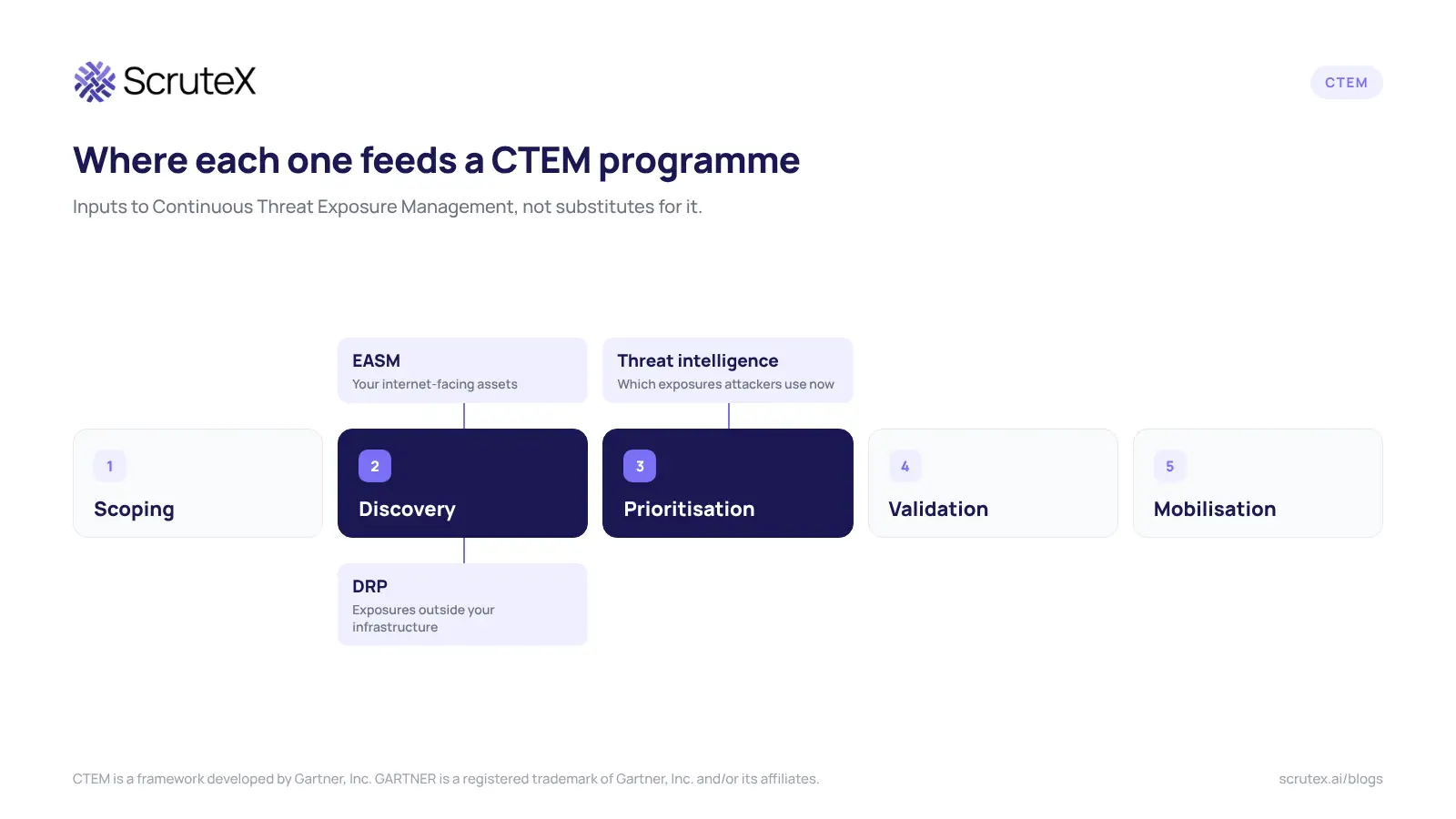
All three are inputs to Continuous Threat Exposure Management (CTEM), not substitutes for it:
- EASM feeds discovery with the internet-facing assets you own.
- DRP adds the exposures that sit outside your infrastructure.
- Threat intelligence sharpens prioritisation by showing which exposures attackers are using now.
Key takeaways
- EASM finds what you expose, DRP finds where you are being abused, and threat intelligence tells you who matters and what to fix first.
- Analysts now group DRP with threat intelligence and EASM with exposure management. That reflects how vendors package products, not what you need first.
- Exploitation leads initial access in both Verizon's and Mandiant's 2026 data, but sector, observed abuse and credential exposure can change the right first purchase.
- Buy only what a named owner will act on every week.
Am I exposed? Five checks you can run today
- ☐ Search certificate transparency logs (for example, crt.sh) for your main domain. Count the subdomains nobody recognises.
- ☐ In a private browser window, search your brand name plus "login" and "customer care". Check the ads and map listings for numbers and sites you don't own.
- ☐ Search your staff email domain in a breach notification service such as Have I Been Pwned.
- ☐ Compare the last 30 days of CISA KEV additions with your VPNs, firewalls and file transfer appliances.
- ☐ Ask who read the last threat intelligence report you received, and what changed because of it.
What ScruteX finds here
- Internet-facing assets: ScruteX starts from your domain. It finds associated IP addresses and open ports, and flags expired or vulnerable SSL certificates, dangling subdomains and outdated web technologies.
- Brand impersonation: It scans for newly registered lookalike domains, rogue mobile apps and fake social media profiles impersonating your brand or executives. Takedown assistance comes with the Enterprise plan.
- Leaked credentials and data: It searches dark and deep web sources for credentials from third-party breaches, infostealer logs from infected machines and leaked session cookies. It also monitors paste sites, Telegram channels and open cloud storage buckets.
- Threat intelligence: It tracks ransomware groups and leak sites, profiles threat actors and their techniques, and maps exploited CVEs to your industry and region.
What that looks like
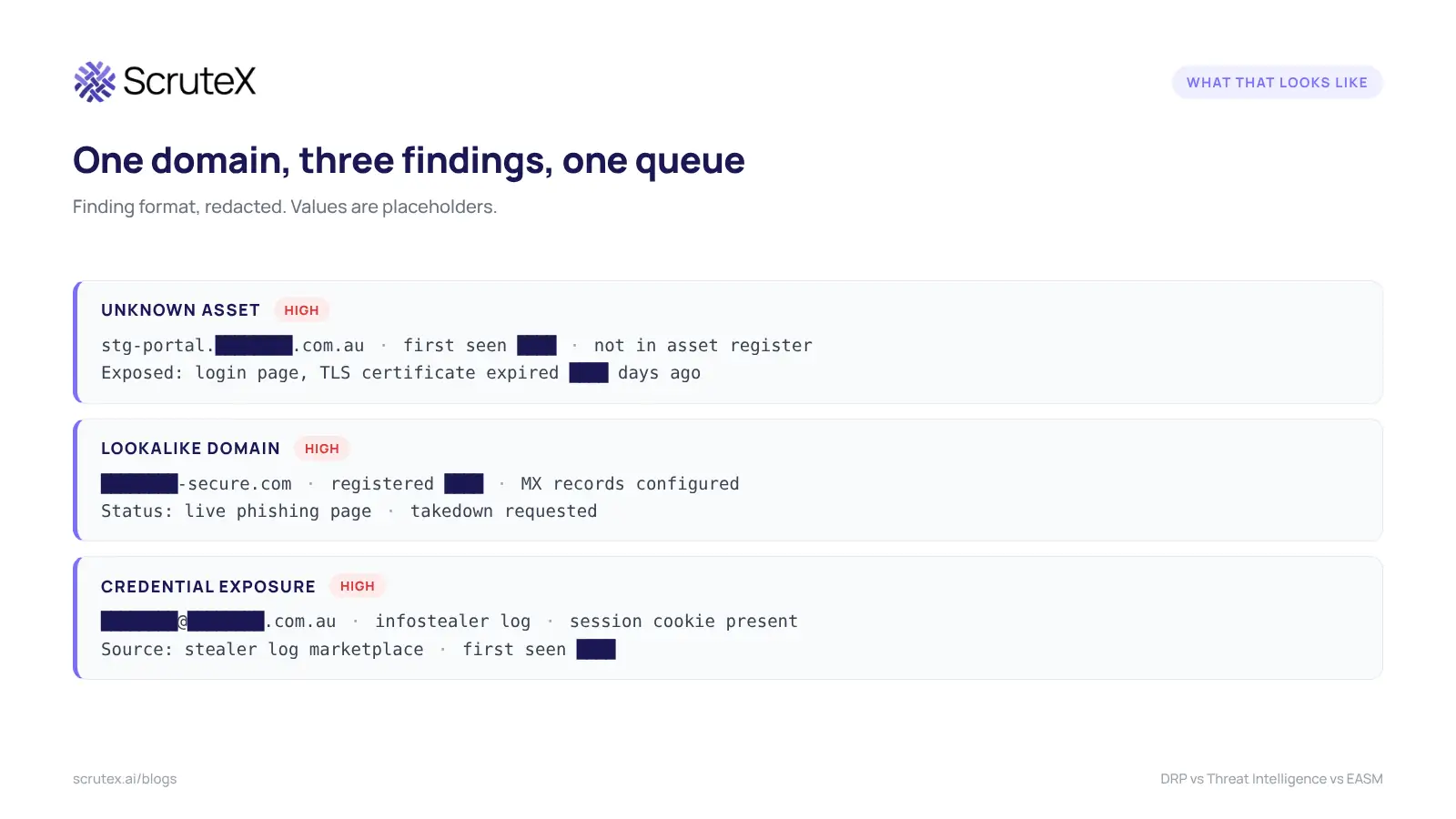
At one ASX-listed financial services client, the first ScruteX scan returned 30+ internet-facing assets against a 20-asset manual register. Nine were unknown, including a staging environment for a client-facing app. Over the next twelve months ScruteX detected seven lookalike domains; three were live phishing pages with mail records configured, and takedown averaged five business days. Median credential exposure detection across the same 12-month deployment was 1.8 days, down from 26.
A single domain's findings arrive in one queue. The format looks like this (values redacted and replaced with placeholders):
Which gap do you have? Check it on your own domain
ScruteX offers three free scans. Each starts from your domain on the free tier: you sign up, with no credit card. Pick the one that matches your answer to the First-Purchase Test:
- If question 1 pointed to EASM: See what an attacker sees on your domain.
- If question 3 pointed to credential exposure: Check whether your logins and sessions are already on the dark web.
- If question 2 pointed to brand abuse: Find lookalike domains and fake apps using your name.
ScruteX works from the outside only. It will not tell you whether an internal server is patched or whether a laptop is infected, until data stolen from that laptop shows up outside your network. Takedown is coordinated, not guaranteed: registrar and platform response times vary by jurisdiction.
Where to go next
- If asset visibility is your gap: Vulnerability Insights, continuous discovery of your internet-facing assets, prioritised by real-world exploitability.
- If impersonation is already reaching your customers: Brand Insights, lookalike domains, rogue apps, fake profiles and takedown assistance.
- If you want the full picture on DRP: What Is Digital Risk Protection (DRP)? goes deeper on each DRP capability.
- If your real question is internal versus external asset coverage: ASM vs EASM vs CAASM.
Frequently asked questions
Is DRP part of threat intelligence?
Gartner now lists DRP monitoring as a mandatory feature of cyberthreat intelligence technologies, so analysts treat it as part of that market. In practice they do different jobs. DRP finds and removes abuse of your brand and data. Threat intelligence explains adversary behaviour and helps you prioritise.
What is the difference between EASM and DRP?
EASM finds the internet-facing assets you own and the exposures on them. DRP finds threats outside your infrastructure, such as lookalike domains, fake apps and leaked credentials.
Do I need threat intelligence if I already have EASM?
Usually, eventually. EASM tells you what is exposed. Threat intelligence tells you which of those exposures attackers are exploiting now, which turns a long patch list into a short one.
Which should a small security team buy first?
Run the First-Purchase Test. Asset visibility is a common starting point. Active brand abuse, unknown credential exposure or a named threat to your sector can change that.
Can one platform cover DRP, threat intelligence and EASM?
Several platforms now cover all three. Test each capability separately on your own domain before you commit.