ASM vs EASM vs CAASM: What Each One Actually Does
By ScruteXPublished
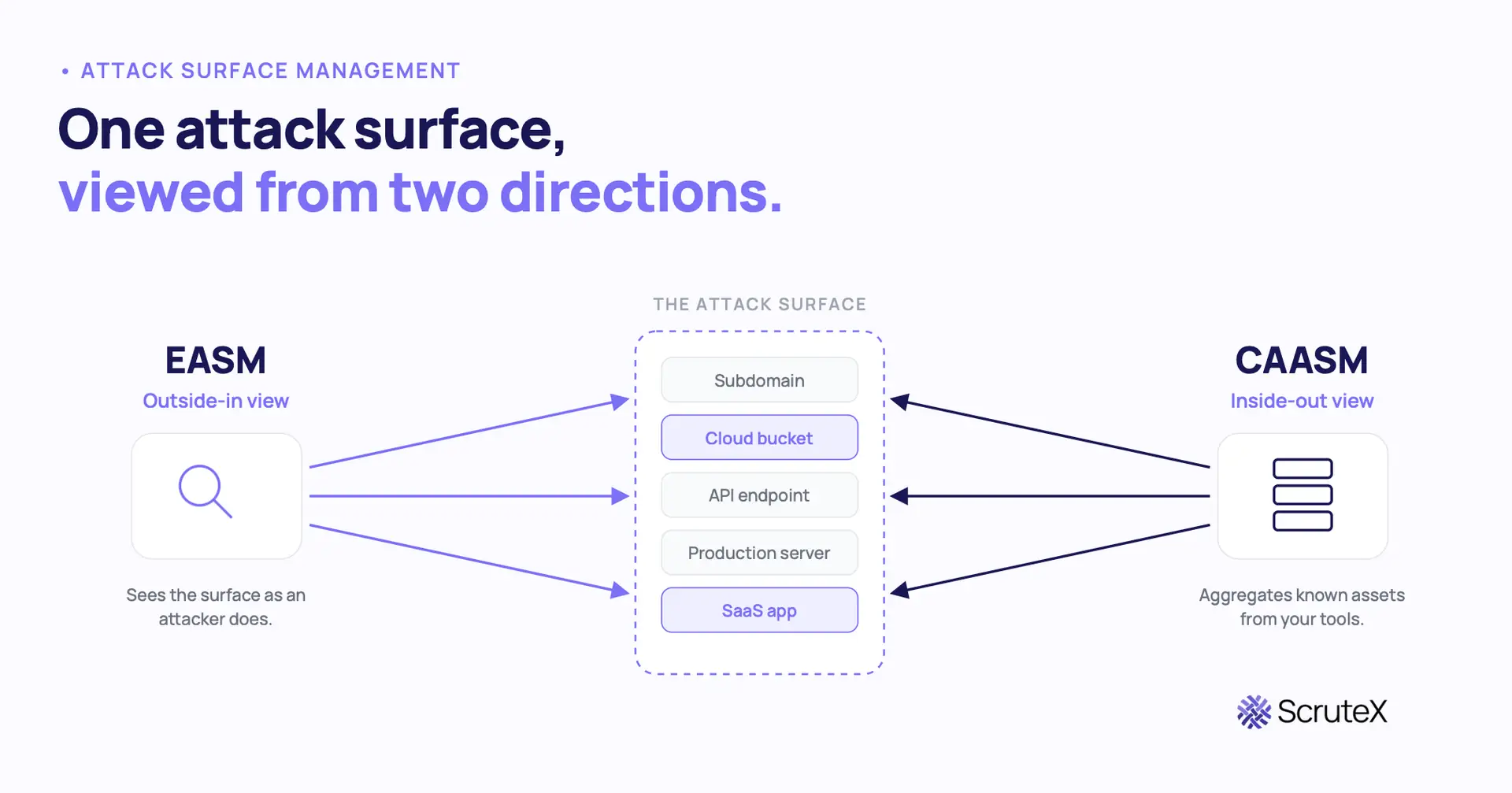
A security team buys an EASM tool, switches it on, and feels covered. Three months later the auditor asks one question: do all our production servers have EDR running? The tool has no idea. It was never built to know.
That is the cost of treating ASM, EASM, and CAASM as the same purchase. They are not. All three deal with one idea, knowing what you own and what is exposed, but they answer different questions, look from opposite directions, and miss different things. Buy the wrong one and you leave open the exact blind spot the right one would have closed.
This guide defines each category, shows what it does in practice, maps where they overlap, and sets out which one fits which situation.
The short version: ASM is the umbrella. EASM is the outside-in attacker view. CAASM is the inside-out coverage view. Mature programs run both.
Why this works: it leads with a scenario the buyer recognises, then names the stakes, then hands over the roadmap. The audit question is also a real CAASM question, so the hook quietly previews the buyer mistake the article covers later.
In This Post
- Quick definitions
- What EASM actually does
- What CAASM actually does
- Where the three overlap
- When to use which
- What "ASM" tools add beyond both
- Common buyer mistakes
- Key takeaways and FAQ
Quick definitions: ASM vs EASM vs CAASM
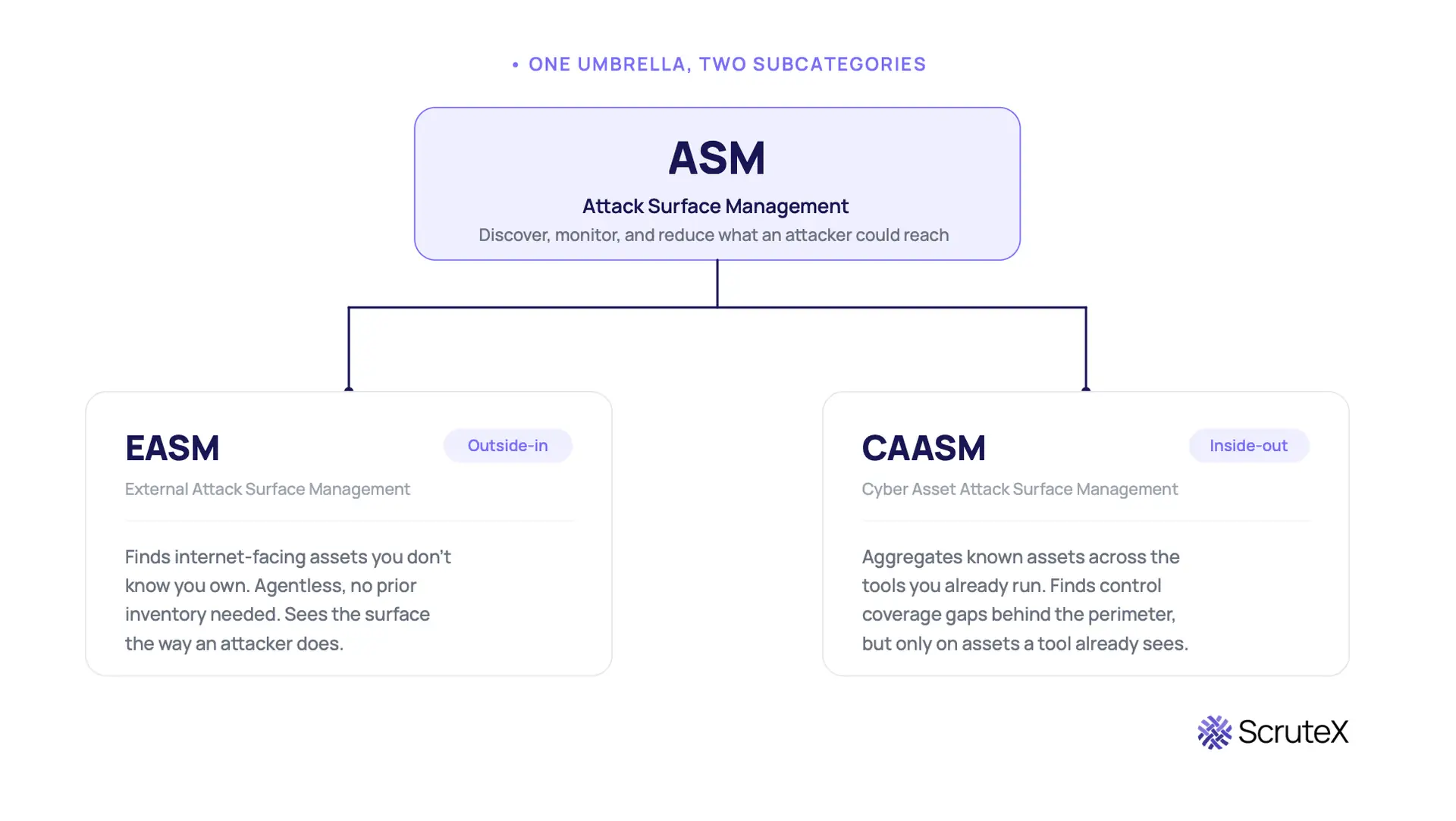
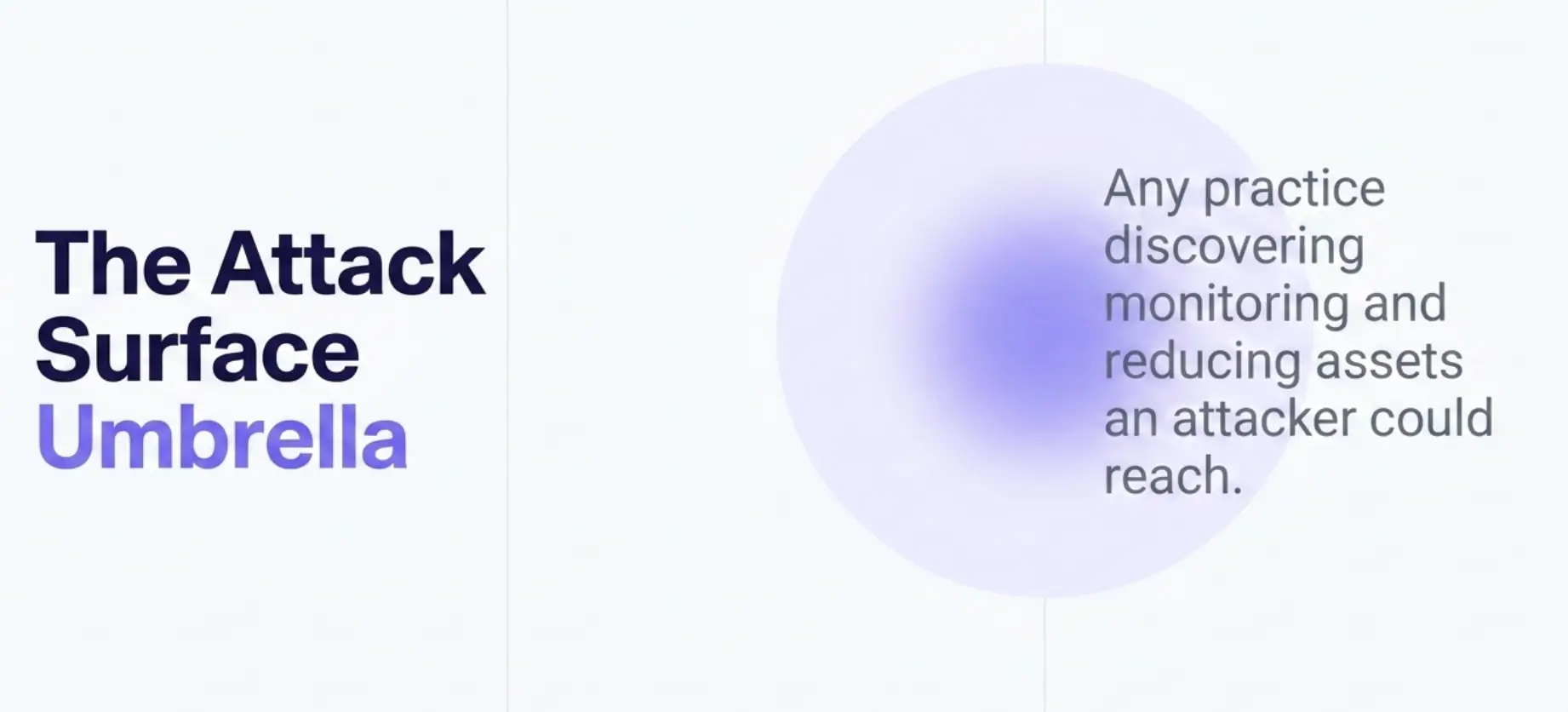
- ASM (Attack Surface Management): the umbrella. Any practice or tool focused on discovering, monitoring, and reducing the assets an attacker could reach.
- EASM (External Attack Surface Management): the outside-in view. Discovers internet-facing assets without agents, often without prior knowledge of what the organisation owns. Sees the surface as an attacker does.
- CAASM (Cyber Asset Attack Surface Management): the inside-out view. Aggregates asset and security data through the APIs of tools you already run (CMDB, EDR, CSPM, IAM, scanners) into one view of known assets and their security state.
EASM and CAASM are both subsets of ASM. The distinction that matters is the direction of view.
What EASM actually does
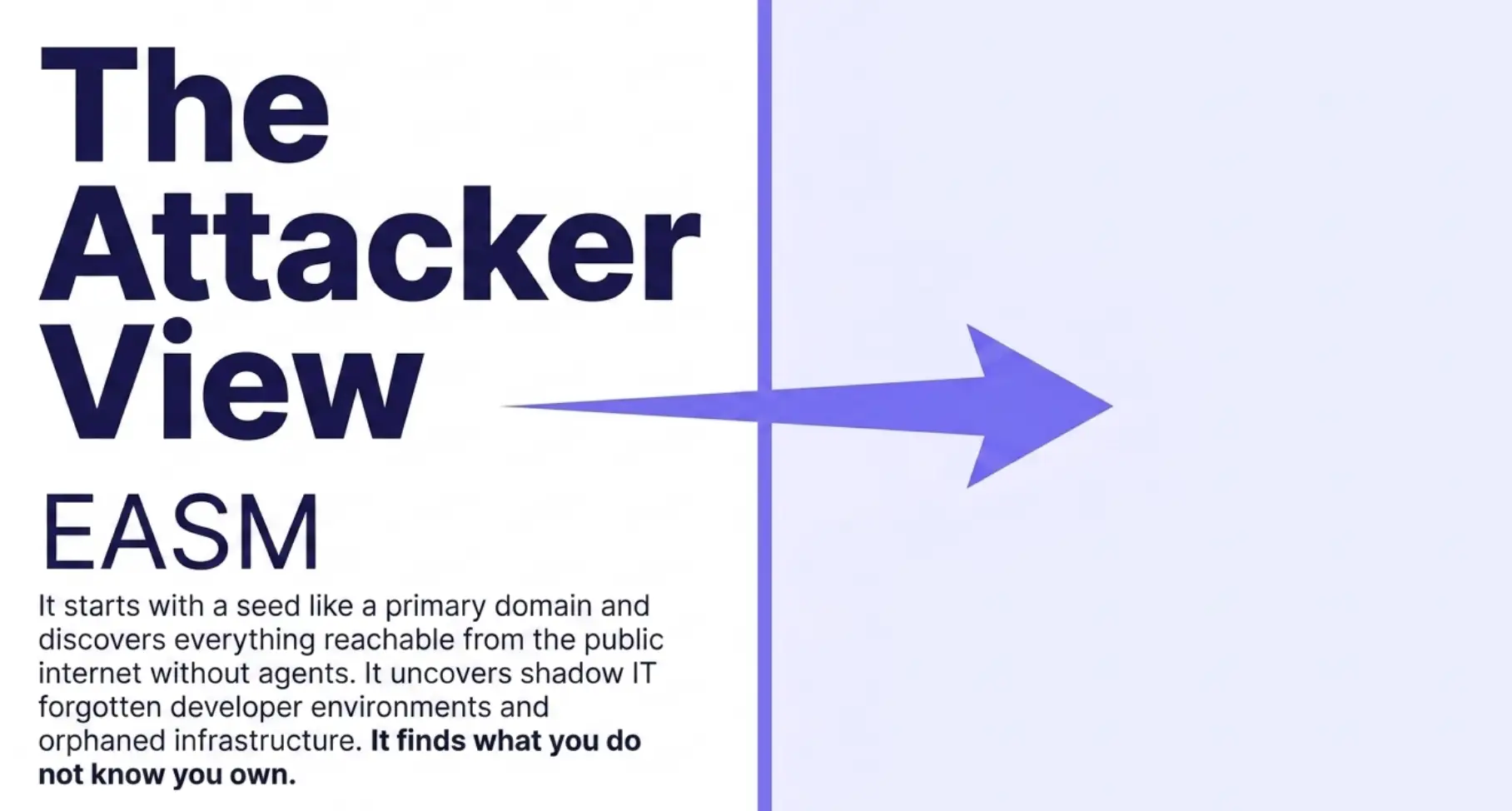
EASM starts with a seed, a primary domain, a company name, a few keywords, and discovers everything reachable from the public internet that belongs to the organisation. It does this without agents and usually without a prior inventory.
Typical findings include subdomains the security team did not know about (shadow IT, dev environments, marketing micro-sites), IP ranges and reverse DNS, exposed services and ports, TLS certificate posture and expiry, cloud storage buckets and exposed databases, orphaned assets inherited through acquisitions, public code repositories tied to the organisation, exposed admin panels and APIs, and the third-party services in use.
EASM's strength is that it sees what your scanners cannot, because scanners only check what you tell them to check. EASM finds what you do not know you own. Its weakness is that it only sees the outside. It cannot tell you whether a server is internally segmented or whether a database has encryption at rest.
Gartner treats EASM as the combination of process, technology, and managed services that finds an organisation's internet-facing assets and flags the exposures attached to them. It emerged as a distinct Gartner category around 2021.
What CAASM actually does
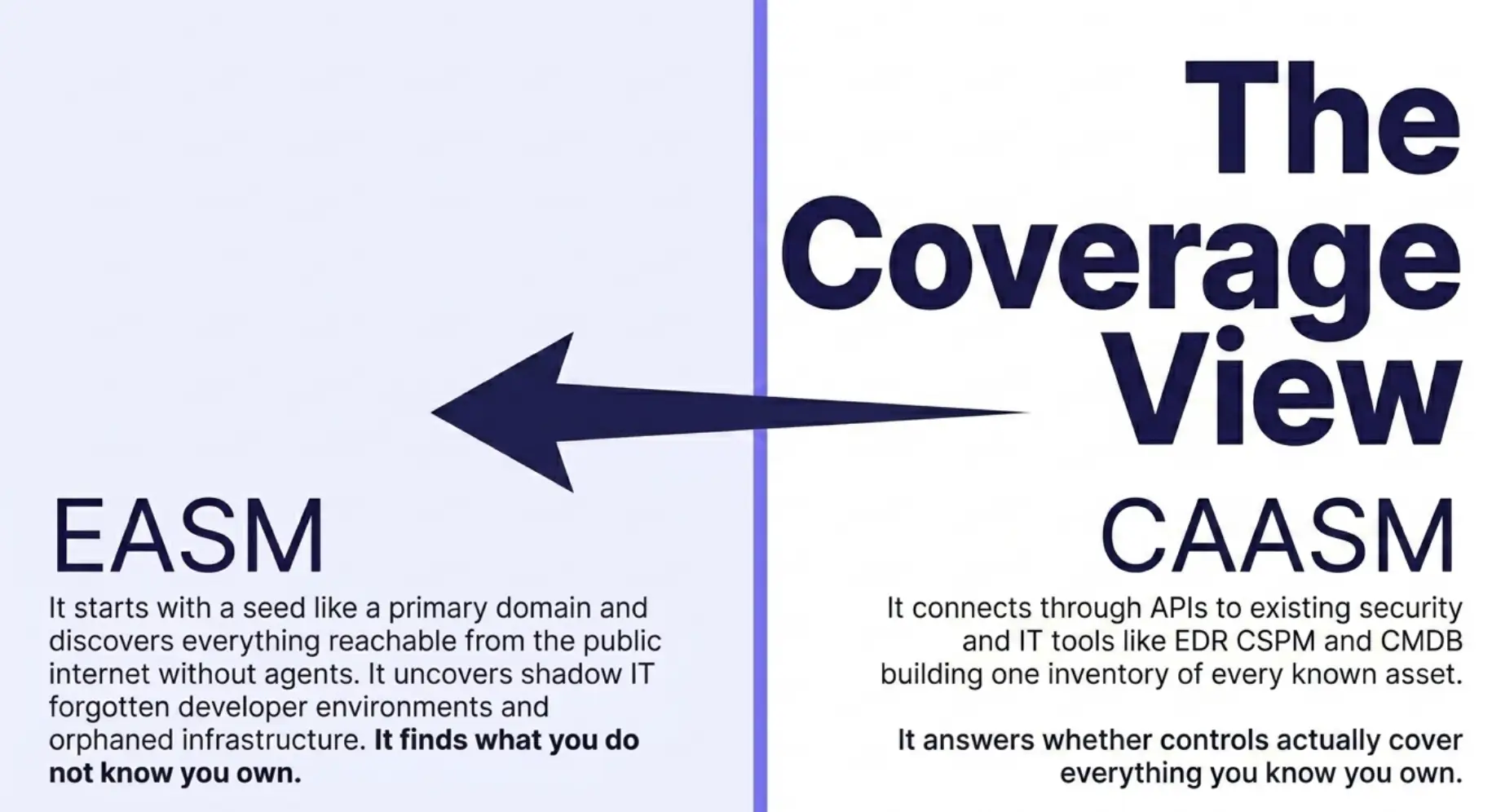
CAASM takes the opposite approach. It connects through APIs to the security and IT tools you already run (EDR, CSPM, CMDB, AD, IAM, scanners, ticketing, SaaS posture, cloud accounts) and builds one inventory of every known asset, with security context attached.
Typical outputs include a single asset inventory across cloud, endpoint, server, identity, SaaS, and on-premises; coverage-gap reports ("this asset is in the CMDB but has no EDR, no scan, no backup"); compliance posture per asset across frameworks; asset-to-owner mapping; and a query interface that answers questions like "show every production Windows server with no MFA on its admin account."
CAASM's strength is stitching together the internal view across tools that do not talk to each other. It answers "do my controls actually cover everything I know I own?" Its weakness is that it only sees assets already present in some source system. If an asset is in no tool, CAASM cannot see it, by definition.
Gartner introduced CAASM as a category in its 2021 Hype Cycle for Network Security and has tracked it since.
Where ASM, EASM, and CAASM overlap
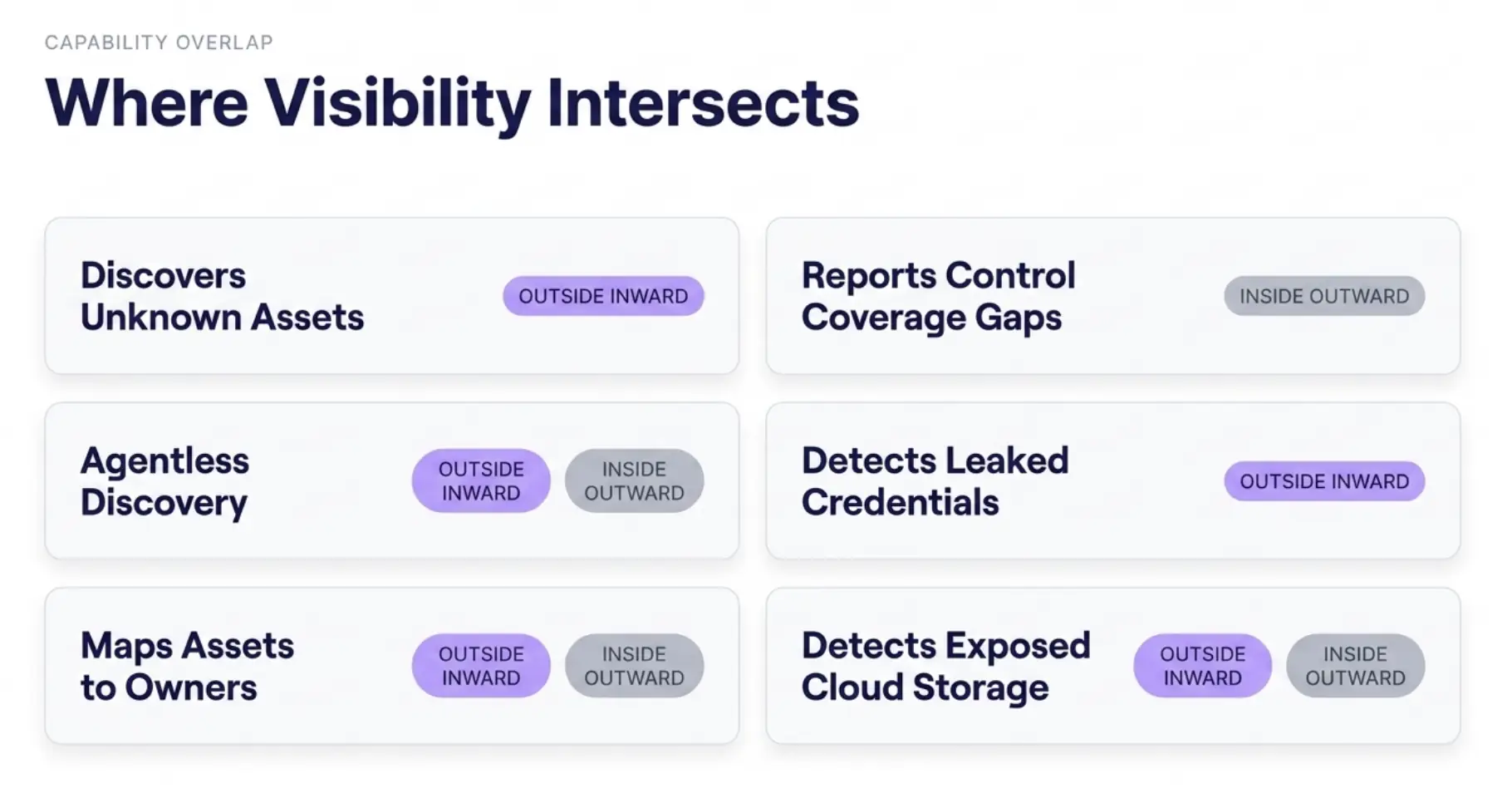
The overlap zone is where most vendor confusion lives. Several tools sit in two or three categories at once.
| Capability | ASM (umbrella) | EASM | CAASM |
|---|---|---|---|
| Discovers unknown internet-facing assets | Yes | Yes | No |
| Aggregates known assets across internal tools | Yes | Limited | Yes |
| Agentless | Often | Yes | Yes |
| Sees behind the firewall | Varies | No | Yes |
| Detects exposed cloud storage | Yes | Yes | If integrated with CSPM |
| Detects leaked credentials | Often | Often | Rarely |
| Identifies shadow IT not in CMDB | Yes | Yes | No |
| Maps assets to owners | Yes | Partially | Yes |
| Reports control coverage gaps | Sometimes | No | Yes |
| Validates exploitability | Sometimes | Sometimes | Rarely |
EASM and CAASM share asset visibility. They differ in direction. EASM looks in from the internet. CAASM looks out from your tool stack.
When to use which
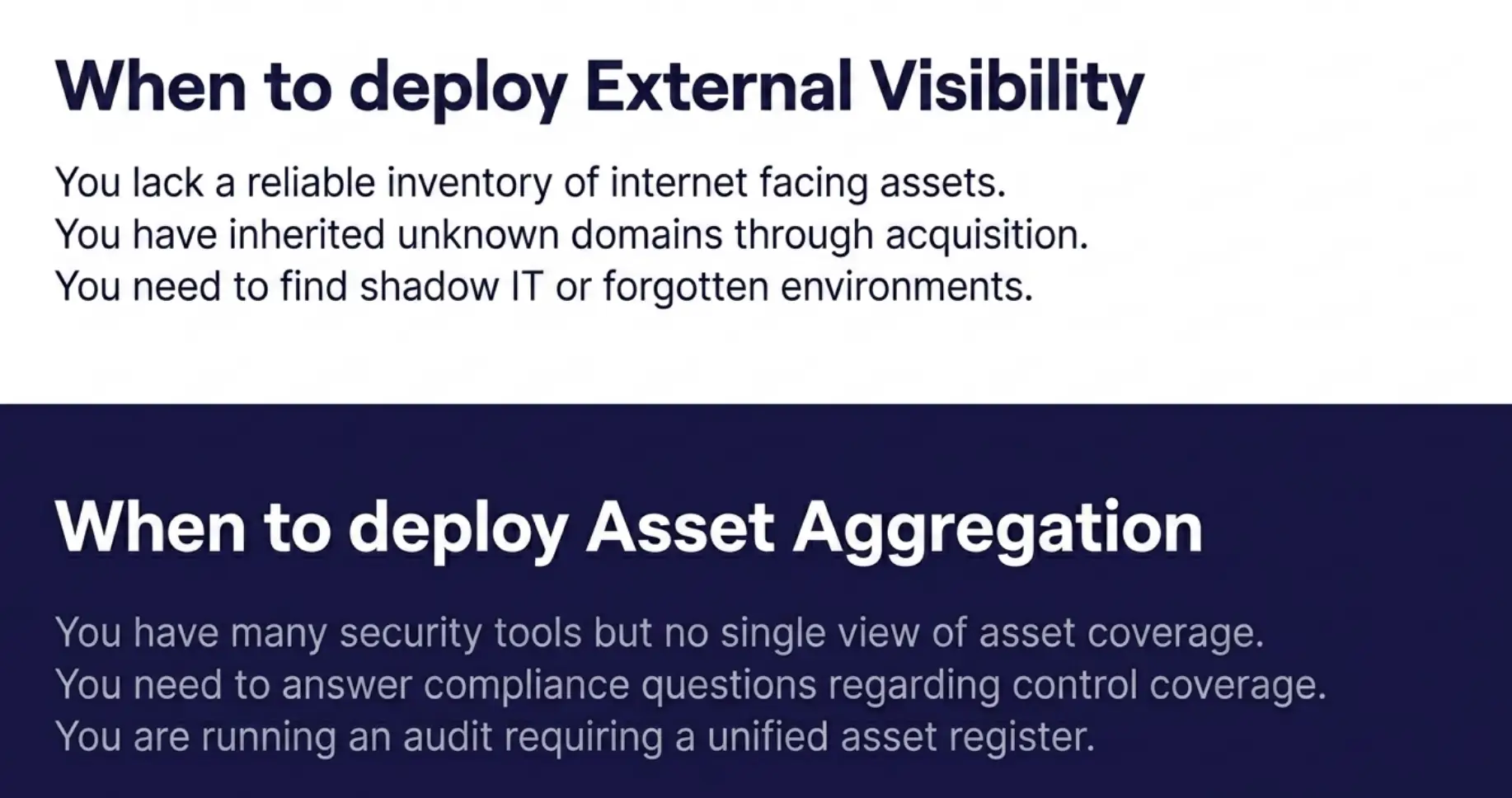
Use EASM when you lack a reliable inventory of internet-facing assets, you have grown through acquisition and inherited unknown domains and infrastructure, you want an attacker's view rather than an inventory view, you need to find shadow IT or forgotten dev environments, or you want continuous monitoring for newly exposed assets.
Use CAASM when you have many security tools but no single view of asset coverage, you need to answer compliance questions like "are all production servers covered by EDR," you want to find assets that exist in one tool but are missing from another, or you are running an audit and need a unified asset register with security context.
Use both when you are running a CTEM program (Stage 2 discovery benefits from both: EASM for the unknown, CAASM for the known), or you have a mature program and want to reduce blind spots on both sides of the perimeter. See the CTEM five-stage framework for where each fits.
What "ASM" tools add beyond EASM and CAASM
Some products marketed as ASM go past what either does alone. The extensions usually cover continuous exposure monitoring rather than one-time discovery, risk-based prioritisation that blends external exposure with internal context, integration with threat intelligence and dark web monitoring, brand abuse and typosquatting detection, leaked credential and data exposure monitoring, and third-party exposure tracking.
The category that combines these is sometimes called external security or grouped under CTEM, depending on the vendor. Gartner's CTEM framework treats EASM and CAASM as building blocks for the discovery stage of a larger program rather than as the program itself.
This is also where attack surface management stops being only about the company. A typosquatted domain or a fake mobile app is an external asset that targets the organisation's customers, not its servers. Finding and taking it down protects people who never see the security team's work. Pure EASM and pure CAASM rarely cover this. It sits in the broader external-security set.
Common buyer mistakes
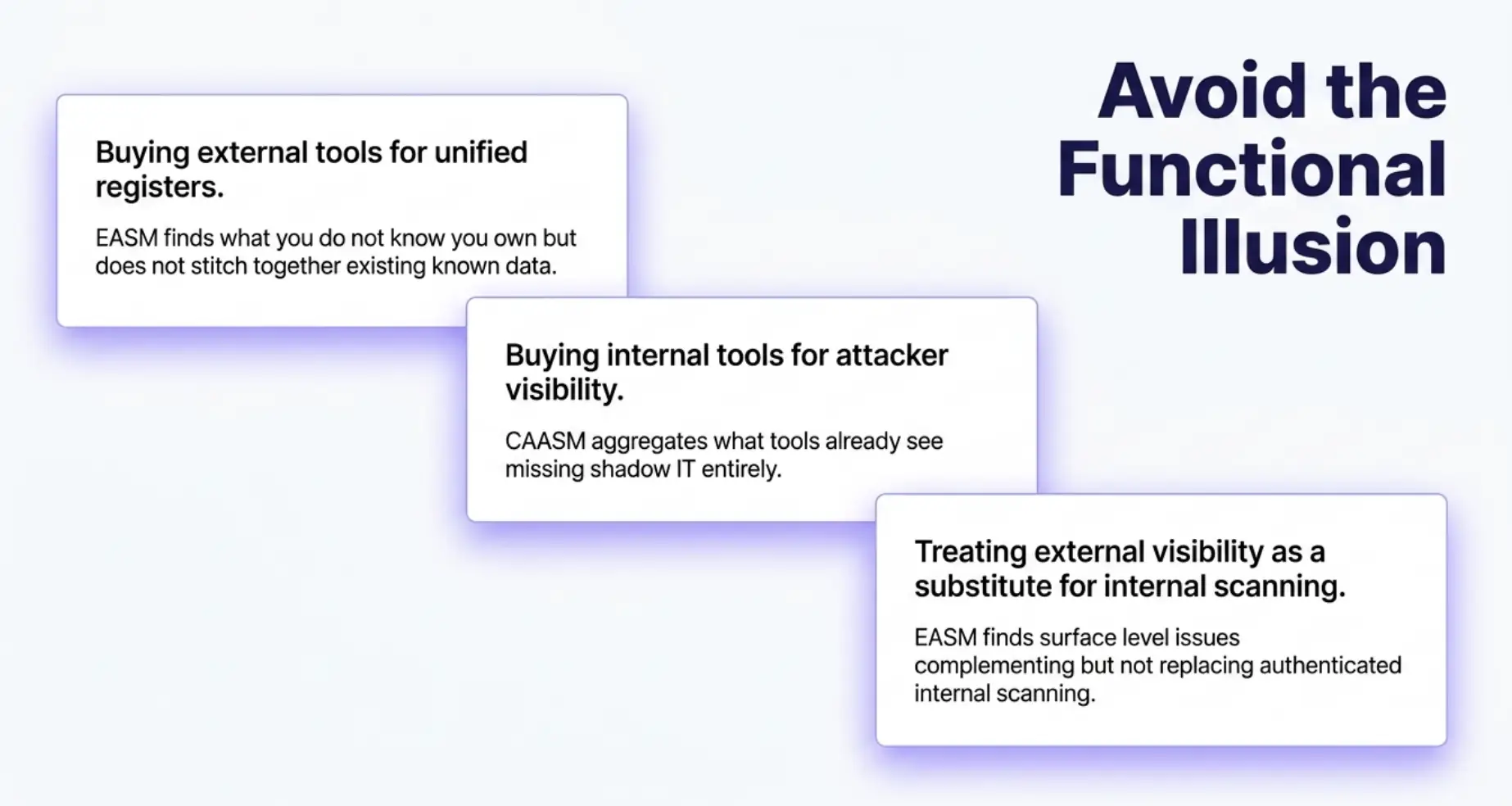
Three patterns recur in buying conversations.
Buying EASM and expecting a unified asset register. EASM finds what you do not know you own. It does not stitch together what you do know. If you need that, you need CAASM or a CAASM-like layer.
Buying CAASM and expecting attacker visibility. CAASM aggregates what your tools already see. It does not show what they miss, and the most common miss is shadow IT, which CAASM cannot see by definition.
Treating EASM as a replacement for vulnerability scanning. EASM finds exposed assets and surface-level issues. It is not a substitute for authenticated scanning on internal systems. The two complement each other.
Key takeaways
- ASM is the umbrella. EASM and CAASM are subsets that solve different problems.
- EASM gives an outside-in attacker view and finds what you do not know you own.
- CAASM gives an inside-out coverage view and finds gaps across known assets.
- Mature programs use both; CTEM's discovery stage needs both views.
- The most common buyer mistake is expecting one category to do the other's job.
Where ScruteX fits
ScruteX sits on the EASM and external-exposure side: agentless discovery of internet-facing assets, dark web monitoring for leaked data and credentials, brand abuse detection, and third-party exposure tracking. It is built to feed a broader CTEM program, not to replace internal CAASM or authenticated vulnerability tooling, which still have their own jobs. See scrutex.ai for module details.
EASM, CAASM, and CTEM are categories defined by Gartner, Inc. GARTNER is a registered trademark and service mark of Gartner, Inc. and/or its affiliates and is used herein with attribution. This article is not endorsed by Gartner.
Frequently Asked Questions ?
Q: What is the difference between ASM and EASM?
A: ASM is the umbrella term for attack surface management. EASM is a subcategory focused on the external, internet-facing surface, using an outside-in view that usually starts from a seed like a domain and discovers related assets without agents.
Q: What is the difference between EASM and CAASM?
A: EASM discovers internet-facing assets from an attacker's perspective and finds what you do not know you own. CAASM aggregates data from your existing security and IT tools to build a unified inventory of what you do know, including coverage gaps across those tools.
Q: Can one tool replace both EASM and CAASM?
A: Some platforms cover parts of both, but the methods differ. EASM uses external scanning and OSINT. CAASM uses API integrations with your internal stack. Most organisations run one of each, or a CTEM platform that includes both layers.
Q: Is CAASM the same as a CMDB?
A: No. A CMDB is a database of known assets, usually maintained manually or by limited discovery. CAASM aggregates from the CMDB plus other tools (EDR, CSPM, IAM, scanners) and adds security context per asset. It complements a CMDB; it does not replace it.
Q: Where does EASM fit in a CTEM program?
A: EASM is a primary tool for Stage 2 (discovery). It finds external assets and exposures that internal tools cannot see. Stage 3 (prioritisation) then combines that output with threat intelligence and business context.
Q: Do I need EASM if I already run external vulnerability scans?
A: Yes, if your scans only run against a known IP list. EASM discovers assets you have not added to that list, including shadow IT, acquired infrastructure, and forgotten dev environments. External scanning is a complement, not a substitute.