Pastebin Leaks: How Company Data Reaches Paste Sites and How to Detect It Before Attackers Do
By ScruteXPublished
Most security teams find out about a credential leak from a third party. A customer, a bank, a regulator, or the attacker who already used it. By then the useful window has closed.
The sequence rarely varies. A credential gets stolen from an endpoint. It sits in a log file. A sample goes public to advertise the rest. It gets aggregated, sold, tested, and eventually used. Weeks pass between the first step and the last. That gap is the only structural advantage defenders have in this whole chain, and most organisations spend it unaware the clock is running. Leaked credentials are not the aftermath of a breach. They are the warning that precedes one.
A Pastebin leak is company data posted to a public text-sharing site, most often credentials, API keys, tokens, or database extracts, where anyone can read it without authentication. Paste sites are used as a distribution layer: attackers publish samples to prove a breach, advertise a larger dataset, or hand off data between operators. The exposure is public, indexed, and usually short-lived, which is why detection speed decides the outcome.
This post covers how data gets there, what attackers do with it, why the standard advice to "monitor Pastebin" no longer works the way people think, and what a working detection process looks like in 2026.
What is a paste site, and why do attackers use one?
A paste site stores plain text at a public URL. Pastebin, running since 2002, is the best known. Developers use these sites to share log output, config snippets, and stack traces without email or chat mangling the formatting. No account is needed to post. No account is needed to read.
Those same properties make paste sites useful to attackers:
- No attribution. A guest paste carries no account. Pastebin's own FAQ notes that content posted as a guest has no quick delete option, which cuts both ways: the poster cannot pull it back either.
- Instant public reach. A URL works immediately, in any browser, with no Tor, no invite, and no marketplace registration.
- Search engine indexing. Pastebin states that search engines index public pastes. A dump can surface in Google results before any security team notices it.
- Expiry as an anti-forensics feature. A paste can be set to expire, which limits how long defenders and researchers can collect it while the intended audience has already taken a copy.
The result is a low-friction handoff point that sits on the surface web, not the dark web. That distinction matters more than most articles admit, and it changes how you detect it.
How does company data end up on paste sites?
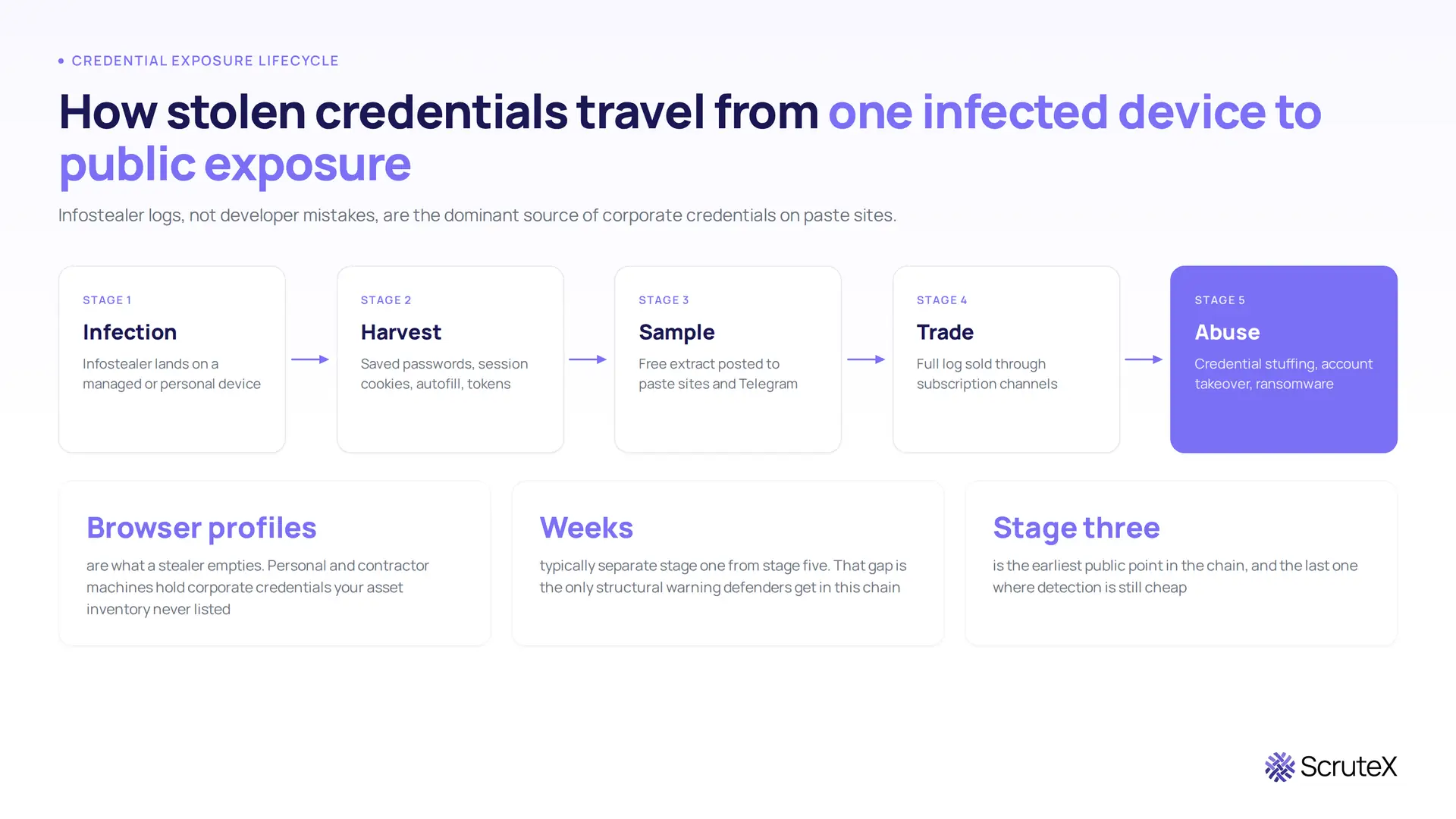
Company data reaches paste sites through six routes. They are not equally common, and treating them as equal is where most monitoring programmes waste effort.
1. Infostealer logs. This is the dominant supply line. Malware such as the RedLine, Lumma, and Vidar families harvests browser-saved passwords, session cookies, autofill data, and crypto wallets from an infected machine, then packages it as a log file. Operators publish free samples publicly to advertise paid access to the full set. The uncomfortable part is where the infection sits. A stealer takes whatever is in the browser profile on that machine, and a large share of corporate credentials live in browser profiles on personal laptops, home desktops, and contractor devices. Your endpoint controls never saw those machines, your asset inventory does not list them, and no amount of hardening on managed devices changes what is stored on the unmanaged ones.
2. Credential stuffing combo lists. Aggregators merge credentials from dozens of historical breaches into a single list, then post fragments publicly to demonstrate freshness. The list itself is often worthless. Password reuse is what gives it value. An employee's password from a retail breach five years ago becomes a live corporate credential the moment they reused it, which means a breach you had no involvement in becomes your incident.
3. Developer error. A stack trace pasted to get help, with a connection string still in it. A config file shared to debug a deployment, with the API key intact. This is a real source, but it is far smaller than the market assumes, and building your entire programme around it means missing the other 80%.
4. Hacktivist and extortion proof-of-life posts. Groups post a sample of stolen records to prove a claim before the full dump goes to a leak site. In geopolitically active regions, this is often the first public signal that an organisation has been hit.
5. Third-party and vendor compromise. Your data leaks through someone else's environment. A payroll provider, a marketing agency, a support contractor. Your name appears in a paste even though nothing in your perimeter failed, and you find out from the paste rather than from the vendor.
6. Automated exfiltration. Some malware families write stolen data directly to web services rather than to attacker infrastructure, mapped in MITRE ATT&CK as T1567, Exfiltration Over Web Service. Traffic to a well-known paste domain looks unremarkable in netflow.
What data appears in pastes, and what does it cost you?
The data type determines the clock. Some exposures give you days. Some give you hours.
| Data type | What an attacker does with it | ATT&CK reference | Practical response window |
|---|---|---|---|
| Employee passwords | Credential stuffing, account takeover | T1110.004, T1078 | Hours to days |
| Session cookies and tokens | MFA bypass through session hijacking | T1539, T1550.004 | Hours. MFA does not stop this |
| Cloud access keys | Resource abuse, privilege escalation, data theft | T1552.001, T1078.004 | Minutes to hours |
| SSH and VPN credentials | Direct remote access, lateral movement | T1078, T1133 | Hours |
| Database connection strings | Bulk record theft | T1552.001 | Hours |
| Source code fragments | Recon for hardcoded secrets and logic flaws | T1213.003 | Days |
| Internal hostnames and URLs | Target mapping before an intrusion | T1590 | Days to weeks |
| Customer records | Fraud, phishing, regulatory exposure | T1213 | Reporting clock starts immediately |
Two rows deserve emphasis because they are routinely misread.
Session cookies bypass MFA. A stolen valid session token authenticates without a password and without a second factor. Rotating the password does not invalidate an active session on most platforms. You have to revoke the session explicitly. Teams that respond to an infostealer exposure with a password reset alone have closed one door and left another open.
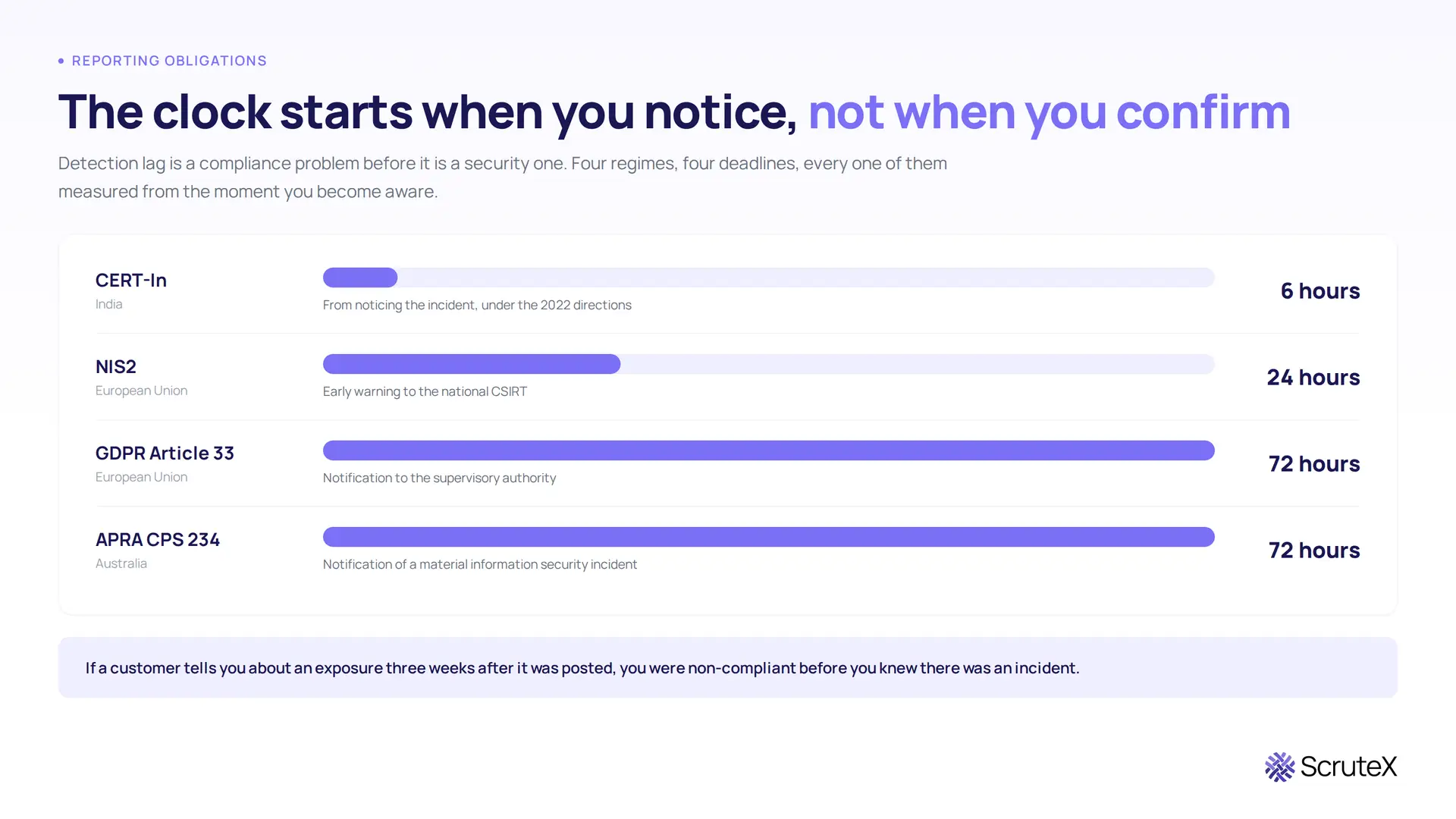
Customer records start a regulatory clock, not a technical one. Under CERT-In's 2022 directions, Indian organisations must report certain cyber incidents within six hours of noticing them. APRA CPS 234 requires notifying APRA within 72 hours of a material information security incident. NIS2 expects an early warning within 24 hours. GDPR Article 33 sets 72 hours. If your detection lag is measured in weeks, you were non-compliant before you knew there was an incident.
Why attackers post to Pastebin as well as steal from it
Paste sites are not only where stolen data lands. They are also live attack infrastructure, and this is the part most explainer articles skip entirely.
MITRE ATT&CK documents technique T1102.001, Dead Drop Resolver. Malware on a compromised host fetches a public paste containing an encoded command and control address, then connects to the real C2 elsewhere. The paste is a pointer, rotated whenever the C2 moves. MITRE records APT41 using GitHub, Pastebin, and Microsoft TechNet this way, the Rocke group hosting encoded configuration data on Pastebin, and PlugX retrieving stored C2 addresses from it.
The defensive problem is that this hides in plain sight. From your egress logs, an infected host talking to a dead drop resolver looks exactly like a developer reading a paste. It is TLS traffic to a domain your network already communicates with daily. MITRE's mapped mitigations, M1021 Restrict Web-Based Content and M1031 Network Intrusion Prevention, both come with real operational friction, which is why most organisations do not apply them.
The practical takeaway for a SOC: outbound traffic to paste domains deserves process-level context, not domain-level allow or block decisions. A browser reaching pastebin.com is routine. A signed system binary or an unexpected scripting host doing it, on a schedule, is not.
Why monitoring Pastebin alone no longer works
"Monitor Pastebin for your domain" is advice from 2015 that has been quietly obsolete for years. Four things changed.
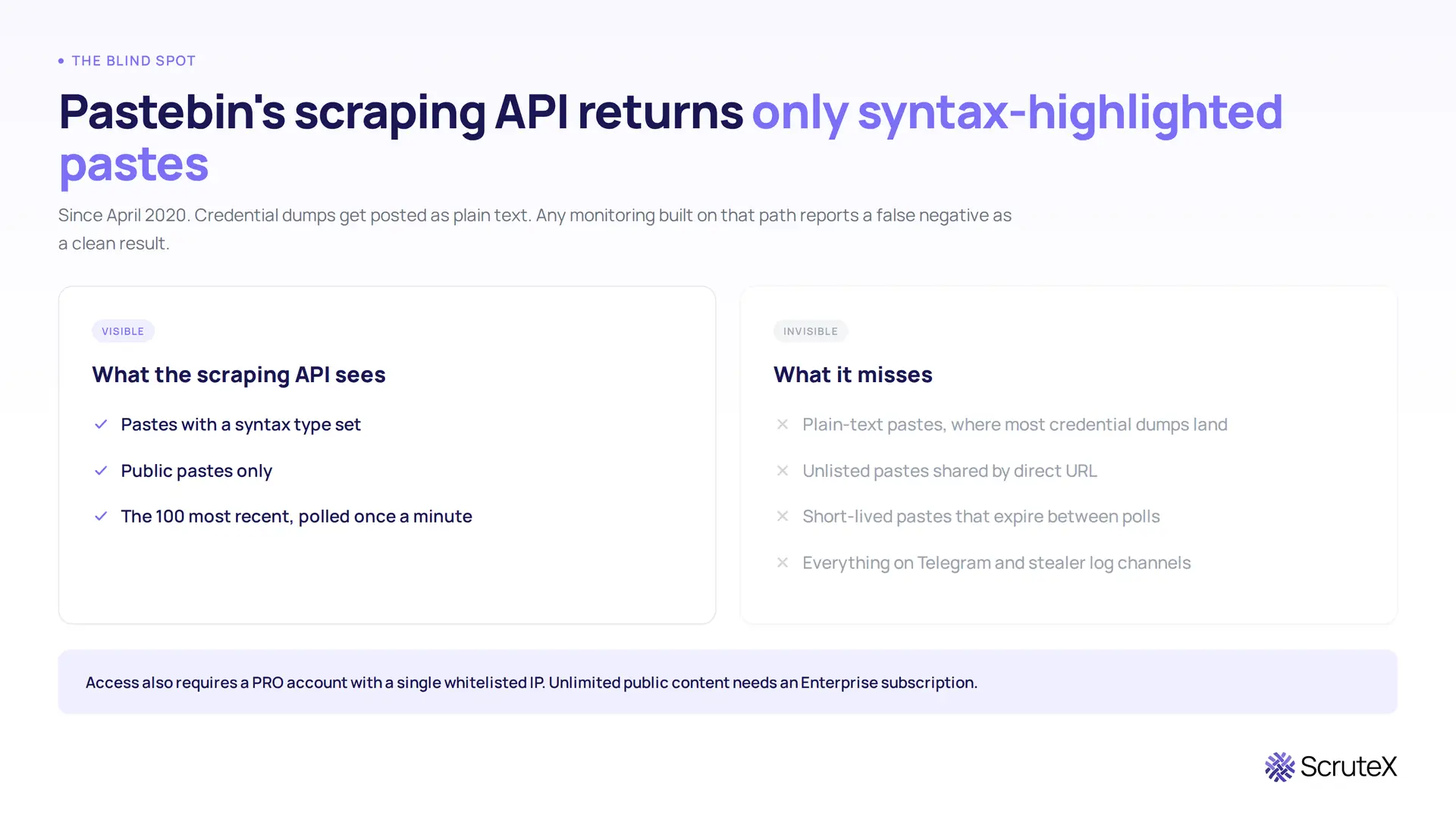
The scraping API is gated and partially blind. Pastebin's scraping API requires a PRO account with a single whitelisted IP address per account, and its documentation states that scraping the site outside those endpoints will get the IP blocked. More importantly, since a change in April 2020 the scraping API returns only pastes with syntax highlighting set. A credential dump posted as plain text, which is how most of them are posted, does not appear in that stream at all. Unlimited access to public content requires an Enterprise API subscription. Any tool or script built on the free or PRO scraping path is watching a filtered subset and reporting silence as safety.
Unlisted pastes never enter the public stream. Pastebin supports public, unlisted, and private visibility. An unlisted paste is readable by anyone with the URL but does not appear in public listings. Shared over Telegram or a forum, it reaches its audience while remaining invisible to anyone polling the recent-pastes endpoint.
Expiry beats polling frequency. Pastebin's own guidance suggests listing the 100 most recent pastes once per minute. On a high-volume site, a short-lived paste can be created, consumed, and expired between two polls. Collection has to be continuous and redundant, not periodic.
The audience moved. Distribution shifted heavily toward Telegram channels and dedicated leak sites, accelerating after law enforcement action against underground forums including BreachForums between 2024 and 2026. A credential dump that once took days to circulate on a Tor forum now reaches tens of thousands of Telegram subscribers in minutes. Stealer log channels run on a subscription model, publishing free samples to sell fresher logs.
None of this means paste sites stopped mattering. It means a paste-only programme measures a shrinking slice of your exposure and produces a false negative that is worse than no monitoring at all, because it is reported to leadership as a clean result.
Where leaked data actually circulates now
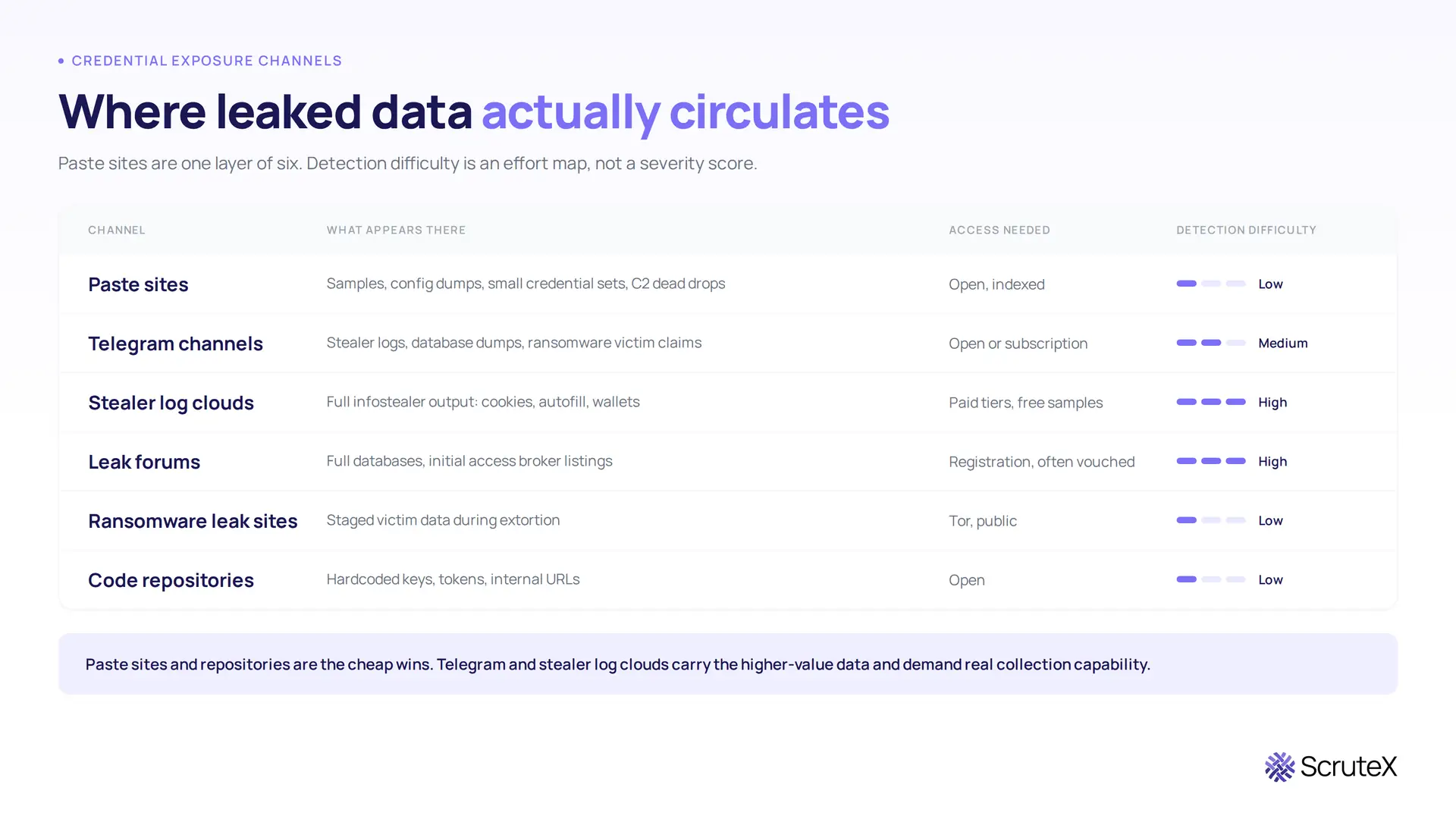
| Channel | What appears there | Access | Detection difficulty |
|---|---|---|---|
| Paste sites | Samples, config dumps, small credential sets, C2 dead drops | Open, indexed | Low, if collection is continuous and unfiltered |
| Telegram channels | Stealer logs, database dumps, ransomware victim claims | Open or subscription, high churn | Medium. Channels rotate names constantly |
| Stealer log clouds | Full infostealer output: cookies, autofill, wallets | Paid tiers, free samples | High. Requires sustained access and tradecraft |
| Leak forums | Full databases, initial access broker listings | Registration, sometimes vouched | High. Takedowns force frequent migration |
| Ransomware leak sites | Staged victim data during extortion | Tor, public | Low to find, but exposure is already advanced |
| Code repositories | Hardcoded keys, tokens, internal URLs | Open | Low, and best caught by secret scanning |
Read the last column as an effort map. Paste sites and repositories are the cheap wins, and no organisation should be missing them. Telegram and stealer log clouds carry the higher-value data and demand real collection capability, which is the honest argument for buying rather than building this layer.
Pastebin monitoring vs dark web monitoring: what is the difference?
Paste site monitoring watches the surface web. Dark web monitoring watches Tor-based forums and markets. They surface different stages of the same lifecycle, and treating either as a substitute for the other leaves a gap.
| Paste site monitoring | Dark web monitoring | |
|---|---|---|
| Where it looks | Public, indexed text sites | Tor forums, markets, closed communities |
| Access needed | HTTP, plus API subscription for full coverage | Persona management, vetted access, tradecraft |
| Typical stage in the lifecycle | Early sample, advertisement, handoff | Sale, bulk trade, extortion staging |
| Data volume per item | Small: a sample or fragment | Large: full databases, log archives |
| Time from post to notice | Minutes to hours, if collection is continuous | Days to weeks |
| Main failure mode | Filtered collection, false negatives | Access loss after a takedown or migration |
The sequence usually runs: infostealer infection, then log sale or free sample, then aggregation into a combo list, then use. A paste often marks the earliest public point in that chain. Dark web collection catches it later but with far more context about who holds the data and what they intend to do with it. You want both, and you want them correlated against the same asset inventory, or you will spend your week triaging the same identity three times from three tools.
Paste monitoring vs GitHub secret scanning: which catches what?
These get compared often, and they are not competitors. They cover different halves of the same problem.
| GitHub secret scanning | Paste site monitoring | |
|---|---|---|
| Catches | Secrets committed to repositories you or your developers control | Secrets and credentials already published outside your control |
| Timing | Pre-exposure and at commit time | Post-exposure |
| Remediation | Rotate the key, rewrite history, add pre-commit hooks | Rotate, revoke sessions, hunt for use |
| Blind spot | Personal repos, private gists, non-Git channels | Anything never posted publicly |
| Verdict | Prevention layer. Non-negotiable | Detection layer. Assumes prevention already failed |
Secret scanning stops the mistake. Paste monitoring tells you the mistake already left the building. A team running only secret scanning has no visibility into credentials stolen from an employee's browser by malware, which is the larger source by volume.
How to monitor paste sites for company data
Five steps. The order matters, because step one is where most programmes fail.
1. Build the identifier set. Monitoring your primary domain is not enough. Assemble: all owned domains and subdomains, historical and acquired brand names, employee email formats including legacy conventions, executive personal identifiers where legally permissible, internal hostname patterns, cloud tenant identifiers, product code names, and API key prefixes specific to your stack. An incomplete identifier set is the single biggest cause of missed detections, and it silently caps everything downstream.
2. Collect continuously and across channels. Real-time or near-real-time ingestion from paste sites, code hosts, Telegram, leak forums, and breach corpora. Periodic collection loses short-lived pastes. Single-channel collection loses everything that moved to Telegram.
3. Match with structure, not string search. Searching for your domain returns marketing lists, scraped contact databases, and unrelated noise. Better signals: credential pairs where the email domain matches yours and the password field is populated, key material matching known secret formats (AWS, Stripe, Slack, GitHub tokens each have recognisable prefixes), and internal hostnames that only exist in your environment. Structured matching is what takes a paste feed from unusable to actionable.
4. Validate before escalating. Not every hit is live. Old passwords, honeypot accounts, and recycled data from prior breaches inflate the numbers and burn analyst trust fast. Check the credential against your identity provider's known state, check whether the account exists, and check whether the exposure is new or a repeat of something already remediated. Escalate confirmed exposure, not raw hits.
5. Enrich and route. A validated exposure needs an owner, an asset, a business context, and a ticket. A credential belonging to a contractor who left last year is a different action from one belonging to a serving domain admin. Route to whoever can actually revoke, not to a shared mailbox.
The first 24 hours after you find leaked credentials
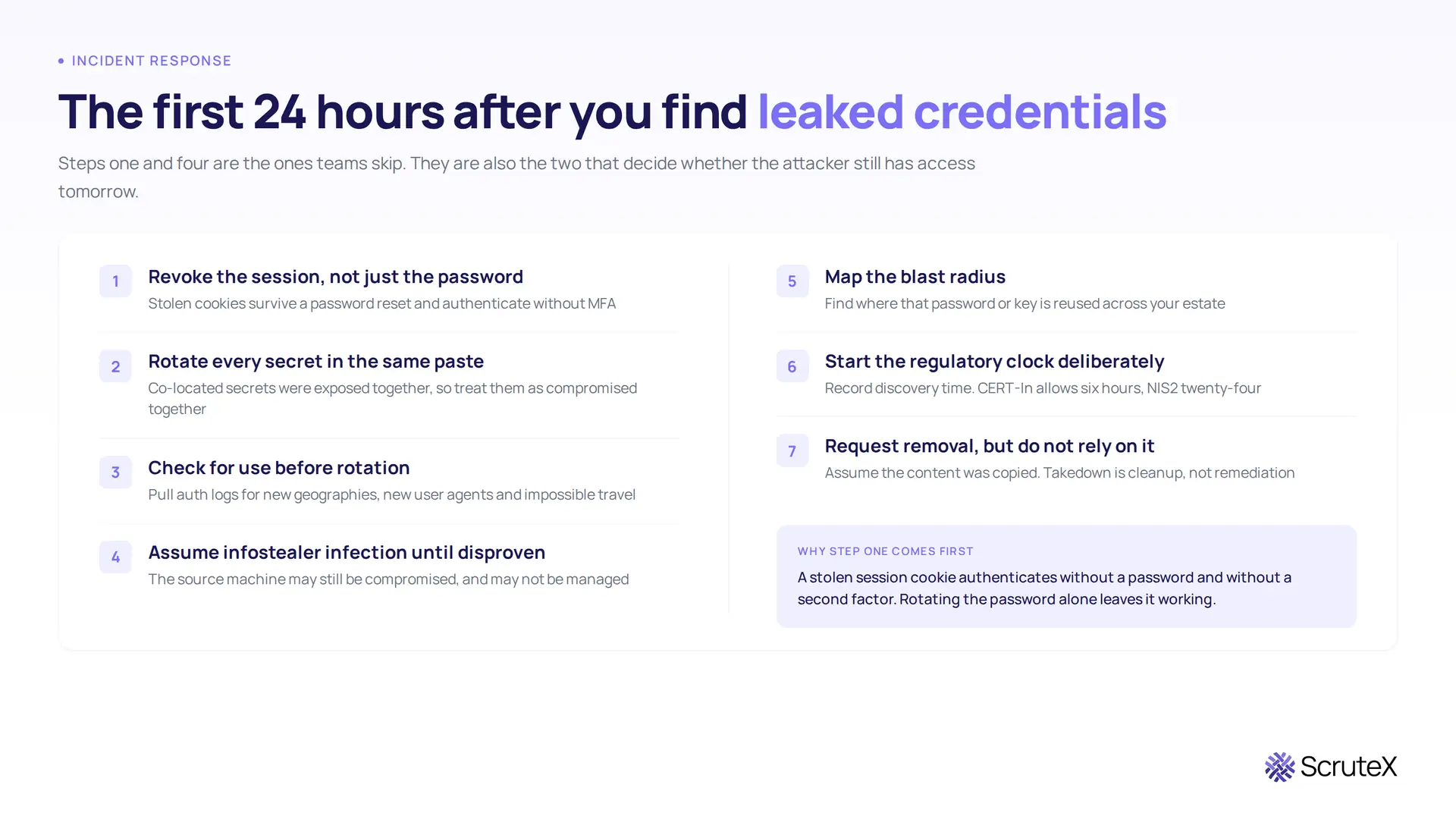
A response checklist that assumes the exposure is real and the credentials are live.
- Revoke the session, not just the password. Force session invalidation across the identity provider, VPN, and SaaS applications. Stolen cookies survive a password reset.
- Rotate the credential and every secret in the same paste. Treat co-located secrets as compromised together, because they were exposed together.
- Check for use before rotation. Pull authentication logs for that identity across the exposure window. Look for new geographies, new user agents, impossible travel, and successful logins that preceded your discovery.
- Assume infostealer infection until disproven. If the exposure came from a stealer log, the source machine is compromised and may still be. Isolate it and check whether it is managed. Nearly half of infostealer-compromised systems holding corporate logins are unmanaged devices.
- Map the blast radius. Where else does that password appear? Where else does that key grant access? Reuse turns one exposure into several.
- Start the regulatory clock deliberately. Record the discovery time. Your reporting obligation runs from awareness, not from confirmation, and six hours under CERT-In is not much runway.
- Request removal, but do not rely on it. Paste sites accept abuse reports. Assume the content was copied before removal, and treat takedown as cleanup, not remediation.
Steps 1 and 4 are the ones teams skip. They are also the two that decide whether the attacker still has access tomorrow.
Where paste monitoring fits in a CTEM programme
Continuous Threat Exposure Management is a framework developed by Gartner, Inc., introduced in 2022, with five stages: scoping, discovery, prioritisation, validation, and mobilisation. GARTNER is a registered trademark and service mark of Gartner, Inc. and/or its affiliates.
Credential exposure maps onto it cleanly, which is a useful way to see why standalone paste monitoring underperforms:
- Scoping is your identifier set. Get this wrong and every later stage inherits the gap.
- Discovery is continuous collection across paste sites, Telegram, leak forums, breach corpora, and code hosts.
- Prioritisation ranks by real exploitability. A live admin credential outranks a five-year-old password for a decommissioned service, regardless of how alarming the paste looks.
- Validation confirms the credential still works and the session is still active, before anyone gets paged.
- Mobilisation puts a ticket in front of the person who can revoke it, with the evidence attached.
A tool that only performs discovery hands you stage two and leaves stages three, four, and five as manual analyst labour. That is why paste alerts so often become a queue nobody reads.
Where ScruteX fits
ScruteX runs external risk as one connected lifecycle rather than five disconnected tools. Data Exposure Insights covers dark web, paste site, breach corpus, and stealer log monitoring, and correlates what it finds against the same asset inventory used by Vulnerability Insights, Brand Insights, Threat Insights, and Vendor Insights. A leaked credential is scored against the asset it opens and the campaigns active in your sector and region, then routed into ticketing with the evidence attached. Setup is agentless: add your domain and brand keywords and discovery starts. ScruteX reports a 92% reduction in mean time to detect and a 48-hour median remediation time across its own measured customer deployments, with results varying by environment.
To be fair about the alternatives: dedicated credential recapture vendors run deeper collection into closed communities than most connected platforms do, and if you have a mature CTI function with the headcount to run correlation yourself, best-of-breed tools will give you better raw depth per layer. The connected approach wins where the team is small and the correlation work is the bottleneck, which describes most security functions outside the largest enterprises.
Key takeaways
- Leaked credentials are a leading indicator, not an aftermath. The gap between theft and use is measured in weeks, and it is the only warning most organisations get.
- Infostealer logs, not developer mistakes, are the dominant source of corporate credentials on paste sites and Telegram.
- Pastebin's scraping API requires a PRO account and, since April 2020, returns only syntax-highlighted pastes. A plain-text dump never appears in it. Tools built on that path report false negatives.
- Session cookies bypass MFA. Revoke sessions, not just passwords.
- Paste monitoring and dark web monitoring cover different stages. Secret scanning and paste monitoring cover different sides of the same failure. You need all of them correlated, not stacked.
- Detection without validation produces an alert queue. Validation is what makes credential exposure actionable.
See your own exposure
ScruteX offers a free tier with no credit card: add your domain and brand keywords and see what is already public. If you would rather start with the reading, the dark web credential detection guide covers the collection side in more depth.
FAQ
Q: What is Pastebin used for?
A: Pastebin is a public text storage site, running since 2002, used mainly by developers to share code snippets, logs, error output, and configuration files. Pastes can be public, unlisted, or private, and can be set to expire after a chosen period.
Q: Is Pastebin illegal?
A: No. Pastebin is a legitimate service with terms of use that prohibit abuse. The illegality lies in what some people post, such as stolen credentials or personal data, not in the platform itself.
Q: Is Pastebin part of the dark web?
A: No. Pastebin is on the surface web, reachable through any browser without Tor, and its public pastes are indexed by search engines. This is why paste site monitoring and dark web monitoring are separate capabilities.
Q: Can hackers use Pastebin?
A: Yes, in two ways. They publish stolen data samples to advertise or prove a breach, and they host encoded command and control addresses that malware retrieves, which MITRE ATT&CK documents as T1102.001, Dead Drop Resolver.
Q: Can Google index Pastebin?
A: Yes. Pastebin states that search engines index public pastes. Unlisted and private pastes are excluded, which is one reason search-based checks miss a large share of exposure.
Q: How do companies monitor Pastebin for leaks?
A: Through continuous collection across paste sites and other leak channels, matched against a defined identifier set of domains, email formats, hostnames, and secret key patterns, then validated before escalation. Manual searching does not scale and misses short-lived and unlisted pastes.
Q: Can API keys appear on Pastebin?
A: Yes. Cloud access keys, database connection strings, and service tokens appear regularly, either pasted by developers during troubleshooting or included in stolen configuration files. Most major providers use recognisable key prefixes, which makes structured detection practical.
Q: What are stealer logs?
A: Stealer logs are the output of infostealer malware on an infected machine, typically containing saved browser passwords, session cookies, autofill data, and crypto wallet files. They are traded on Telegram channels and forums, often with free samples published publicly.
Q: How quickly should leaked credentials be rotated?
A: Immediately on confirmation, and alongside session revocation. Rotating a password without invalidating active sessions leaves stolen session cookies working, since those authenticate without a password or a second factor.
Q: Does MFA protect against leaked credentials?
A: It protects against password-only reuse but not against stolen session tokens. A valid session cookie authenticates without triggering a second factor, which is why infostealer exposure requires session revocation as well as password rotation.
Q: How do attackers find leaked passwords?
A: They buy or download stealer logs and combo lists from Telegram channels, leak forums, and paid log services, then test them at scale against corporate login portals. Testing is cheap and automated, so a list with a low hit rate is still worth running.
Q: Can leaked secrets lead to ransomware?
A: Yes, and it is one of the most common routes in. A valid credential gives an operator authenticated access with no exploit and no malware delivery, which is quieter and more reliable than attacking a perimeter service. Credential exposure is best treated as a ransomware precursor rather than an isolated hygiene issue.
Q: What is credential exposure monitoring?
A: Credential exposure monitoring is the continuous detection of an organisation's credentials, keys, and tokens appearing in public or criminal sources, including paste sites, breach corpora, stealer logs, Telegram channels, and code repositories, followed by validation of which exposures are still live.
Q: Is paste site monitoring enough on its own?
A: No. Distribution has shifted heavily to Telegram channels and dedicated leak sites, and Pastebin's scraping API returns only syntax-highlighted pastes. Paste monitoring is a necessary layer, not a sufficient one.
Q: What is the difference between a paste site leak and a data breach?
A: A paste site leak is a publication event, which is usually evidence that a breach or malware infection already happened somewhere. The breach is the compromise. The paste is the distribution.