Why CTEM Programs Stall at Stage 3: The Prioritization Problem
By ScruteXPublished
Stage 1 and 2 of a CTEM program are mostly engineering problems: build the scope, run the discovery. Stage 4 and 5 are mostly process problems: validate, then route to owners. Stage 3, prioritization, sits in the middle and is neither. That is why most programs stall there, and why a stalled Stage 3 quietly turns a CTEM program back into vulnerability management with new labels.
Continuous Threat Exposure Management runs in five stages: scoping, discovery, prioritization, validation, mobilization. This post explains what Stage 3 is supposed to do, the six patterns that break it, the symptoms to watch for, and the three moves that unblock it. The analysis draws on patterns commonly reported across CTEM rollouts in mid-to-large enterprises, plus published Gartner research and practitioner accounts. Where a claim is a general pattern rather than a measured figure, it is described as one.
In This Post
- What Stage 3 is supposed to do
- The six stall patterns
- What a working Stage 3 looks like
- Symptoms your Stage 3 is stalling
- How to unblock a stalled Stage 3
- Key takeaways and FAQ
What Stage 3 is supposed to do
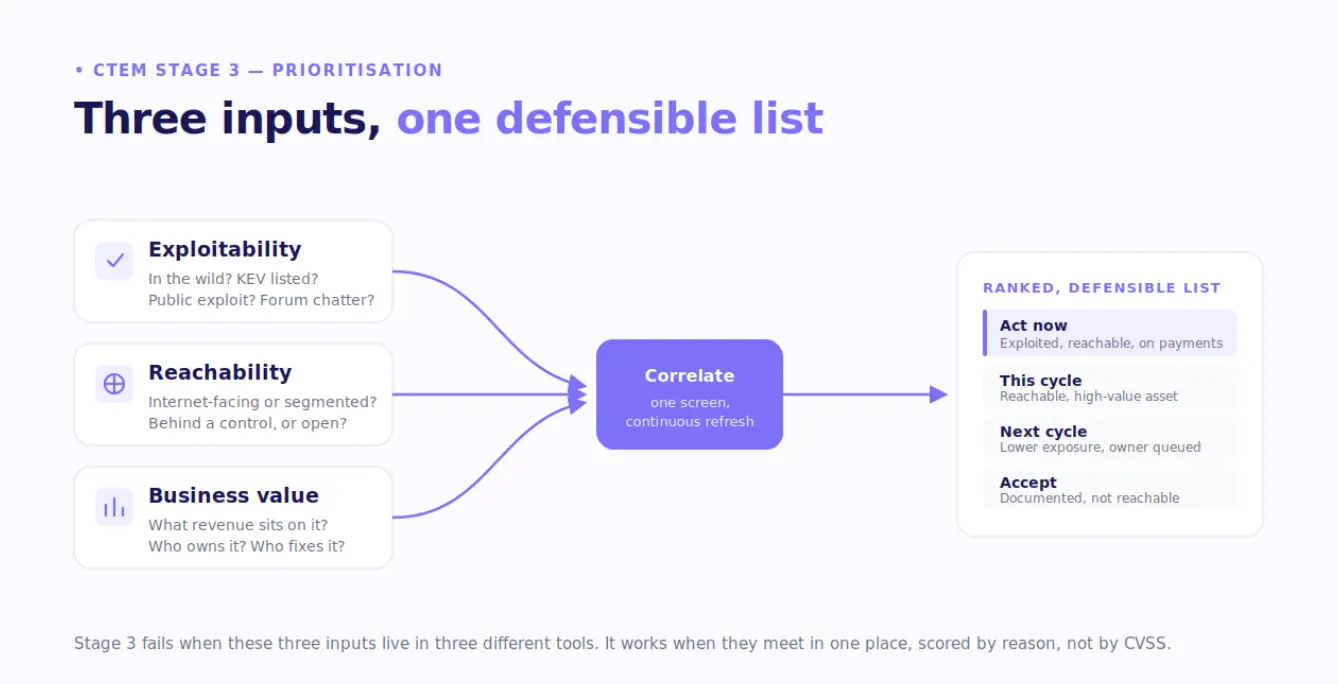
Stage 3 takes the raw discovery output, often tens of thousands of items spanning CVEs, misconfigurations, leaked credentials, exposed assets, brand abuse, and identity weaknesses, and turns it into a ranked list of what the organization will actually act on this cycle.
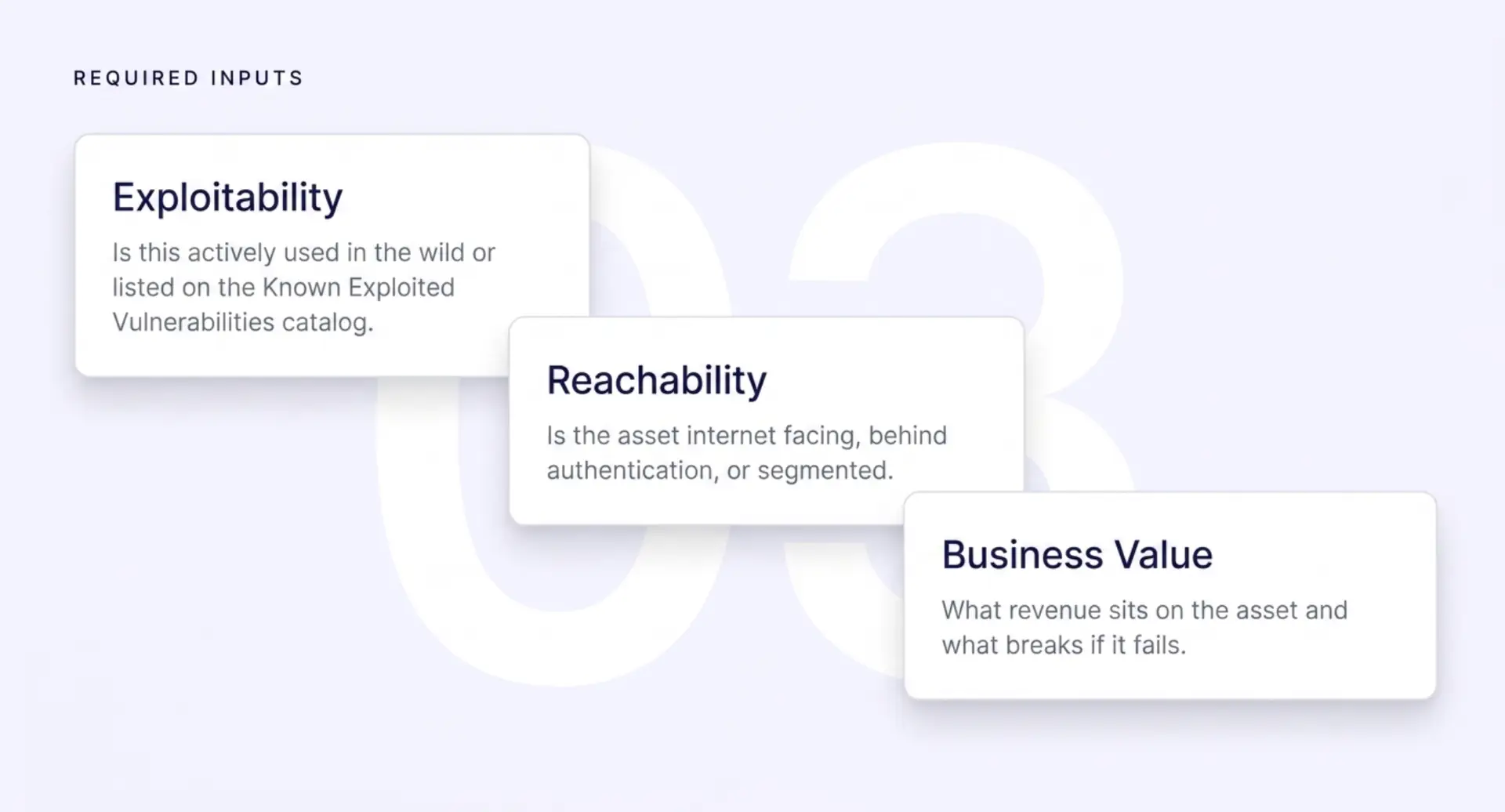
A real Stage 3 combines three inputs. Exploitability: is this being used in the wild, is there a public exploit, is it on the CISA Known Exploited Vulnerabilities catalog, is it being discussed on criminal forums? Reachability: is the asset internet-facing, behind authentication, segmented, or part of a chain that could be reached? Business value: what process or revenue sits on the asset, who owns it, and what breaks if it fails?
The output is a list the security team can defend to engineering, finance, and the board. Without those three inputs together, prioritization collapses back to CVSS sorting, which is the exact behavior CTEM was created to replace.
The six stall patterns
Stall 1: Threat intel lives in a separate tool
Most organizations have a threat intelligence platform. The platform does not talk to the scanner or the EASM tool. Vulnerability data gets exported to a spreadsheet, threat intel gets checked by hand, and someone tries to correlate them manually. It does not scale past the first 200 rows. The result: only the loudest items get a threat-intel overlay, so a medium-severity exposure that is actively exploited slips through.
Stall 2: Asset-to-business-value mapping does not exist
Almost every program has a CMDB. Almost none have a usable map from "this IP" to "this process generates this revenue and is owned by this VP." When prioritization needs to ask what business impact a fix protects, the answer is unavailable. Teams fall back to "it is in prod, so it matters," which is too coarse to rank anything.
Stall 3: Reachability is assumed, not validated
Stage 3 needs to know whether an exposure is actually reachable. Most tools mark assets external or internal from inventory metadata, not network reality. The result is a list where some "criticals" sit on isolated networks and some "mediums" are reachable from the internet through a misconfigured proxy. Stage 4 is supposed to settle this, but if validation is not yet running, Stage 3 has to approximate.
Stall 4: Prioritization runs monthly instead of continuously
Many programs run Stage 3 monthly or quarterly. That is the cadence of legacy VM. CTEM prioritization is meant to refresh as new exploit intelligence lands and discovery output changes. When the list is monthly, you ship a stale list, and by the time engineering acts, the most pressing items have already moved.
Stall 5: The team running prioritization does not own remediation
In many enterprises, security produces the list and hands it to IT, application teams, or DevOps. If the receiving team had no say in how priority was set, they push back, defer, or rebucket it. The priority output becomes a request, not an instruction. The fix is to bring remediation owners into Stage 3, not just Stage 5.
Stall 6: The team reverts to CVSS under deadline pressure
The most common failure. When a list is needed fast, the easy path is "sort by CVSS, take the top 100." It looks like prioritization. It is not. Once a program ships its first CVSS-sorted list and calls it CTEM, the shortcut repeats next month, and six months in the program is doing VM with new branding.
What a working Stage 3 looks like
A functional Stage 3 has four properties.
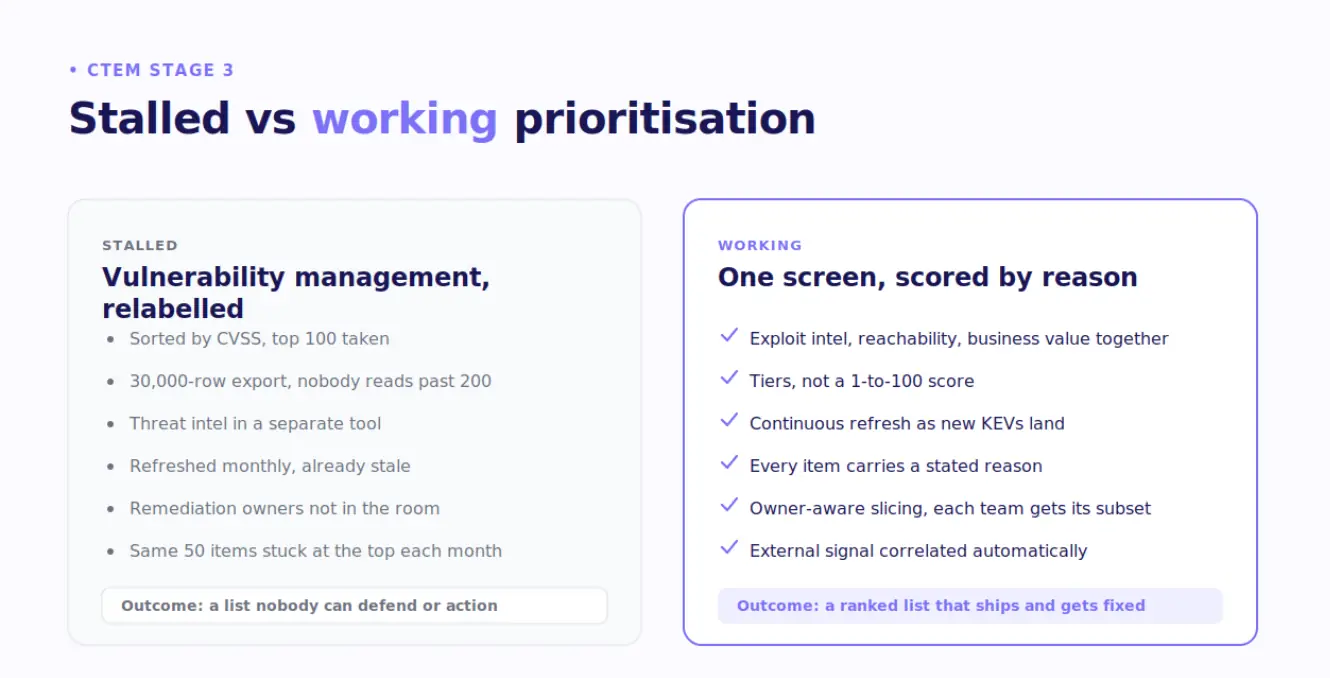
One screen: exploit intel, reachability, business value, and asset metadata in one view, not four tools. Continuous refresh: new KEV additions, dark web mentions, and exploit proof-of-concepts flow into the list within hours, not weeks. Defensible scoring: every item has a stated reason ("exploited in the wild, reachable, supports payment processing"), not just a CVSS number. Owner-aware slicing: the list is cut by owner, so each team gets its own actionable subset with the reasoning attached.
Symptoms your Stage 3 is stalling
If two or more of these are true, the stall is already happening:
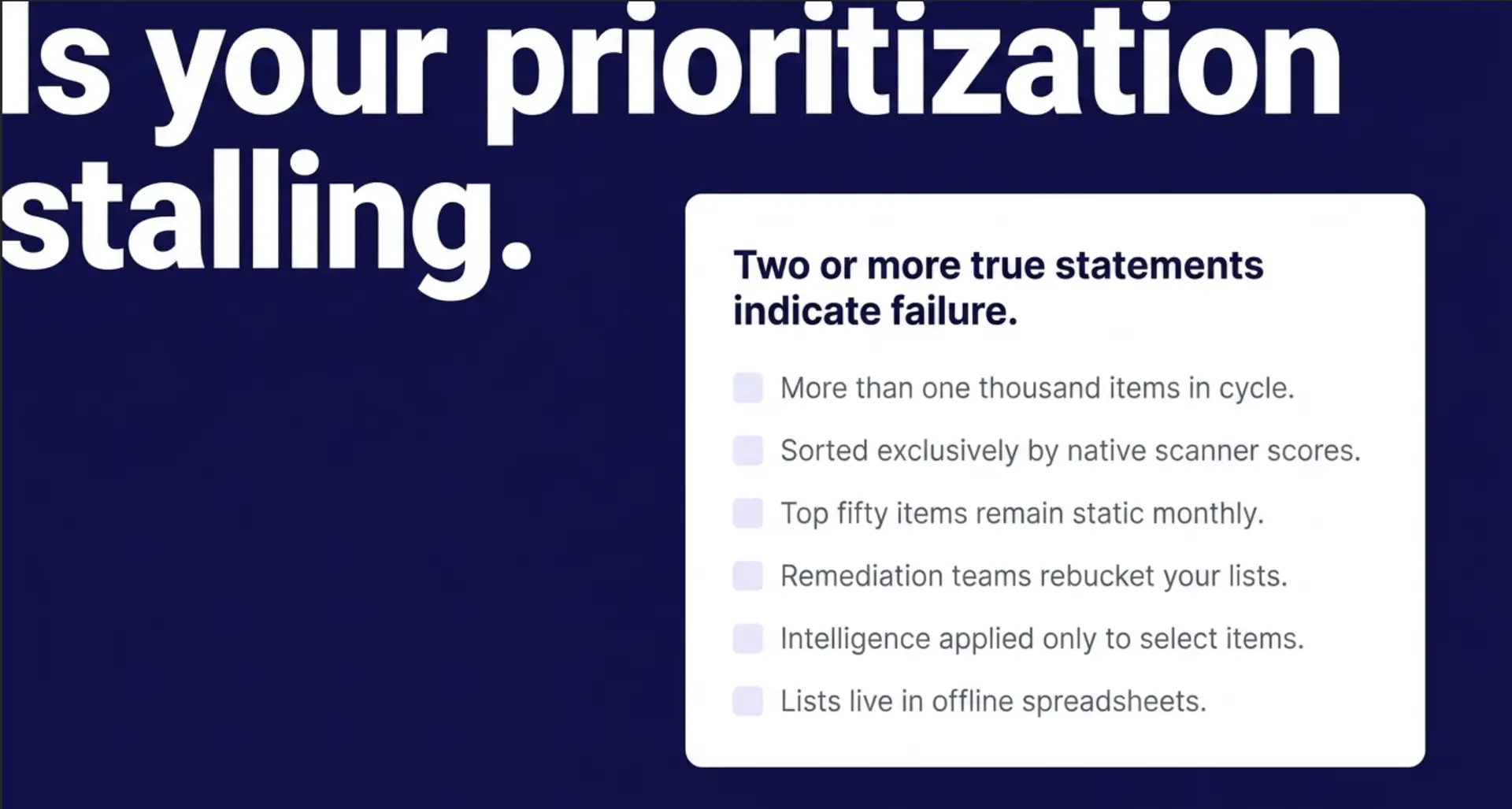
- The priority list has more than 1,000 items in cycle.
- It is sorted by CVSS or a scanner's native score.
- The same items sit in the top 50 every month with no movement.
- Remediation teams ignore or rebucket the list.
- Threat intel is applied only to a handful of "interesting" items.
- The list is produced in a spreadsheet, not a tool.
- Nobody in the room can explain why item 1 ranks above item 2 without checking CVSS.
How to unblock a stalled Stage 3
Three moves help, in this order.
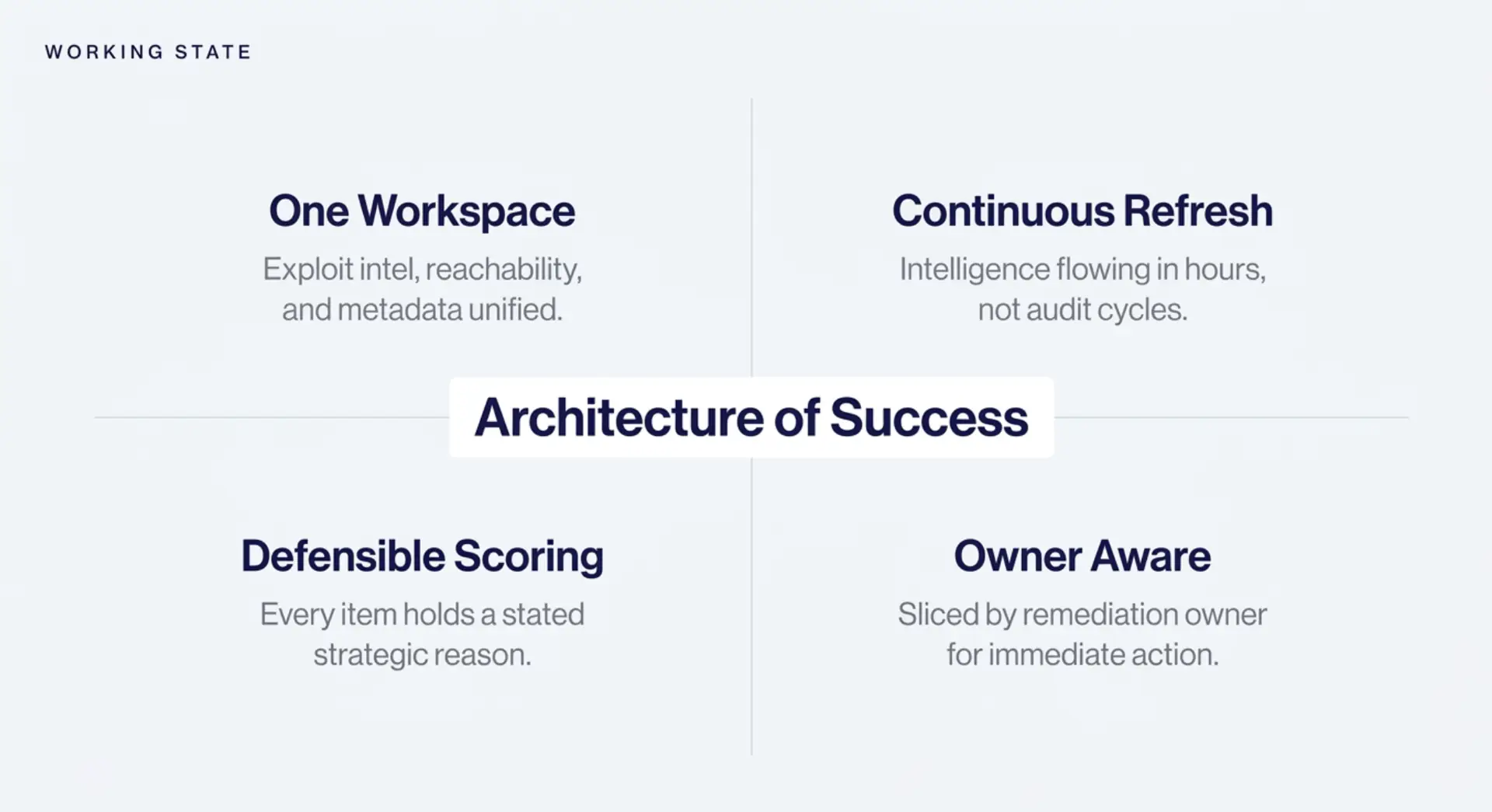
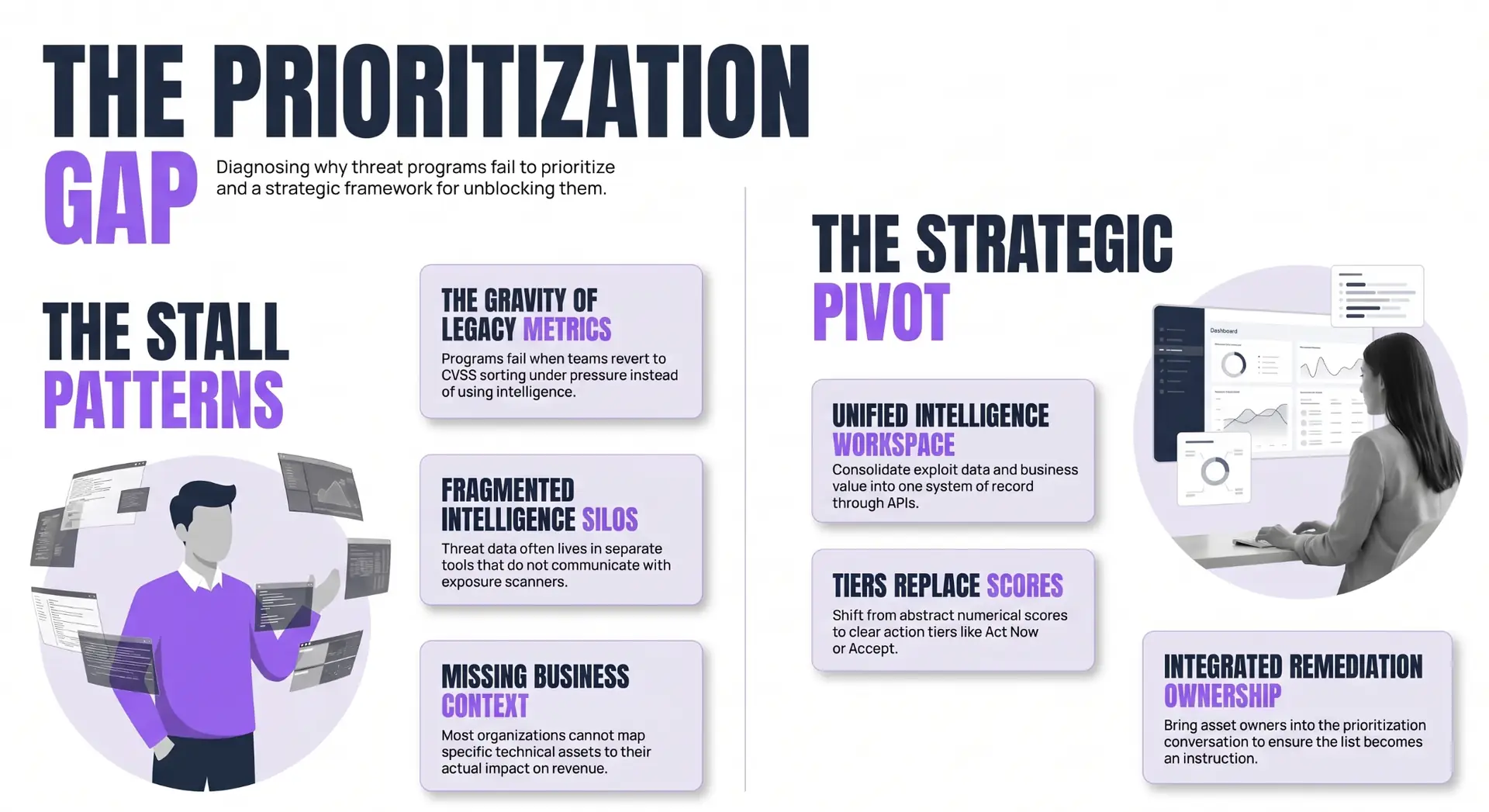
Consolidate the three inputs into one workspace. Threat intel, exposure data, and business value need to live where prioritization happens. In practice that means picking one tool as the system of record and pushing the other data into it through APIs, rather than exporting everything to a spreadsheet.
Use a small set of tiers, not a numeric score. Three or four tiers (Act Now, This Cycle, Next Cycle, Accept) are easier to defend and easier to act on than a 1-to-100 score. Tiers force the conversation onto why, not the number.
Get a remediation owner into Stage 3. The IT or application owner of the highest-risk assets should sit in the prioritization conversation. Their input decides what is shippable this cycle, which is the difference between a list that gets actioned and one that gets argued.
These three changes usually move Stage 3 from a monthly bottleneck to a running process.
There is a pattern worth naming under Stall 1. The exposures hardest to correlate by hand are the external ones: a credential that appears in a leak today, a lookalike domain registered overnight, an exposed asset that was not in the CMDB. They arrive on the attacker's clock, not the audit cycle's. Correlating that external signal against your asset list and active threat intelligence, automatically, is what keeps Stage 3 from drowning. It is also where the consumer payoff sits, because the leaked credential caught early is the customer account that is never taken over.
Key takeaways
- Stage 3 (prioritization) is the most common CTEM stall point, because it needs exploitability, reachability, and business value combined.
- Six patterns drive the stall: siloed threat intel, no business-value map, unvalidated reachability, monthly cadence, no remediation ownership, and reversion to CVSS.
- A working Stage 3 has one screen, continuous refresh, defensible scoring, and owner-aware slicing.
- Three moves unblock most stalls: consolidate inputs, use tiers not scores, bring remediation owners in.
How ScruteX contributes to Stage 3
ScruteX sits on the discovery and external-prioritization side of the CTEM pipeline. It correlates external exposures with active threat intelligence, including dark web mentions and exploit chatter, and pushes scored findings into the systems where prioritization happens, so Stage 3 has one less silo to reconcile by hand. It does not replace the internal context (CMDB, business-value mapping, change management) that the rest of Stage 3 needs. See the ScruteX platform for what each module covers.
Frequently Asked Questions
Q: What is Stage 3 of CTEM?
A: Stage 3 is prioritization. It takes the raw discovery output and produces a ranked list of what the organization will act on this cycle. It needs exploitability data, reachability context, and business-value mapping combined.
Q: Why is CTEM Stage 3 the hardest stage?
A: Because it needs three inputs that usually live in three different tools and teams: threat intelligence, exposure data, and business context. Most organizations cannot combine them in one workspace, so prioritization defaults to CVSS sorting.
Q: How is CTEM prioritization different from vulnerability prioritization?
A: Traditional vulnerability prioritization uses CVSS as the primary score. CTEM prioritization combines exploitability in the wild, reachability, and business impact. CVSS becomes one input among several, not the answer.
Q: How often should CTEM Stage 3 refresh?
A: Continuously. It should reflect new threat intelligence within hours, not weeks. Monthly or quarterly prioritization is the cadence of legacy vulnerability management, not CTEM.
Q: What is the single biggest mistake in CTEM Stage 3?
A: Reverting to CVSS sorting under deadline pressure. Once a program ships its first CVSS-ordered list and calls it CTEM, it rarely recovers without a structural reset.
Q: Do I need a specific tool for CTEM Stage 3?
A: Not a specific product, but you do need one workspace where exploit intel, exposure data, and business context come together. The consolidation matters more than the exact stack.