Vendor Risk Management Software: How to Choose the Right Platform in 2026
By ScruteXPublished Updated
Vendor risk management software is a platform that discovers, scores, and monitors the security risk your third-party suppliers introduce. It replaces spreadsheets and one-off questionnaires with a live inventory of vendors, continuous checks on their external security posture, and a workflow to assess, tier, and remediate the risks that matter. Buyers use it to answer one question fast: which of our vendors could get us breached, and what do we do about it.
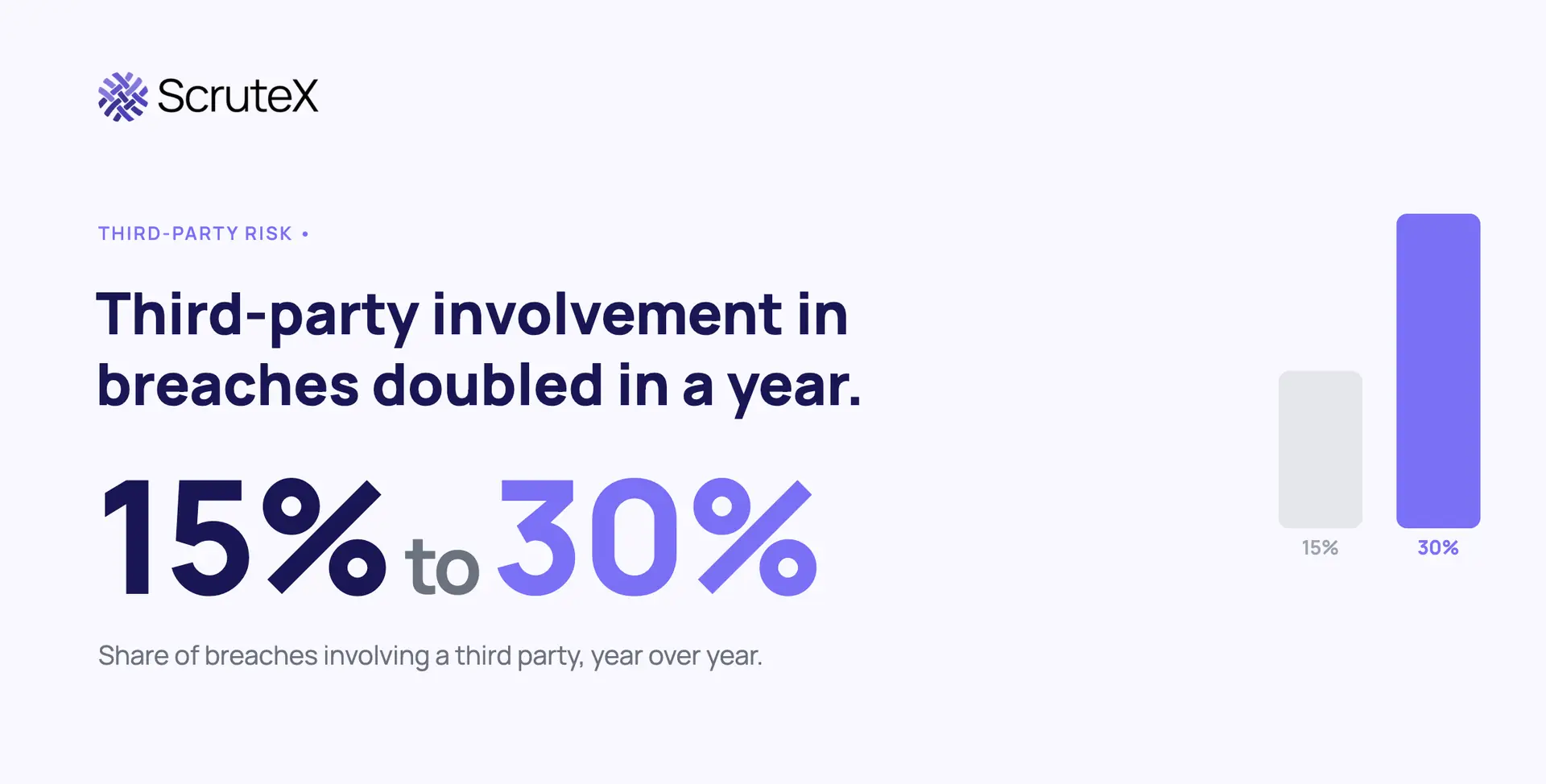
That question is no longer academic. In the 2025 Verizon Data Breach Investigations Report, the share of breaches that involved a third party doubled in a single year, from 15% to 30%. The same report found the median time to remediate leaked secrets discovered in a public GitHub repository was 94 days. Your vendors hold your data, your credentials, and your API keys. When they are slow, you are exposed, and you often find out late.
This guide is written for the person who has to pick the tool: a CISO defending the choice to a board, or a consultant putting a shortlist in front of a client. It covers what the software does, how continuous monitoring differs from questionnaires, a full evaluation matrix, real pricing ranges, build versus buy, and how vendor risk connects to attack surface management. No vendor hype, and one honest note at the end about where Scrutex fits.
In This Post
- What is vendor risk management software?
- Why vendor risk got worse in 2026
- What vendor risk management software actually does
- Questionnaires vs continuous monitoring: the real difference
- What to look for: the evaluation matrix
- How the vendor risk lifecycle works
- Build vs buy
- How much does vendor risk management software cost?
- How long does implementation take?
- Where vendor risk meets attack surface management
- Key takeaways and FAQ
What is vendor risk management software?
Vendor risk management software (often shortened to VRM software, and closely related to third-party risk management software) is a system for tracking and reducing the security risk that suppliers, SaaS providers, contractors, and data processors bring into your organisation. It does four jobs. It keeps a single inventory of who your vendors are. It assesses each one against a security baseline. It monitors that posture over time instead of once a year. And it drives remediation when something breaks.
The category grew out of manual third-party risk management (TPRM), where teams sent security questionnaires, collected SOC 2 and ISO 27001 reports, filed them, and moved on. That model still exists inside good software, but the better tools now add outside-in evidence: security ratings, external scanning, and dark web signals that do not depend on the vendor answering honestly.
A useful way to frame it: questionnaires tell you what a vendor says they do. Continuous monitoring tells you what they are actually doing right now. Mature programmes use both, and the software is where the two meet.
Why vendor risk got worse in 2026
Three shifts pushed vendor risk up the priority list.
First, the raw numbers. Verizon's 2025 DBIR put third-party involvement in breaches at 30%, twice the prior year. Supply chain compromises, exposed vendor credentials, and misconfigured SaaS all sat inside that figure. The attack pattern is simple: it is easier to breach a small supplier with weak controls and pivot into its larger customers than to attack those customers head-on.
Second, fourth-party risk became visible. Your vendors have vendors. A single SaaS tool may depend on a hosting provider, a payments processor, and half a dozen sub-processors, each a link in the chain. When one of those upstream providers is hit, the blast radius reaches you even though you never signed a contract with them. Good software maps this concentration risk so you can see when forty of your vendors all sit on the same cloud region or the same identity provider.
Third, regulators made it a named obligation. The EU's Digital Operational Resilience Act (DORA) requires financial entities to manage ICT third-party risk with registers and exit strategies. APRA CPS 234 in Australia holds boards accountable for the security of information assets managed by third parties. RBI guidance in India and MAS guidance in Singapore push the same way. "We trusted the vendor" is no longer a defensible answer to an auditor.
What vendor risk management software actually does
Strip away the marketing and the core capabilities are consistent across serious tools.
Vendor inventory and tiering. A central register of every third party, classified by how much damage they could do. A payroll provider with access to employee data is not the same risk as a stock-photo subscription. Tiering by data access, system access, and business criticality decides how much scrutiny each vendor gets.
Security assessments. Questionnaire automation using standard frameworks such as the Shared Assessments SIG, SIG Lite, or the Cloud Security Alliance CAIQ, plus collection of evidence like SOC 2 Type II reports, ISO 27001 certificates, and penetration test summaries. AI-assisted review now drafts answers and flags gaps so analysts stop copy-pasting.
Security ratings and continuous monitoring. An outside-in score of a vendor's external posture: exposed ports, expired certificates, leaked credentials, patching hygiene, and misconfigurations. This runs continuously, so a vendor that was clean at onboarding but degraded six months later gets flagged.
Risk scoring and a risk register. A combined view of questionnaire results, ratings, and monitoring signals, rolled into a risk score and logged against your risk appetite. This is what feeds board reporting and continuous controls monitoring.
Remediation and workflow. Findings routed to owners, tracked to closure, with evidence captured for audit. Two-way integration with ticketing systems (Jira, ServiceNow) and procurement tools keeps the work where teams already live.
Questionnaires vs continuous monitoring: the real difference

The single biggest decision in this category is how much weight you put on point-in-time assessments versus continuous evidence. Here is the honest comparison.
| Dimension | Point-in-time questionnaires | Continuous monitoring and ratings |
|---|---|---|
| What it measures | What the vendor claims | What the vendor's external posture shows |
| Frequency | Once at onboarding, maybe annually | Daily or near real-time |
| Evidence type | Self-attested, sometimes stale | Observed, outside-in, dated |
| Catches drift | No. A clean answer in January says nothing about June | Yes. Flags new exposure as it appears |
| Depth on internal controls | High. Covers policy, process, governance | Limited. Sees the outside, not the inside |
| Effort per vendor | High and manual, though AI now helps | Low once configured |
| Best for | Governance, compliance evidence, contract terms | Early warning, prioritisation, scale |
Neither wins alone. Questionnaires capture the controls a scan can never see: how a vendor handles access reviews, incident response, and sub-processor governance. Continuous monitoring catches the drift a questionnaire misses: the expired certificate, the credential dumped on a paste site, the internet-facing server that went unpatched for months. A tool that only does one side of this is doing half the job. Weight your evaluation toward products that combine both and reconcile them into one score.
What to look for: the evaluation matrix

Use this matrix to score a shortlist. Rate each product 1 to 5 on every row, weight the rows by what your programme needs, and the winner usually becomes obvious. Buyers who skip this step tend to pick on demo polish and regret it at renewal.
| Capability | What good looks like | Why it matters |
|---|---|---|
| Vendor discovery and inventory | Imports from procurement, SSO, and expense data to find shadow vendors | You cannot assess vendors you do not know you have |
| Automated tiering | Rules-based classification by data and system access | Focuses effort on the vendors that can hurt you |
| Questionnaire automation | SIG, CAIQ, custom; AI-drafted responses and gap detection | Cuts weeks of manual review per vendor |
| Continuous security ratings | Daily outside-in scoring with evidence, not a black-box grade | Catches posture drift between reviews |
| Dark web and credential monitoring | Alerts when vendor credentials or data appear in leaks | Third-party credential reuse is a top breach vector |
| Fourth-party mapping | Surfaces concentration and sub-processor risk | Shows the blast radius you do not control |
| Risk scoring and register | Configurable to your risk appetite, board-ready output | Turns signals into decisions and reporting |
| Remediation workflow | Two-way ticketing, ownership, evidence capture | Findings without workflow become wallpaper |
| Framework and regulatory mapping | Maps to DORA, ISO 27036, NIST SP 800-161, regional rules | Audit evidence without a second project |
| Integrations and API | SIEM, SOAR, GRC, procurement, REST and webhooks | Vendor risk data has to reach other systems |
| Transparency of scoring | You can see why a vendor scored as it did | Vendors will dispute scores; you need the receipts |
| Total cost and time to value | Clear pricing, fast onboarding, no forced services | Slow, opaque rollouts kill programmes |
Two rows deserve extra attention. Scoring transparency separates credible security ratings from marketing grades; if a product cannot show the evidence behind a score, your vendors will win every dispute. And framework mapping to standards such as ISO/IEC 27036 (security in supplier relationships) and NIST SP 800-161 (cyber supply chain risk management) turns your monitoring into audit evidence, which is where a lot of the real return sits.
How the vendor risk lifecycle works

Software should support the whole vendor relationship, not just the assessment at the start. The lifecycle has six stages, and gaps at either end are where risk hides.
| Stage | What happens | What the software should do |
|---|---|---|
| Onboarding | New vendor enters, contract terms set | Auto-inventory, tier by risk, trigger the right assessment depth |
| Tiering | Classify by data, system access, criticality | Apply rules, name critical vendors, set monitoring cadence |
| Assessment | Questionnaire plus evidence collection | Automate the questionnaire, review evidence, score |
| Monitoring | Ongoing posture and threat signals | Continuous ratings, dark web alerts, drift detection |
| Remediation | Fix or accept findings | Route to owners, track to close, log against risk appetite |
| Offboarding | Vendor exits, access removed | Confirm data return, revoke access, close the record |
Onboarding and offboarding are the two stages teams neglect, and both are dangerous. A vendor onboarded without tiering gets the wrong level of scrutiny. A vendor offboarded without confirming that access was revoked and data was returned leaves a live path into your environment long after the contract ended. The DORA exit-strategy requirement exists precisely because regulators watched organisations lose track of vendors on the way out.
Build vs buy
Some large, mature security teams ask whether they can build vendor risk management in-house on a GRC platform plus scripts. It is a fair question, and the honest answer depends on scale and appetite.
Building can work when you have a small number of vendors, a strong engineering team, and an existing GRC system to extend. You keep full control and avoid per-vendor licence fees. The cost shows up elsewhere: you own the scanning infrastructure, the security-ratings data, the dark web collection, and the maintenance forever. Recreating continuous outside-in monitoring is the part almost no one builds well, because it needs data sources and tuning that are a product in themselves.
Buying makes sense for most teams because the data and the workflow are the hard parts, and both are commodities you can rent. The trade to watch is lock-in and opaque scoring. Best-of-breed point tools (a ratings tool here, a questionnaire tool there) suit large teams that want to integrate the best of each. A single connected platform suits smaller teams that would rather have one view than five integrations to maintain. Neither is wrong. Match the model to the team you actually have, not the one on the org chart.
How much does vendor risk management software cost?
Pricing in this category is rarely public, and vendors price on the number of third parties you monitor, the modules you turn on, and your size. As a planning guide based on typical market ranges rather than any single vendor's rate card:
- Entry and mid-market: roughly 15,000 to 40,000 USD per year for continuous monitoring across a few hundred vendors, questionnaires included in most tiers.
- Enterprise: 50,000 to 150,000 USD per year and up, driven by vendor count, fourth-party mapping, and premium data feeds.
- Free and freemium tiers: some platforms offer a free tier that scores your own and a limited set of vendors' external posture, useful for a proof of value before you commit budget.
Two cost traps recur. The first is per-vendor pricing that punishes you for good hygiene, since a full inventory that finds shadow vendors can raise your bill. The second is professional-services fees for onboarding that can match the first-year licence. Ask for all-in year-one pricing, and treat any tool that needs a six-month deployment as a red flag rather than a feature.
How long does implementation take?

For outside-in monitoring, time to first value should be days, not quarters. You add domains and vendor identifiers, and the platform starts scoring external posture almost immediately because it needs no agent on the vendor's side. Standing up the full programme, tiering rules, questionnaire templates, workflow, and integrations, usually takes a few weeks of configuration.
Be sceptical of any product that requires a long professional-services engagement before it produces a single finding. Agentless, same-day monitoring is now the baseline, and a slow rollout usually signals architecture from an older era.
Where vendor risk meets attack surface management

Here is the shift worth understanding before you buy. Vendor risk is not a separate discipline from your own external security. Your vendors are part of your attack surface. A leaked vendor credential, a vendor's exposed server, or a lookalike domain impersonating a vendor to your staff are all external exposures that lead back to you.
This is why the strongest programmes correlate vendor monitoring with external attack surface management (EASM) and the wider continuous threat exposure management (CTEM) model that Gartner introduced in 2022. Instead of a vendor score in one tool and your own exposure in another, you get one prioritised view of external risk, ranked by real-world exploitability rather than raw severity. When a vendor appears in a breach corpus, the value is knowing within hours which of your systems and data that vendor touches, so you can act before the exposure is abused.
Scrutex runs vendor risk this way. Its Vendor Insights module handles continuous vendor posture scoring, questionnaire automation, evidence repositories, and AI-assisted review, and it correlates that vendor data with the same external attack surface, dark web, and threat intelligence signals the platform already tracks for your own estate, under one CTEM lifecycle. Scrutex reports a 92% reduction in mean time to detect across its customer deployments; that figure is Scrutex's own measured data, not an industry average, and results vary. The point is not the number. It is the model: vendor risk read as part of your attack surface, not as a spreadsheet you revisit once a year. You can score your own posture and a set of vendors on the free tier before deciding whether it fits.
The consumer payoff sits at the end of this chain. When a vendor breach is caught early, the customers whose data that vendor holds do not end up phished, defrauded, or exposed. That is the real reason the category exists.
Key Takeaways
- Vendor risk management software gives you a live inventory of third parties, continuous checks on their security, and a workflow to fix what breaks. It replaces annual spreadsheets.
- Third-party involvement in breaches doubled to 30% in Verizon's 2025 DBIR. This is now a board-level and regulated obligation under DORA, APRA CPS 234, and regional rules.
- Buy for the combination of questionnaires and continuous monitoring. A tool that does only one side does half the job.
- Score your shortlist on the evaluation matrix, weighting scoring transparency, fourth-party mapping, and framework alignment. Do not pick on demo polish.
- Insist on agentless, same-day monitoring and all-in year-one pricing. A six-month deployment is a red flag.
- The best results come from reading vendor risk as part of your external attack surface, not as a separate silo.
See your third-party exposure the way an attacker would. Scrutex's Vendor Insights runs continuous vendor posture scoring and questionnaire automation, correlated with your own attack surface and dark web signals, on a free tier with no agent to install. Add a domain and start scoring in minutes at scrutex.ai.
FAQ
Q: What is the best vendor risk management software?
A: There is no single best tool for every team. The best fit is the one that scores highest on your weighted evaluation matrix: strong vendor discovery, both questionnaires and continuous monitoring, transparent scoring, fourth-party mapping, and framework alignment to the rules you answer to. Large teams often prefer best-of-breed point tools; smaller teams usually prefer one connected platform.
Q: How much does vendor risk management software cost?
A: Most tools price on vendor count and modules. Mid-market programmes commonly run 15,000 to 40,000 USD per year, and enterprise deployments run from 50,000 USD upward. Some platforms offer a free tier for external posture scoring, which is a low-risk way to prove value first. Always ask for all-in year-one pricing including onboarding.
Q: Can vendor risk management software replace security questionnaires?
A: No, and any vendor claiming it can is overselling. Continuous monitoring sees a vendor's external posture but not their internal controls, policies, or incident-response maturity. Questionnaires cover those. The right approach uses both and reconciles them into one risk score.
Q: Is continuous vendor monitoring necessary, or are annual assessments enough?
A: Annual assessments alone leave you blind for eleven months. A vendor can be clean at review time and exposed by mid-year through a new leak or an unpatched server. Continuous monitoring catches that drift. For any vendor with access to sensitive data or systems, it is now the baseline expectation of auditors and regulators.
Q: How long does it take to implement vendor risk management software?
A: Agentless outside-in monitoring should produce findings within days, because it needs nothing installed on the vendor side. Building out the full programme (tiering, questionnaires, workflow, integrations) usually takes a few weeks. Treat any tool that needs a multi-month services engagement before first value as a warning sign.
Q: What is fourth-party risk, and does the software handle it?
A: Fourth-party risk is the risk from your vendors' vendors: the sub-processors and providers your suppliers depend on. Better platforms map this to show concentration risk, for example when many of your vendors rely on the same cloud region or identity provider, so you can see exposure you never contracted for directly.