Uber Data Breach via Fireworks AI: Full Analysis, Timeline and Detection Signals
By ScruteXPublished
What is the Uber data breach?
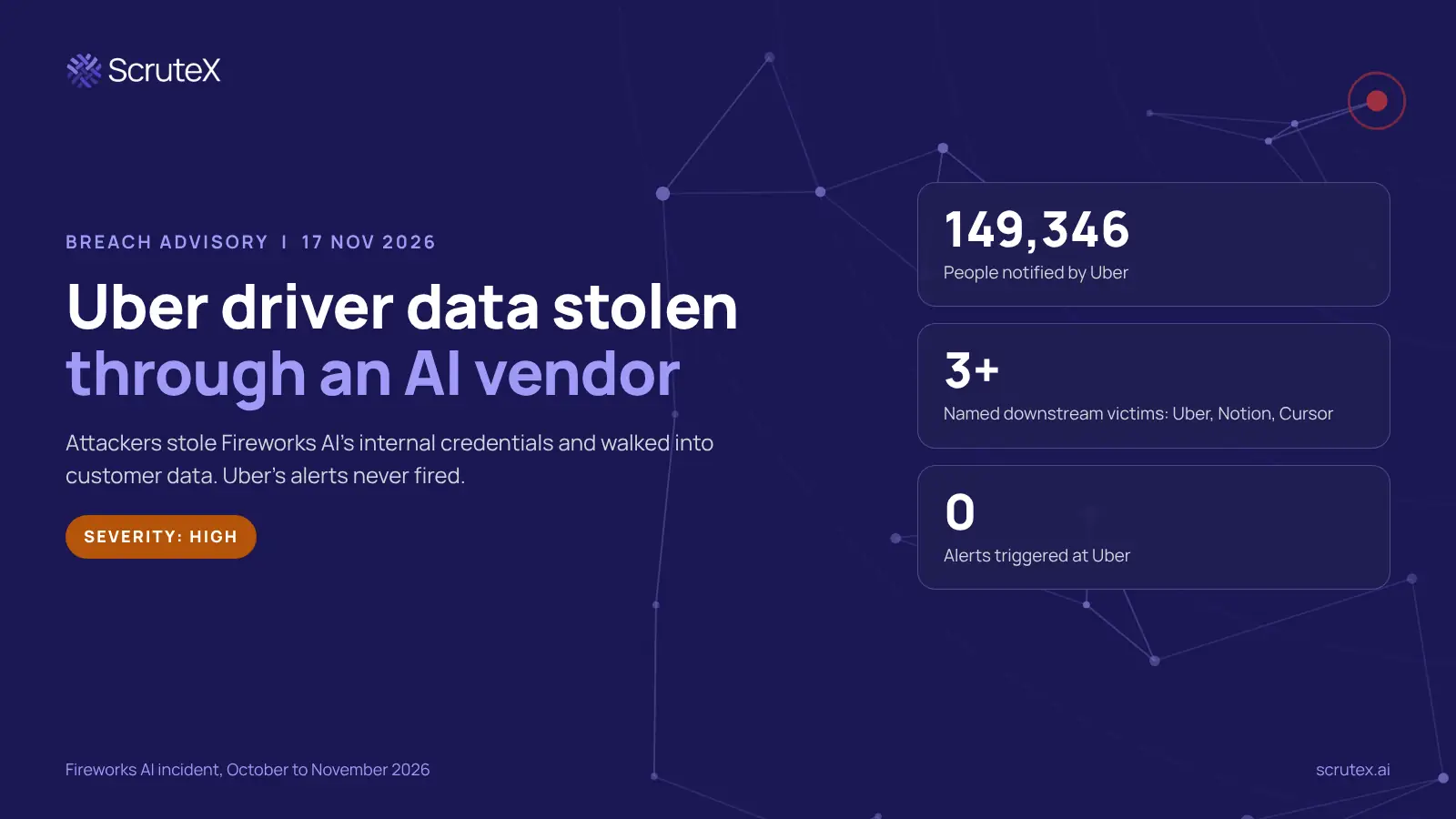
The Uber data breach is a third-party incident in which attackers stole internal credentials from AI inference provider Fireworks AI and used them to reach Uber data. Uber is notifying 149,346 people that their names, postal addresses, dates of birth and driver's licence numbers were stolen. No Uber system was breached. Notion and Cursor were also affected.
Key facts
| Fact | Detail |
|---|---|
| Victim | Uber Technologies, Inc. (driver data) |
| Compromised vendor | Fireworks AI, an AI inference, evaluation and fine-tuning platform |
| Breach date (Uber filing) | 7 October 2026 |
| Vendor detection | 6 October 2026, 09:00 PDT |
| People notified | 149,346 |
| Data stolen | Names, postal addresses, dates of birth, driver's licence numbers |
| Drivers notified in | California, Illinois, Massachusetts, Rhode Island, South Carolina |
| Regulator filings | California, Iowa, Oregon, Texas, Vermont |
| Other victims | Notion (AI chat transcripts, fewer than 1% of workspaces), Cursor (backdoored extension), other Fireworks customers (secrets, billing data, some model weights and datasets) |
| Threat actor | Financially motivated LLMjacking group (unnamed) |
| Scrutex severity | High |
Key takeaways
- Uber's alerts on its Fireworks environment never fired, because the attacker used the vendor's own valid credentials.
- Vendor scope statements lagged downstream impact by weeks. The vendor's first bulletin found no personal data accessed inside its perimeter; Uber later confirmed personal data was taken.
- One credential theft at one AI vendor reached a ride-hailing company, a productivity suite and a developer tool marketplace.
- Deleting a secret stored on a vendor platform does not revoke it. Only the issuing provider can.
- LLMjacking groups resell stolen AI access. Every API key left with an AI vendor is stock in that market until it is revoked.
Updates
| Date | Update |
|---|---|
| 16-11-2026 | Uber's filing with the Oregon regulator puts the total at 149,346 people notified. |
| 13-11-2026 | Cursor traces its incident to an access key it issued to Fireworks and moves all inference off the platform. |
| 09-11-2026 | Notion contacts affected workspace owners. Fireworks widens its disclosure to billing data, model weights and datasets. |
| 09-10-2026 | Fireworks publishes its first security bulletin. |
What happened in the Uber data breach?
Attackers stole internal credentials from Fireworks AI and used them to reach Uber data held through the vendor relationship. Uber filed 7 October 2026 as its breach date. Fireworks notified Uber on 9 October, and on 13 October Uber confirmed the stolen credentials had been used to access personal data. Uber then cut its data connections to Fireworks.
Uber is notifying 149,346 people. Early state filings showed 7,870 residents across three states before the full count was filed. Notice letters are dated 10 November 2026. This is Uber's second disclosed incident in 2026, after an extortion group's claim against Uber Freight earlier in the year.
What did Fireworks AI disclose?
Fireworks AI gives developers access to open AI models for inference, evaluation and fine-tuning, and describes its platform as zero data retention: prompts and outputs are not stored by default. Its October 2026 security bulletin sets out the first intrusion.
Fireworks bulletin timeline (PDT)
| Date and time | Fireworks action |
|---|---|
| 6 October, 09:00 | Activity identified; containment started |
| 7 October, 07:00 | Began notifying affected customers |
| 9 October, 16:00 | Rotated Fireworks employee API keys |
| 9 October, 18:00 | Notified identified affected customers |
| 9 October, 22:00 | Published the bulletin |
| 10 October | Revoked more user API keys and rotated service-account tokens after a credential review; status "active monitoring", last updated 11:16 PDT |
What Fireworks says was affected
- Access method: unauthorised use of internal Fireworks credentials. No detail on the attacker or how the credentials were stolen.
- Captured data: environment variables used in evaluation jobs in a limited number of customer accounts, including API keys and tokens stored as secrets.
- Stated not affected at the time: no evidence of unauthorised access to customer models, datasets, training data, inference traffic or personal information inside the Fireworks perimeter. Calls made with the exposed credentials were still under review.
- Vendor actions: revoked the internal credentials, affected API keys and keys the actor created; added access restrictions; began reviewing how secrets reach evaluation jobs; engaged an outside cybersecurity firm.
The four customer actions Fireworks recommends
- Create new Fireworks API keys to replace revoked ones and update applications. Affected applications fail authentication until updated.
- Rotate or revoke third-party credentials with their issuing providers, then update applications and Fireworks secrets. Removing a stored secret does not invalidate the credential.
- Review access logs and accessible data for the exposed third-party credentials with those providers, and rotate them even without suspicious activity.
- Check API keys, users, evaluators, training jobs and datasets for anything unrecognised, and send names or IDs to Fireworks.
Fireworks offers secret names and credential fingerprints through a secure channel at security@fireworks.ai. It says customers who received no affected-customer notice need take no incident-specific action.
The second intrusion and the widened scope
On 23 October a third-party cloud provider hosting Fireworks research and development machines suffered its own incident. On 24 October the attacker used it to reach Fireworks development machines and run an unauthorised compute workload. Fireworks detected it the same day.
On 9 November Fireworks widened its disclosure: secrets, resource metadata, billing data (billing and shipping addresses, invoices, payment history, balances) and, for some customers, incomplete model weights and datasets. Card numbers were not affected. Fireworks disabled self-serve dataset upload and download for batch inference and dataset training.
Who was affected by the Fireworks AI breach?
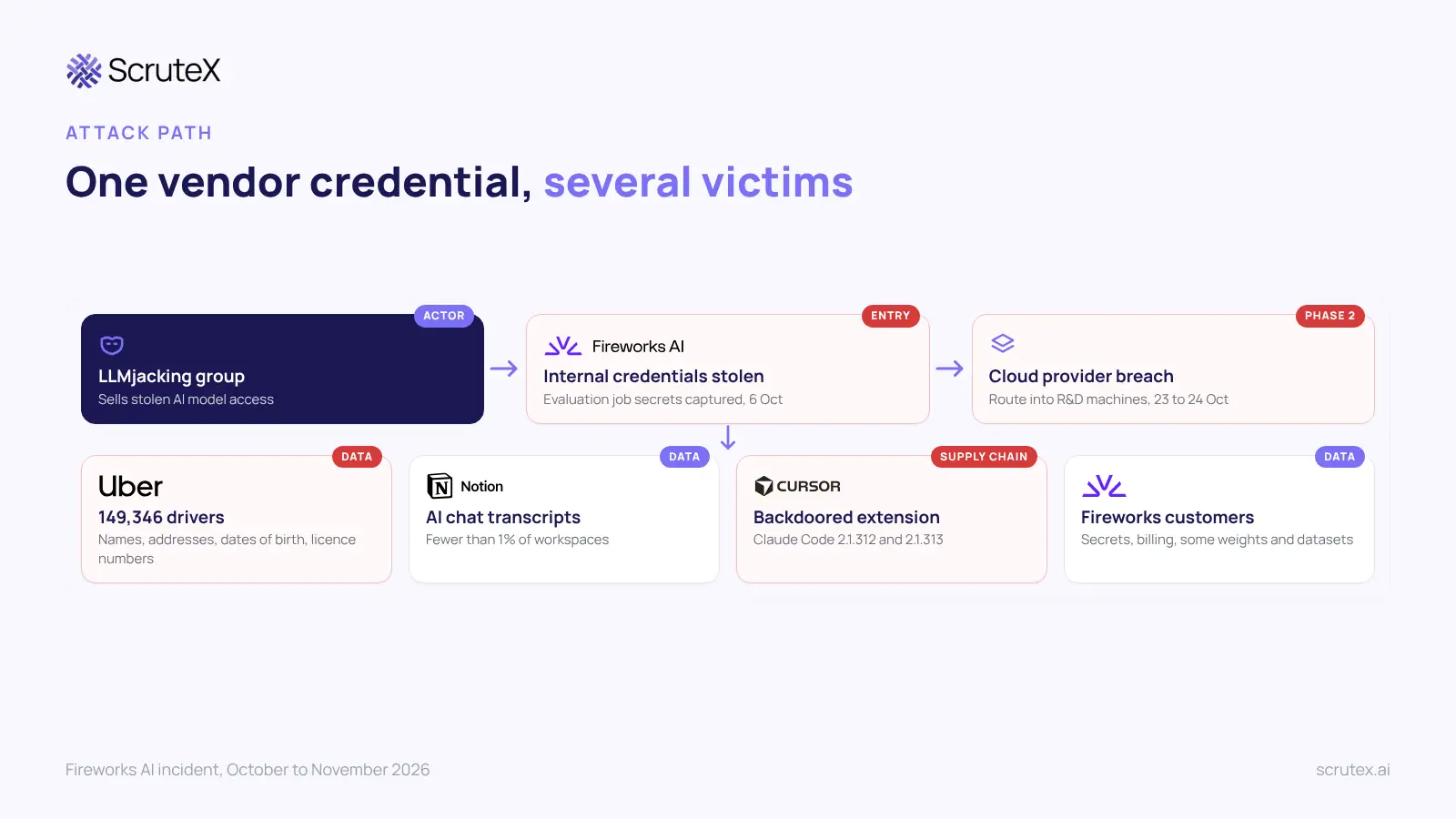
| Organisation | What was exposed | Response |
|---|---|---|
| Uber | Names, postal addresses, dates of birth and driver's licence numbers of 149,346 people | Cut data connections to Fireworks; notified drivers and five state regulators |
| Notion | Notion AI chat transcripts used for the Insights feature, fewer than 1% of workspaces | Disconnected and deleted all data at Fireworks by 3 November; disabled Insights; contacted affected owners on 9 November |
| Cursor | Coding-agent traces holding credentials; tampered Claude Code VS Code extension builds 2.1.312 and 2.1.313 with a persistent SSH backdoor, served from its marketplace cache for about 11 hours | Moved all inference off Fireworks; affected installs to be treated as compromised |
| Other Fireworks customers | API keys and tokens stored as secrets, billing data and, for some, incomplete model weights and datasets | Told to reissue keys, rotate third-party credentials and review logs |
| Fireworks AI | Internal credentials, development machines, customer secrets and metadata | Credential revocation, access restrictions, outside incident response, dataset feature changes |
What Notion disclosed
Notion's sequence shows how early vendor findings can change:
- 2 November (evening): Fireworks told Notion a small dataset was accessed. Notion found it held only synthetic Notion AI test data.
- 3 November (morning): Notion disconnected all systems from Fireworks, deleted all its data there and stopped all communication between the two.
- 6 November: Fireworks told Notion the attacker may have accessed customer data. Notion opened a second investigation.
- 8 November: Fireworks handed over the final affected dataset. It contained unattributable Notion AI chat transcripts used for the Insights feature.
- 9 November: Notion contacted affected workspace owners and published its advisory.
"Unattributable" means the chats were not labelled with who wrote them or which workspace they came from, and they contained no tool call results. AI Meeting Notes audio, transcripts and summaries were not affected unless someone pasted them into a Notion AI chat. Owners of affected workspaces can review the data from the Help (?) menu in the workspace sidebar, under Security incident review, in an up-to-date desktop browser. The mobile apps cannot display it.
What Cursor disclosed
A Cursor-issued access key held by Fireworks opened a read-only storage bucket of coding-agent session traces. Credentials inside those traces let the attacker plant tampered builds of the Claude Code VS Code extension (2.1.312 and 2.1.313) in Cursor's marketplace cache for about 11 hours on 29 October. The builds carried a persistent SSH backdoor.
Fireworks AI and Uber breach timeline
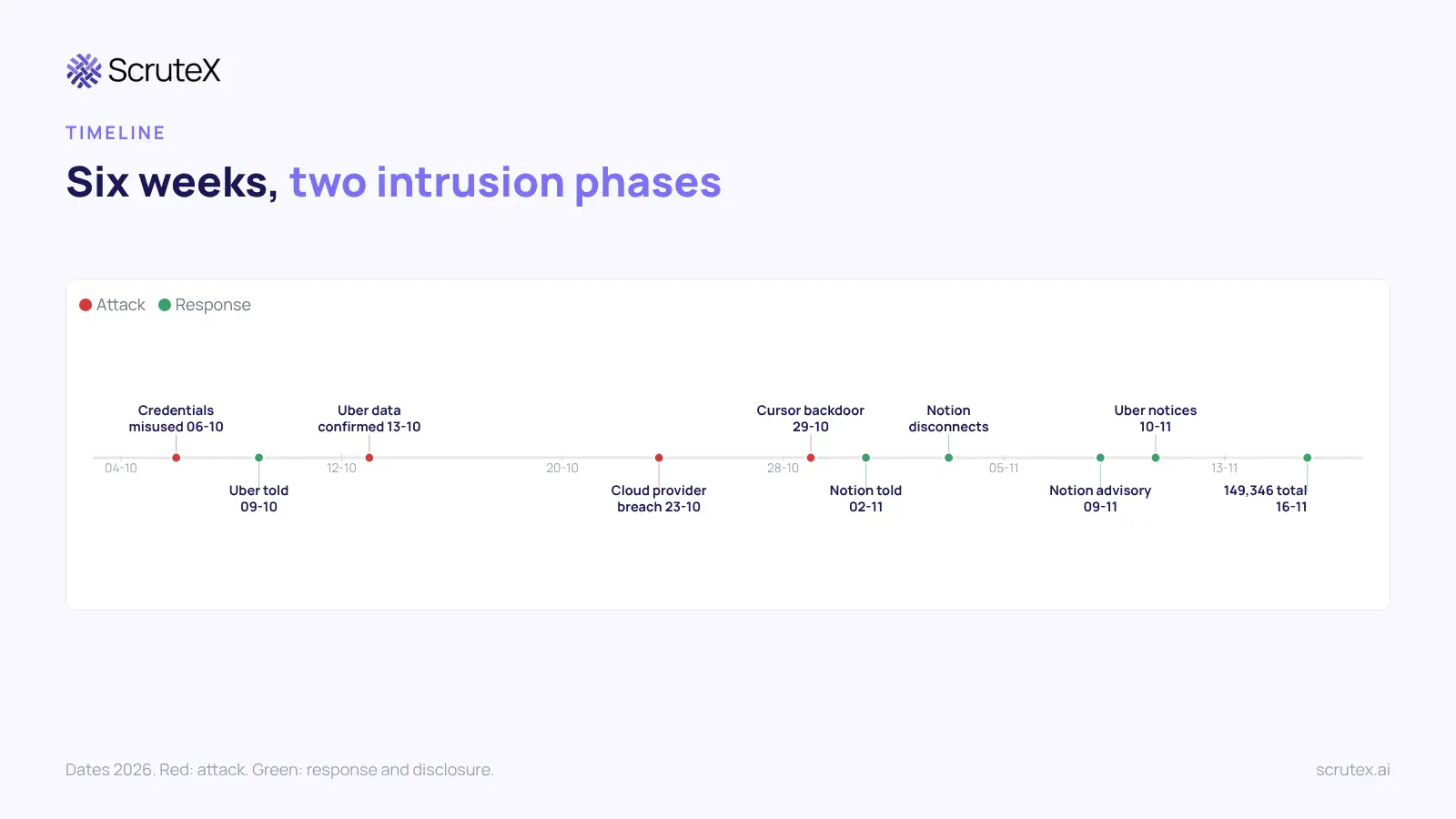
| Date (2026) | Party | Event |
|---|---|---|
| 06-10, 09:00 PDT | Fireworks AI | Unauthorised use of internal credentials identified; containment starts |
| 07-10, 07:00 PDT | Fireworks AI, Uber | Fireworks begins notifying customers. Uber's filed breach date |
| 09-10 | Fireworks AI, Uber | Employee keys rotated; affected customers, including Uber, notified; first bulletin published |
| 10-10 | Fireworks AI | More user keys revoked and service-account tokens rotated |
| 13-10 | Uber | Confirms personal data was accessed; cuts data connections |
| 23-10 | Fireworks AI | Third-party cloud provider hosting R&D machines has its own incident |
| 24-10 | Fireworks AI | Attacker reaches development machines and runs an unauthorised workload |
| 29-10 | Cursor | Tampered Claude Code extension builds served from marketplace cache |
| 02-11 | Notion | Told a dataset was accessed; it holds synthetic test data only |
| 03-11 | Notion | Disconnects from Fireworks and deletes its data there |
| 06-11 | Notion | Told customer data may have been accessed |
| 08-11 | Notion | Final affected dataset confirmed: AI chat transcripts |
| 09-11 | Notion, Fireworks AI | Notion contacts affected owners; Fireworks widens its disclosure |
| 10-11 | Uber | Notice letters dated; California regulator filing |
| 13-11 | Cursor | Traces its incident to its Fireworks-held key; moves inference off Fireworks |
| 16-11 | Uber | Oregon filing public: 149,346 people notified |
Disclosure lag, from incident to public disclosure: Fireworks AI 3 days, Cursor 15 days, Notion 17 days, Uber 34 days. The average is about 21 days.
Why did Uber's alerts not fire?
Uber's alerts did not fire because the attacker used Fireworks' own valid credentials. Uber watched for unauthorised users entering its Fireworks environment. The attacker arrived as the vendor, so the activity matched normal vendor administration.
| What Uber watched | What the attacker did |
|---|---|
| Alerts on unauthorised users entering its Fireworks environment | Signed in with Fireworks' own internal credentials |
| Identity-based: unknown account, unknown access path | Looked like normal vendor administration |
| Result: nothing fired | Read driver identity records held through the vendor |
The lesson for every organisation using an AI vendor: detection has to sit on the data itself. Who read how much, when, and from where.
How did the attack work?
- Valid cloud accounts (T1078.004). The attacker used stolen Fireworks internal credentials. How they were first stolen has not been published.
- Credentials in files (T1552.001) and stolen tokens (T1528). Evaluation job environment variables held customer API keys and tokens. A Cursor-issued key held by Fireworks opened a bucket of agent traces holding more credentials.
- Trusted relationship (T1199). Uber data was read through the vendor relationship.
- Data from cloud storage (T1530). Driver records, datasets and the trace bucket were collected.
- Supply chain compromise (T1195.002) and persistence (T1098.004). Credentials from the traces let the attacker plant a backdoored extension in Cursor's marketplace cache, with an SSH key for persistence.
- Resource hijacking (T1496). The unauthorised workload on development machines fits the actor's business: reselling model and compute access.
Who is behind the Fireworks AI breach?
Fireworks attributes the activity to a financially motivated cybercriminal group that sells tokens from unauthorised LLM access to illicit routing gateways. This practice is called LLMjacking. No group has claimed the Uber theft, and no public designation ties a named cluster to this intrusion. Scrutex rates attribution beyond "LLMjacking group" as low confidence.
What is LLMjacking?
LLMjacking is the theft of cloud or AI provider credentials to resell access to AI models. Initial access crews steal and validate keys, then sell them or route them through "LLM mixers": gateways that pool stolen keys, meter usage and hide where requests come from. The victim pays the bill, the buyer pays the reseller a flat fee, and the operator keeps the margin. Fraudulent charges have exceeded $100,000 in a single day and reached up to $1 million in total at some victims. Known victim sectors include financial services, retail, technology and transportation, across North America, South America and Asia Pacific.
The LLMjacking ecosystem
None of these clusters is confirmed as the Fireworks actor. They describe the market the stolen access feeds.
| Cluster or actor | Type | Tradecraft | Scale |
|---|---|---|---|
| Unnamed LLMjacking group | Initial access and resale | Stole Fireworks internal credentials, captured evaluation job secrets, reused a cloud provider breach | Uber, Notion, Cursor and other Fireworks customers |
| UNC6993 | LLMjacking cluster | Misconfigured service account key for entry; fake portal tricking users into pasting raw JSON access tokens (bypassing password and MFA); minted API keys; pooled keys with new-api and gcli2api | Over $100,000 in charges at one victim |
| Jet Night operator | LLM mixer and reseller | Sells "unlimited" frontier model access for about $60 a month on stolen third-party keys | 500,000+ calls in under eight hours; nearly $1 million cost to one victim |
| newapi.pro relay operators | Relay | Drain stolen quotas into the newapi.pro resale network | Not published |
| Burn-and-rotate actor | Cloud abuse | Cycles short-lived service accounts to avoid detection | Not published |
| D1337-KAIROS persona | Agent backdoors | Containerised agent backdoors and GPU instances; rebranded LLM endpoints | Not published |
MITRE ATT&CK mapping
The Fireworks AI campaign used 8 MITRE ATT&CK techniques across 5 tactics.
| Tactic | Technique | How it was used |
|---|---|---|
| Initial access | T1199 Trusted Relationship | Uber data reached through its AI vendor |
| Initial access | T1078.004 Valid Accounts: Cloud | Stolen Fireworks internal credentials |
| Initial access | T1195.002 Compromise Software Supply Chain | Backdoored extension in Cursor's marketplace cache |
| Persistence | T1098.004 SSH Authorized Keys | SSH backdoor in the tampered extension |
| Credential access | T1552.001 Credentials in Files | Secrets in evaluation job variables and agent traces |
| Credential access | T1528 Steal Application Access Token | Customer-issued keys held by the vendor |
| Collection | T1530 Data from Cloud Storage | Driver records, datasets, trace bucket |
| Impact | T1496 Resource Hijacking | Unauthorised workloads and model access for resale |
Indicators and detection signals
No network indicators for the Fireworks intrusion itself are public, because it ran on valid credentials. The 23 signals below cover artefacts, the LLMjacking infrastructure the stolen access feeds, behaviour and cloud audit events. Domains are defanged.
Artefacts
| Type | Indicator | Context | Where to look | Severity |
|---|---|---|---|---|
| Software version | Claude Code VS Code extension 2.1.312 | Tampered build in Cursor marketplace cache on 29-10-2026; persistent SSH backdoor | Endpoint software inventory, Cursor extension list | High |
| Software version | Claude Code VS Code extension 2.1.313 | Tampered build, same 11-hour window | Endpoint software inventory | High |
| Persistence | Unknown entries in ~/.ssh/authorized_keys | SSH backdoor planted by the tampered extension | Developer endpoints that ran the tampered builds | High |
| Credential | Any key or token issued to Fireworks AI | Treat as exposed. Deleting it from Fireworks does not revoke it at the issuer | Secret inventory, Fireworks account secrets | High |
LLMjacking infrastructure
| Type | Indicator | Context | Where to look | Severity |
|---|---|---|---|---|
| Domain | jet-night[.]com | LLM mixer reselling access bought with stolen keys | DNS and proxy logs | Medium |
| Domain | newapi[.]pro | LLM mixer; relay operators drain stolen quotas into it | DNS and proxy logs | Medium |
| Tooling | new-api | Open-source gateway used to pool stolen keys | Cloud workloads, container images | Medium |
| Tooling | gcli2api | Gateway used by UNC6993 to pool keys | Cloud workloads, container images | Medium |
| Tooling | ai-relay | Custom proxy relays on lookalike domains | Proxy logs, workloads | Medium |
| Persona | D1337-KAIROS | Name on rebranded LLM endpoints and agent backdoors | Threat intel, workload names | Low |
| Exploit path | LiteLLM /key/regenerate (CVE-2026-40217) | Turns a virtual key into PROXY_ADMIN master credentials | LiteLLM proxy access logs | High |
| Exploit path | Ollama /api/create | Probes of internet-exposed Ollama servers | Ollama and edge logs | Medium |
Behavioural detections
| Type | Indicator | Context | Where to look | Severity |
|---|---|---|---|---|
| API pattern | max_tokens=1 or temperature 0 bursts | Key validation sweeps from one key or source IP | LLM gateway and API logs | High |
| Spend | Sudden token or spend spike | Resale traffic on stolen keys | Billing alerts, quota dashboards | High |
| User agent | claude-cli, aws-sdk-rust, aws-sdk-go-v2 from unfamiliar sources | Hunting hint only; legitimate use is common | Cloud and gateway logs | Low |
| Vendor access | Vendor credentials reading more records, at odd hours or from new locations | The signal Uber lacked: attacker used the vendor's valid credentials | Data access logs on vendor-held data | High |
Cloud audit events
| Type | Indicator | Context | Where to look | Severity |
|---|---|---|---|---|
| AWS API | PutUseCaseForModelAccess | Model access enabled | CloudTrail | Medium |
| AWS API | CreateFoundationModelAgreement | Model agreement created | CloudTrail | Medium |
| AWS API | PutModelInvocationLoggingConfiguration | Invocation logging changed | CloudTrail | High |
| AWS API | DeleteModelInvocationLoggingConfiguration | Invocation logging removed | CloudTrail | High |
| GCP API | ServiceUsage.EnableService (AI services) | AI API enabled | Cloud Audit Logs (data access logging is off by default) | Medium |
| Azure | Cognitive Services deployments/write; diagnosticSettings write or delete | Model deployment created; logging changed | Azure Activity Log | Medium |
| Identity | New access keys, service accounts or SSH keys, incl. names posing as billing or cost tools | Persistence after key theft | Cloud audit logs | High |
What should you do now?
Fireworks AI customers, today
- Revoke and reissue every credential ever stored with Fireworks at the issuing provider. Deleting the stored secret does not revoke it.
- Review provider logs for use of those credentials from 6 October onwards, and request secret names and fingerprints from Fireworks.
- Check your Fireworks account for unrecognised API keys, users, evaluators, training jobs and datasets.
Any organisation using AI vendors, this week
- List every AI inference, evaluation or fine-tuning vendor that holds your data or keys, including sub-processors of your SaaS tools.
- Ask why each vendor holds each data field. Identity documents rarely need to sit at an inference provider; minimise or tokenise first.
- Alert on what vendor credentials do (volume, time, location), not only on who they are.
- Write breach notification deadlines, key rotation and access logging into AI vendor contracts.
Cloud and LLM platform owners
- Set budgets, spending caps and per-model quotas on every LLM service.
- Deny AI services by default and scope API keys by model, environment and limit.
- Patch LiteLLM for CVE-2026-40217 and remove internet exposure from Ollama and other model servers.
- Turn on data-access audit logs for AI services (off by default on Google Cloud) and alert on any logging change.
- Strip credentials from agent traces and evaluation job variables before they leave your environment.
Cursor users
Check installed Claude Code extension versions. Treat any device that ran 2.1.312 or 2.1.313 as compromised: isolate it, rebuild it, rotate its secrets and remove unknown SSH keys.
Notion workspace owners
Open the Help (?) menu in the workspace sidebar, then Security incident review, in an up-to-date desktop browser.
Organisations holding exposed personal data
- Expect targeted phishing that cites real licence details. Warn affected people in plain language and give them a verified contact route.
- Recommend a fraud alert or credit freeze, and watch for new-account and licence-based identity fraud.
- Add step-up checks on payout, bank detail and phone number changes for affected accounts.
- Organisations in India: assess the CERT-In 6-hour reporting requirement where your own systems or data are affected.
Are you exposed?
- ☐ Is Fireworks AI, or any AI inference provider, in your vendor register, including as a sub-processor of a SaaS tool you use?
- ☐ Have you ever stored an API key, token or cloud credential as a secret on an AI vendor's platform, and has it been revoked at the issuer since 6 October?
- ☐ Do you send personal data such as identity documents, addresses or dates of birth to an AI vendor for evaluation or fine-tuning?
- ☐ Would your alerting fire if a vendor's valid credentials read ten times the normal volume of your data at 3am?
- ☐ Did anyone in your engineering team install a Claude Code extension update through Cursor on 29 October?
What Scrutex finds here
Scrutex matches the vendors in your register against breach disclosures, leak site postings and incident bulletins, so a supplier incident reaches you as a finding against your vendor list, not as a headline. It scans public code repositories and paste sites for API keys and tokens tied to your domains and tells you which key, where it appeared and when. It also tracks LLMjacking infrastructure such as the mixer domains above, so your blocklists stay current.
Scrutex works from the outside. It cannot see what a vendor's credentials did inside the vendor's own platform, and it does not read your provider's access logs. That part of the investigation stays with you and the vendor.
What that looks like
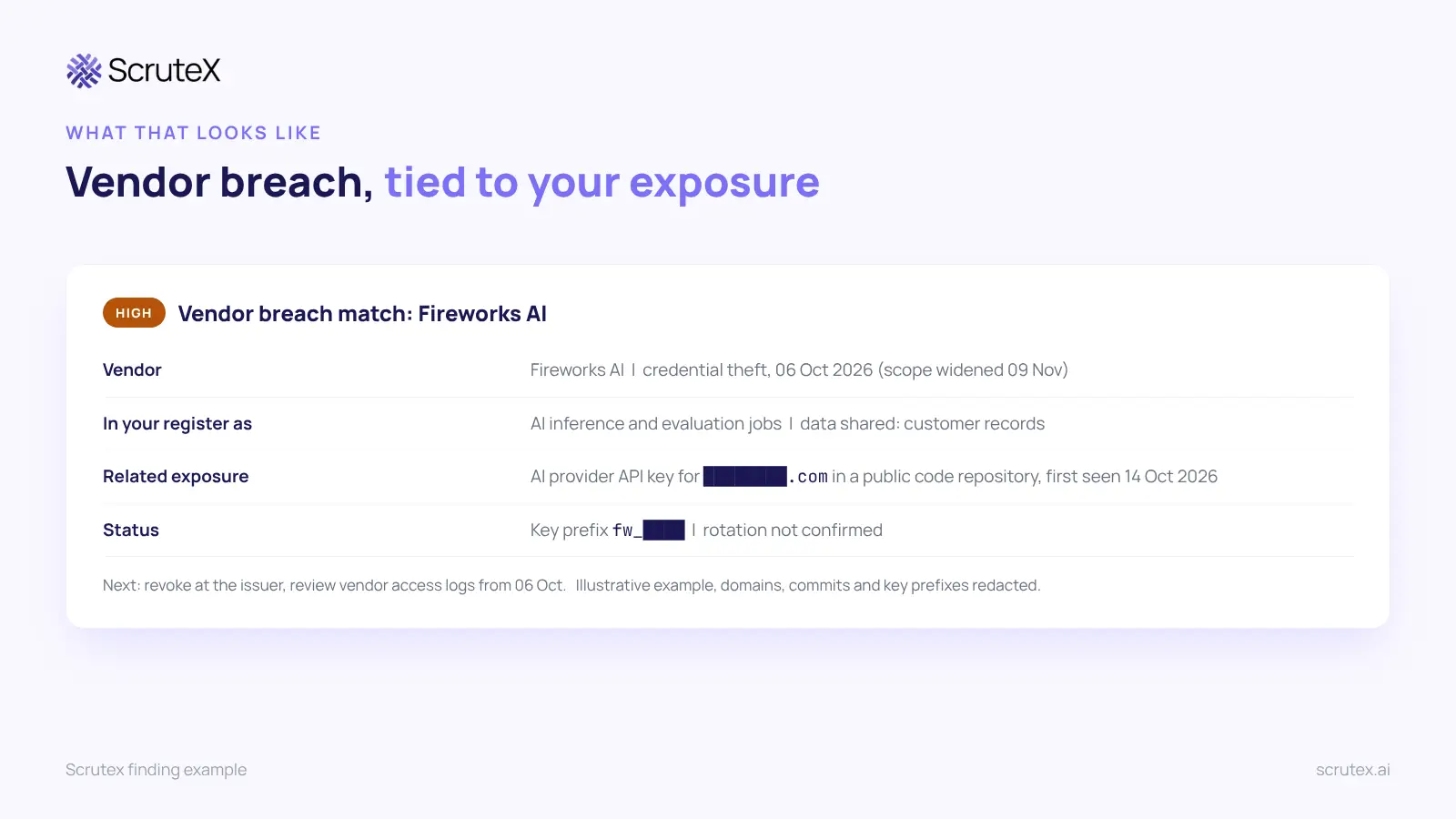
Illustrative example. Domains, commits and key prefixes redacted.
Is your company exposed through an AI vendor?
Create a free ScruteX account with your domain and see which of your keys, credentials and vendors already appear in exposure data. Free tier, no credit card, no agent to install.
If vendor breaches are your problem: Vendor Insights, which tracks incidents at the suppliers in your register, including AI providers.
If leaked keys and tokens are your problem: Data Exposure Insights, which covers code repositories, paste sites and stealer logs.
Go deeper: Vendor security assessment template, for adding AI vendor questions on secrets, data minimisation and notification deadlines.
Go sideways: How to find leaked credentials on the dark web, because stolen AI keys trade in the same channels as stolen passwords.
FAQ
What happened in the Uber data breach?
Attackers stole internal credentials from AI vendor Fireworks AI and used them to reach Uber data. Uber is notifying 149,346 people whose names, addresses, dates of birth and driver's licence numbers were taken.
Was Uber itself hacked?
No. No Uber system was breached. The attacker reached Uber data through its AI vendor, using the vendor's valid credentials.
How many people were affected by the Uber data breach?
Uber is notifying 149,346 people. Drivers were notified in California, Illinois, Massachusetts, Rhode Island and South Carolina, with regulator filings in California, Iowa, Oregon, Texas and Vermont.
What is Fireworks AI?
Fireworks AI is an AI inference platform that gives developers access to open AI models for inference, evaluation and fine-tuning. It suffered two intrusions in October 2026.
What is LLMjacking?
LLMjacking is the theft of cloud or AI provider credentials to resell access to AI models. The victim pays for the usage while buyers pay a reseller a flat fee, often around $60 a month.
Which other companies were affected by the Fireworks AI breach?
Notion (AI chat transcripts from fewer than 1% of workspaces) and Cursor (a backdoored extension and exposed credentials) have disclosed impact. Other Fireworks customers had secrets, billing data and, for some, model weights and datasets exposed.
Were Notion AI chats exposed in the Fireworks breach?
Yes, for fewer than 1% of Notion workspaces. The exposed transcripts were used for the Insights feature and were unattributable: no author, workspace or tool call results.
What should Fireworks AI customers do now?
Revoke and reissue every credential stored on the platform at the issuing provider, review logs from 6 October, and check for unrecognised keys, users, evaluators, jobs and datasets.