The DRP Buyer's Guide for Security Leaders
By ScruteXPublished Updated
Most DRP evaluations fail in the same place. The demo is impressive, the alert volume is high, and nobody asks the question that decides whether the tool earns its licence: what happens between the alert firing and the malicious domain coming down. Detection is cheap now. Validation, enforcement, and evidence are not.
Digital risk protection (DRP) services monitor the internet outside your perimeter for threats aimed at your organisation, then drive those threats to removal. They watch domains, social platforms, app stores, code repositories, paste sites, messaging channels, and criminal marketplaces for impersonation, phishing infrastructure, leaked credentials, exposed data, and brand abuse targeting your customers and staff. When you buy, weight the decision on eight categories: coverage breadth and source transparency (20%), detection quality and validation (20%), remediation and takedown (20%), workflow and integration (15%), context and prioritisation (10%), reporting and evidence (8%), deployment and time to value (4%), and commercial fit and total cost (3%).
What are digital risk protection services?
Digital risk protection (DRP) is the continuous monitoring of external, internet-facing channels for threats that target an organisation's brand, people, customers, and data, combined with the workflow to remove or contain those threats.
The word that decides the category boundary is external. DRP operates outside the area your firewall, EDR, and identity provider defend. The assets it watches are usually ones you do not own: a domain someone else registered, a social profile someone else created, a credential dump someone else is selling, a fake app someone else published. That single fact explains most of what follows, including why takedown matters more than detection and why your existing stack cannot cover the gap by configuration alone.
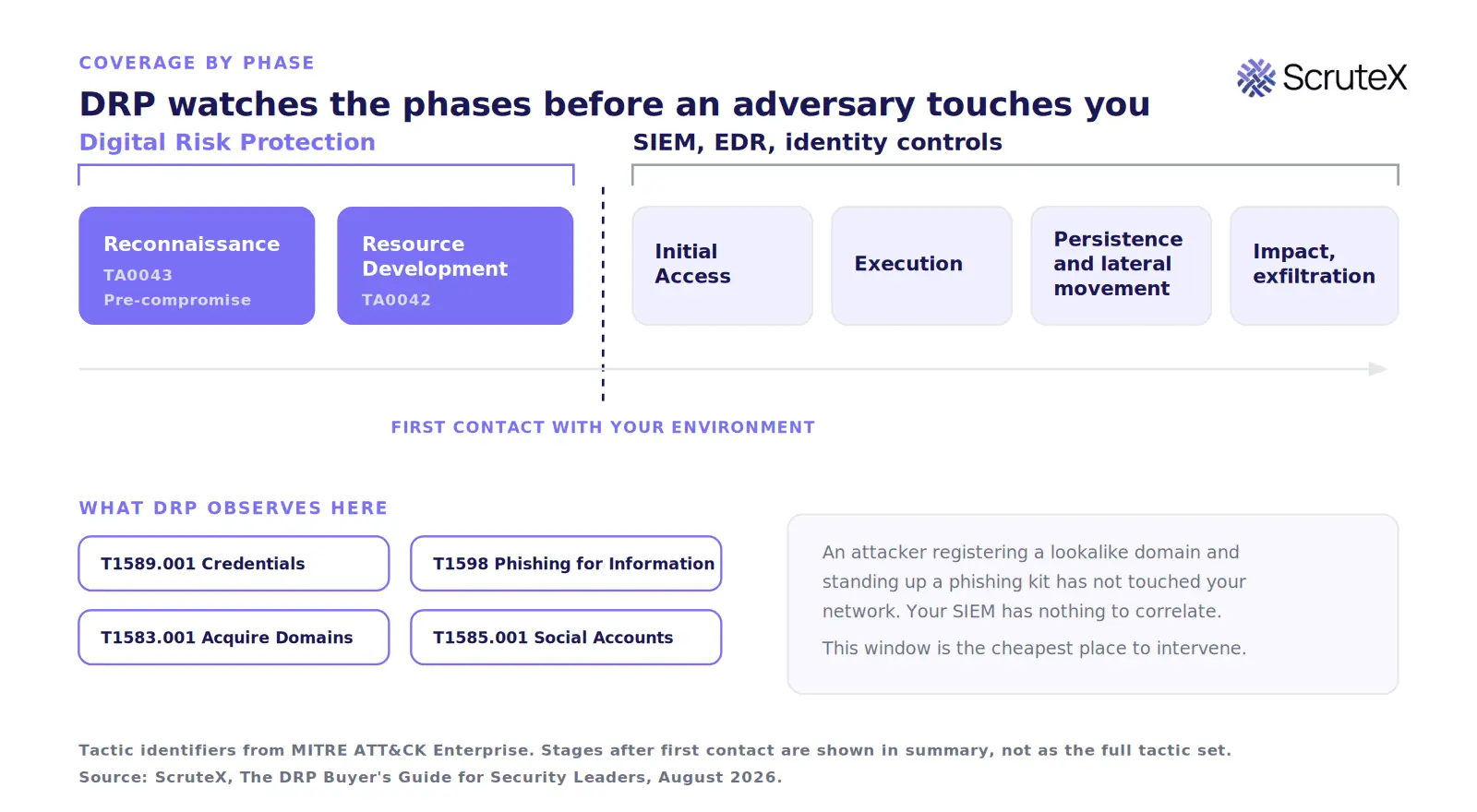
MITRE ATT&CK gives a precise way to place it. DRP is not an ATT&CK control and the framework does not map cleanly onto the whole category, but it does describe the activity DRP observes. The relevant tactics sit at the front of the chain:
- Reconnaissance (TA0043), including Gather Victim Identity Information: Credentials (T1589.001) and Phishing for Information (T1598).
- Resource Development (TA0042), including Acquire Infrastructure: Domains (T1583.001) and Establish Accounts: Social Media Accounts (T1585.001).
An attacker registering a lookalike domain and standing up a phishing kit has not touched your network. Most controls in a standard stack have limited visibility into this phase, because the activity happens on infrastructure you do not control and generates no telemetry you collect. Your SIEM has little to correlate. DRP provides visibility into that window, and the window is the cheapest place to intervene.
Why security leaders buy DRP now
Three gaps drive most purchases, and each one is specific enough to test during a pilot.
Credential exposure moves faster than password rotation. Infostealer malware on an unmanaged or personal device harvests browser-stored credentials and live session cookies. Those logs are then traded on Telegram channels and criminal marketplaces, sometimes within days of infection, though the interval varies by operator and by market. The technique itself is documented: MITRE ATT&CK covers Steal Web Session Cookie (T1539) and Use Alternate Authentication Material: Web Session Cookie (T1550.004). A stolen session cookie replays a session that is already authenticated, which is why MFA on the account does not close that path by itself. Session invalidation and a conditional access review do. Neither happens if nobody sees the log entry.
Impersonation targets your customers, not your network. A lookalike domain with a valid TLS certificate and a cloned login page harms people who trust your brand. Most conventional internal controls will not detect it, and none of them can directly remove infrastructure they do not control. Your incident response plan has no play for this unless someone outside the perimeter is watching.
Regulators now assume you have external visibility. Reporting clocks are triggered by different events, including awareness, classification, and a materiality determination, so delayed visibility can create both security and compliance exposure. The wording matters, so here it is as each regime states it.
CERT-In's 2022 Directions require service providers, intermediaries, data centres, body corporates, and government organisations in India to report specified cyber security incidents within six hours of noticing them, or of being brought notice of them. APRA CPS 234 paragraph 35 requires an APRA-regulated entity to notify APRA as soon as possible and, in any case, no later than 72 hours after becoming aware of an information security incident that materially affected, or had the potential to materially affect, the entity or its customers, or that has been notified to another regulator. NIS2 Article 23 requires an early warning without undue delay and in any event within 24 hours of becoming aware of a significant incident, an incident notification within 72 hours, and a final report within one month of that notification. Under DORA, Article 5 of the incident reporting RTS (Delegated Regulation (EU) 2025/301) requires the initial notification as early as possible, and in any case within four hours of classifying an ICT-related incident as major and no later than 24 hours from becoming aware of it, with an intermediate report within 72 hours and a final report within one month.
The SEC is the outlier. Form 8-K Item 1.05 is generally due four business days after a registrant determines that a cybersecurity incident is material, so the clock starts at the determination rather than at discovery. That reads as more forgiving than it is, because the materiality determination itself must be made without unreasonable delay. Sources are listed at the end of this guide.
There is a fourth reason that rarely reaches the business case, and it should. When a DRP programme works, the person who benefits most is not in your building. It is the customer who never lands on the cloned banking portal, the employee whose reused password gets invalidated before an access broker sells it, and the public that keeps trusting the brand. State that in the board paper. It is the honest justification for the spend.
What does DRP detect?
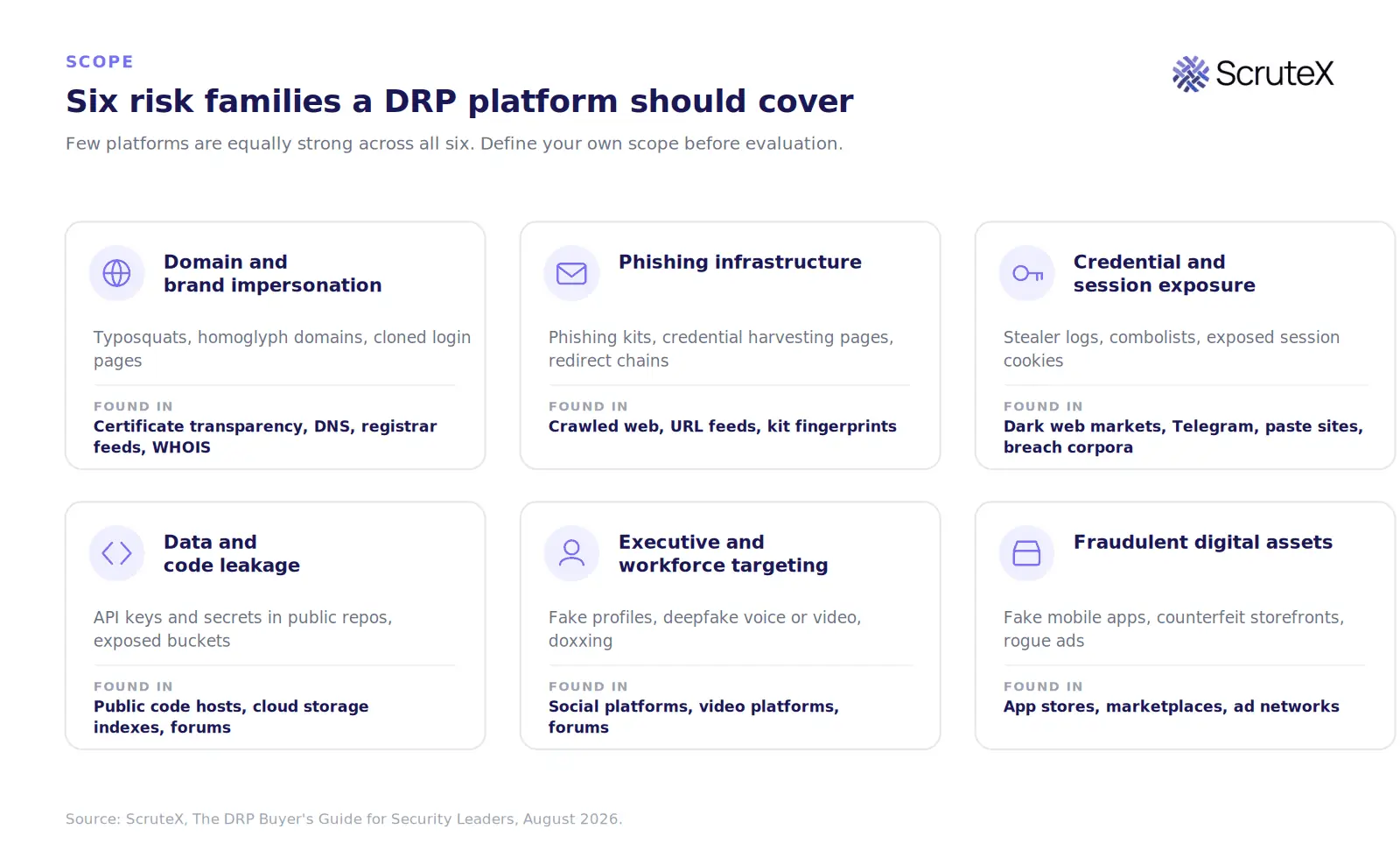
Six recurring risk families. Define your own scope against this table before you talk to vendors, because few platforms are equally strong across all six and the weak ones will not volunteer where they are thin.
| Risk family | Examples | Where found | Typical response |
|---|---|---|---|
| Domain and brand impersonation | Typosquats, homoglyph domains, cloned login pages, fraudulent MX records | Certificate transparency logs, DNS zone data, registrar feeds, WHOIS | Registrar or host takedown, UDRP, blocklist submission |
| Phishing infrastructure | Phishing kits, credential harvesting pages, redirect chains aimed at your customers | Crawled web, URL feeds, kit fingerprints | Host takedown, browser blocklisting, customer warning |
| Credential and session exposure | Stealer logs, combolists, exposed session cookies, corporate email in breach corpora | Criminal marketplaces, Telegram, paste sites, breach corpora | Password reset, session invalidation, conditional access review |
| Data and code leakage | API keys and secrets in public repositories, exposed buckets, internal documents posted publicly | Public code hosts, cloud storage indexes, paste sites, forums | Secret rotation, repo removal, legal notice |
| Executive and workforce targeting | Fake executive profiles, deepfake voice or video, social impersonation, doxxing | Social platforms, video platforms, forums | Platform reporting, executive protection escalation |
| Fraudulent digital assets | Fake mobile apps, counterfeit storefronts, rogue ads and paid search impersonation | App stores, marketplaces, ad networks | Store removal, marketplace enforcement, ad network complaint |
One planning note that catches buyers out. A fake customer care number placed in a paid ad or a marketplace listing sits in that last row and gets missed often, because it is neither a domain nor a credential and it does not fit the standard detection pipelines. If your organisation runs a support line, test for it by name during the pilot.
DRP vs EASM, CTI, and brand protection
The most common evaluation error is buying DRP to solve a problem another tool already owns, or assuming a tool you already own covers DRP.
| Category | Question it answers | Where it looks | Where it stops |
|---|---|---|---|
| Digital risk protection | Who is abusing our brand, people, and data outside our perimeter? | Open web, social, app stores, criminal marketplaces, messaging channels | Does not assess or patch your own infrastructure |
| External attack surface management (EASM) | What internet-facing assets do we own, and how exposed are they? | Your own domains, IPs, certificates, cloud services | Does not watch third-party channels or impersonation |
| Vulnerability management | Which known flaws exist on assets we control? | Internal and external asset scans, CVE matching | Blind to leaked credentials and brand abuse |
| Cyber threat intelligence (CTI) | Who is attacking organisations like ours, and how? | Actor tracking, campaign analysis, IOC feeds | Usually not organisation-specific, rarely includes takedown |
| Security monitoring (SIEM/SOC) | What is happening inside our environment right now? | Logs, telemetry, alerts from internal controls | Little visibility before the adversary touches you |
| Brand protection | Is our trademark and commercial identity being misused? | Marketplaces, ads, counterfeits, social | Often marketing-owned, weaker on credentials and criminal marketplaces |
Three distinctions worth stating plainly.
DRP and EASM are complements. EASM identifies and assesses the internet-facing assets an organisation owns. DRP identifies threats targeting that organisation from infrastructure it does not own. Put another way: EASM answers "what do we expose", DRP answers "what is being done to us". Several platforms now ship both, and there is a real efficiency argument for that, because a leaked credential means something different when you can see which of your exposed services it opens. Our EASM best practices guide covers the asset-inventory half of that pairing.
DRP is not CTI, though it consumes CTI. CTI explains adversaries, campaigns, and indicators across a sector or region. DRP identifies specific external threats aimed at one organisation and drives them to remediation. Generic actor reporting tells you a group targets financial services in your region. DRP tells you a domain impersonating your bank went live four hours ago. Prioritisation is where the two meet, and we go deeper on the boundary in DRP vs threat intelligence.
DRP supports incident response, it does not replace it. DRP gives IR earlier notice, external evidence, and a containment path internal tools cannot reach. Map DRP alert types to your existing playbooks during evaluation, not after.
Now the fair view of the alternatives, because a buyer's guide that only argues for consolidation is a sales document. Best-of-breed point tools genuinely outperform on depth. A dedicated anti-phishing service with its own registrar relationships will usually beat a generalist on takedown speed for phishing specifically. If you run a large, mature team with analysts who can correlate across products, that stack is defensible and often better. Consolidated platforms win when the team is small, when correlation across exposure types matters more than depth in any one, and when nobody has time to reconcile five consoles. Decide which of those describes you before you shortlist, because it changes the shortlist.
The DRP vendor scorecard
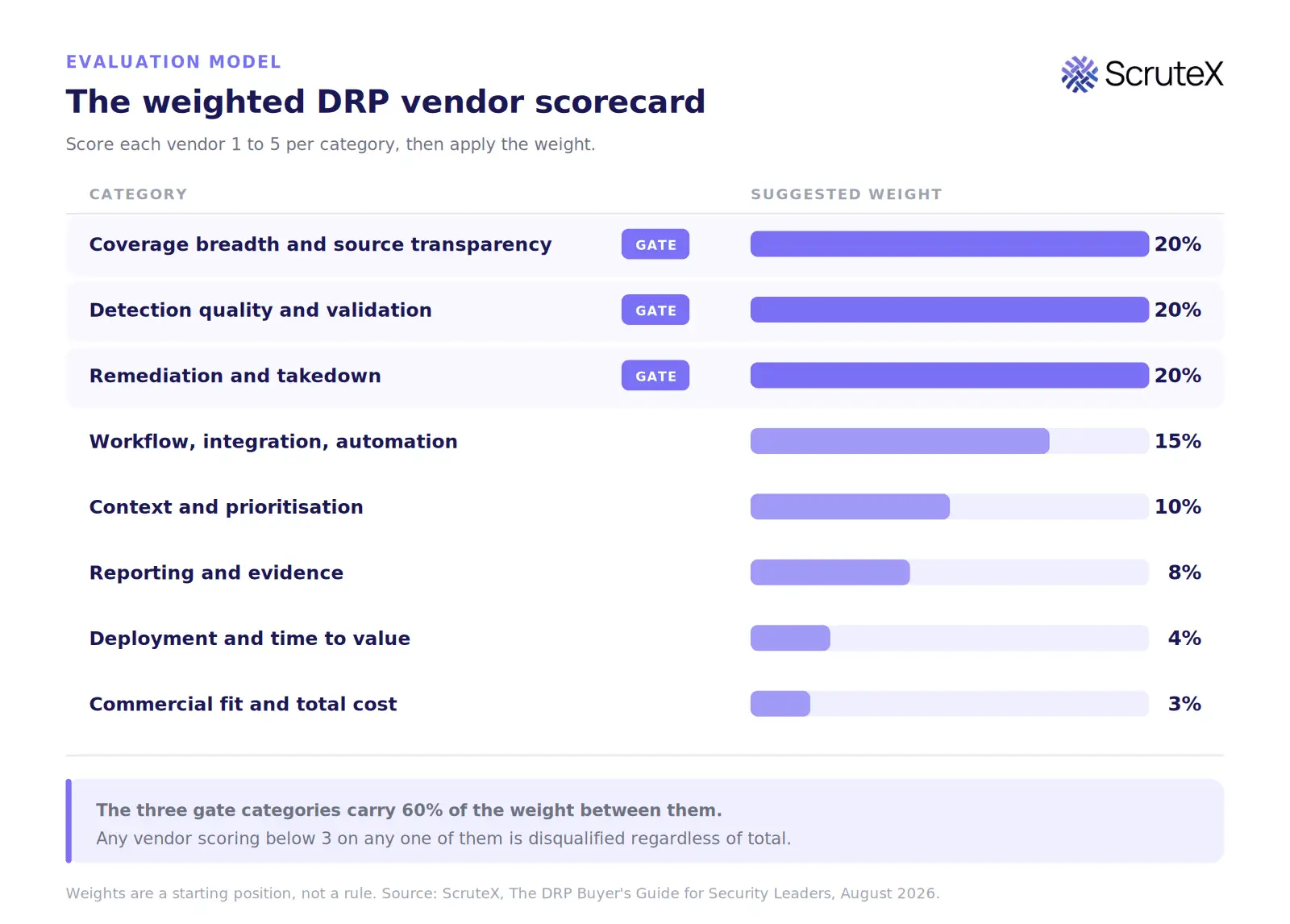
Evaluate digital risk protection services primarily on three things: coverage, detection and validation, and remediation. Together they should carry the majority of the weight, because they decide whether a threat is seen, confirmed, and removed. Everything else decides how much effort that costs you.
One framework, used twice: as the evaluation agenda during demos, and as the scoring sheet afterwards. Score each category 1 to 5, multiply by the weight, and total. Score independently per evaluator, then compare, because the disagreements are where the real risk sits.
| Category | Weight | What a 5 looks like | Question that exposes a 2 |
|---|---|---|---|
| Coverage breadth and source transparency | 20% | Names specific source categories and refresh intervals, separates owned collection from licensed, covers your regions and languages, states what it does not cover | "List the source categories you collect from and how often each refreshes." |
| Detection quality and validation | 20% | Documented validation step between detection and alert, pilot-measured precision above your threshold, campaign clustering that collapses duplicates, thresholds you control | "Show me the validation step between detection and alert." |
| Remediation and takedown | 20% | Vendor-executed takedowns, median and 90th percentile times published per threat type, success rate disclosed, defined escalation when a host refuses, exportable evidence pack | "Give median and 90th percentile takedown times for phishing domains and fake apps separately." |
| Workflow, integration, automation | 15% | Two-way ticketing sync, public API and webhook documentation, identity action triggers, automation rules you can write without professional services | "Is ticketing two-way, and does closure status sync back?" |
| Context and prioritisation | 10% | Findings mapped to your assets and brands, actor or campaign linkage, exploitability reasoning attached to severity | "Why is this alert critical? Walk me through the reasoning." |
| Reporting and evidence | 8% | Board-ready summary and analyst-grade evidence from the same data, SLA and trend reporting, one-click export | "Show a board report and a technical report from the same month." |
| Deployment and time to value | 4% | First validated findings within days, no agents, inputs limited to domains, brands, and keywords | "How long from contract to first validated finding?" |
| Commercial fit and total cost | 3% | Transparent pricing dimensions, stated overage rates, capped renewal uplift, pilot on production assets | "Model total year-one cost at our volumes, including overages." |
Two rules for reading the result. Anything below 3 on coverage, detection, or remediation disqualifies the vendor regardless of the total, because those three carry 60% of the weight and the rest cannot compensate. And adjust the weights to your situation before you start scoring, not after you see the numbers: a regulated bank facing constant phishing should push remediation to 25%, while a software company worried about leaked secrets should push coverage and detection higher and take points off takedown.
Three criteria deserve expansion, because they are where evaluations go wrong.
Validation is the step buyers skip and then complain about. A parked lookalike domain is not the same finding as one serving a live credential harvesting page. Any platform that scores them identically will bury your analysts inside a month. Ask who performs validation, whether it is automated or analyst-led, and what the queue looks like on a bad day.
Evidence decides whether takedowns succeed. Registrars, hosts, and app stores act on defensible proof: screenshots, WHOIS records, hosting details, timestamps, and a chain of custody your legal team can stand behind. Ask for a real exported evidence pack, not a screenshot of the export button.
Context is either reasoning or decoration. A finding should arrive with which asset or brand it targets, whether the infrastructure is live, whether the same kit or actor is active against your sector, and what the exposure enables. Severity without reasoning is a number your team learns to ignore.
How to run a 30-day DRP pilot: the 4-test method
Vendor-supplied accuracy numbers are not evidence. Design the pilot to produce your own, and write the pass or fail criteria before it starts. Four tests do most of the work.
Back-test. Give the vendor a date range covering an impersonation or credential incident you already handled. Ask what they would have found and when. Compare against your own timeline. This is the single most revealing test available to you, and it costs nothing.
Blind test. Register a benign lookalike domain of your own under a name the vendor does not know, stand up a plain page, and see whether it reaches the queue and how fast.
Count what you rejected. Track every alert your team dismissed, with a reason code. That number is your real precision figure and it will differ from the marketing number.
Measure duplicates separately. One campaign spawning forty alerts is a workflow failure, not detection strength.
A workable shape for the month, with the four tests spread across it. Week 1 is baseline and scoping: record time to first validated finding, how complete the asset and brand mapping came out, and the size of the historical backlog. Week 2 is detection: run the back-test and the blind test, and log duplicate rate and rejection rate with reason codes. Week 3 is remediation: record every takedown filed, who filed it, median and 90th percentile time by threat type, and what happened when one failed. Week 4 is scoring: each evaluator completes the scorecard independently, then you measure analyst hours and model total year-one cost.
Ten questions to ask every DRP vendor
Ask them verbatim. The hesitation tells you as much as the answer.
- Name the source categories you collect from, and the refresh interval for each. Which are your own collection and which are licensed?
- How do you collect from closed forums and invite-only channels, and how do you handle the legal exposure of that?
- What do you not cover that a buyer might reasonably expect you to?
- What is your median time from a phishing domain resolving to our alert firing?
- How do you distinguish a parked lookalike domain from an active credential harvesting page?
- What percentage of alerts in a typical customer account are closed as not actionable, and how do you cluster a campaign so we get one case rather than forty alerts?
- Who files the takedown, your team or ours? Give median and 90th percentile times split by phishing domain, fake app, and social impersonation.
- What is your takedown success rate, what happens when a host refuses, and are takedowns metered with an annual allowance and overage rate?
- Can we trigger an identity action, such as a forced password reset, from a credential finding, and does ticketing status sync back both ways?
- Describe a customer scenario where your platform is the wrong fit.
Question 10 is the most useful one on the list. A vendor who cannot name a poor-fit scenario either does not understand their product or is not being straight with you.
What to put in your DRP RFP
Most DRP RFPs fail because they ask for features instead of outcomes. Seven sections carry the weight:
- Scope. Your domains, brands, executives, subsidiaries, regions, and languages, plus which of the six risk families are in scope.
- Coverage. Required source categories with minimum refresh intervals. Ask vendors to mark each as owned, licensed, or not covered.
- Detection. Maximum acceptable time from threat live to alert per threat type, the required validation step, maximum acceptable duplicate rate.
- Remediation. Who executes, target median times per threat type, escalation on refusal, evidence pack contents.
- Integration. Named systems, direction of sync, API and webhook specifications, authentication method.
- Commercials. Pricing dimensions, inclusions and exclusions at each tier, takedown allowances and overage, renewal uplift cap, exit and data return terms.
- Proof. A 30-day pilot on production assets with success metrics agreed before it begins.
Section 7 is the one buyers skip and later regret. Write the pass or fail criteria into the RFP so the pilot produces a decision rather than an impression.
Common DRP buying mistakes
Buying alert volume. More findings is the easiest metric for a vendor to win on and the worst outcome for your team. Ask for findings your team acted on.
Skipping the takedown terms. "Takedown support" can mean a specialist files and chases it, or it can mean a template email you send yourself. Get the difference in writing, with volume limits.
Evaluating without the people who will use it. The analyst working the queue at 9am has a different opinion of a console than the executive who saw the demo. Put a junior analyst in front of it unassisted for an hour and watch.
Treating DRP as a compliance checkbox. Buying it to close an audit finding produces a subscription nobody operates. Assign an owner, define which alert types trigger which playbook, and measure remediation time from day one.
Underestimating scope drift. Subsidiaries, acquisitions, new product brands, and regional domains all expand the surface. Negotiate what growth costs before you sign, not at renewal.
How ScruteX approaches DRP
Read this section as evidence against the framework above, not as a recommendation. Apply the same scorecard and the same pilot to ScruteX that you apply to everyone else.
ScruteX treats digital risk protection as part of a continuous external risk lifecycle rather than a standalone monitoring feed. Four modules do the DRP work, and each answers a buyer requirement this guide has already set out.
Credential exposure: Data Exposure Insights. Monitors dark web sources, paste sites, and breach corpora for leaked credentials, stealer log appearances, exposed sessions, and source code tied to your domains and staff.
Brand impersonation: Brand Insights. Covers typosquats, phishing kits, fake mobile apps, and impersonation campaigns across DNS, social platforms, and app stores, with takedown coordination.
Threat context: Threat Insights. Maps actors, TTPs, and IOCs to your region and sector rather than delivering a generic feed. The Exploit Context Layer sits alongside it, attaching weaponisation status, active campaign intelligence, and asset reachability to a finding before it reaches your queue.
External exposure: Vulnerability Insights. Scans continuously for open ports, expired certificates, dangling subdomains, and outdated technologies, prioritised by real-world exploitability rather than raw CVSS.
One clarification on validation, because the authorisation boundary matters and buyers should ask every vendor about it. ScruteX validates exploitability on your own external attack surface, using continuous automated red teaming and automated penetration testing against assets in a scope you define. For the AI pen testing agent, you describe the target, the agent drafts a scan plan, a human approves it, and only then does it execute inside the configured guardrails. Findings on infrastructure you do not own, such as an impersonating domain or a phishing kit on someone else's host, are validated by observation and evidence capture, not by testing that infrastructure. Any vendor that is vague about which of those two things it does is a vendor to press harder.
Mobilisation is two-way ticketing integration, takedown support, audit-ready evidence, and REST API and webhook connections into SIEM, SOAR, ticketing, and chat.
The argument for keeping these together is correlation, which is also the argument you should stress-test. A leaked credential is one severity when it belongs to a former contractor and another when it opens an exposed service that Vulnerability Insights already flagged and Threat Insights links to an active campaign in your sector. Platforms that separate those signals leave that judgement to a human at 2am. Whether that correlation is worth more to you than best-of-breed depth in one category depends on your team size, and this guide has already said which way that argument goes for large mature teams.
Operationally, ScruteX runs the five CTEM stages continuously: scoping from your domains, brand keywords, and executive identities; discovery across dark web sources, Telegram, OSINT, and your live attack surface; prioritisation with findings enriched and mapped to MITRE ATT&CK; validation through automated red teaming and pen testing; and mobilisation through ticketing and takedown. The platform is agentless, and a free tier covers core modules on primary domains with no credit card, which makes a baseline cheap to establish before any commercial conversation. If CTEM as a framework is new to you, start with what CTEM is and how the five stages work.
On the numbers: ScruteX reports a 92% reduction in mean time to detect and a 48-hour median remediation time across more than 1.2 million monitored digital assets. Those are ScruteX's own figures from measured customer deployment data, not industry statistics, and results vary with deployment scope and configuration. Treat them the way this guide has told you to treat any vendor's numbers. If they matter to your decision, ask ScruteX, and every other vendor quoting similar figures, for five things:
- The measurement window, and the number of customers and assets behind it
- What the detection baseline is measured against
- What counts as remediation, and at what point the clock stops
- Whether that clock runs across weekends and holidays
- Which threat types are included, and which are excluded
A vendor that cannot answer those five is quoting marketing, not measurement.
Note: CTEM (Continuous Threat Exposure Management) is a framework developed by Gartner, Inc. GARTNER is a registered trademark and service mark of Gartner, Inc. and/or its affiliates.
Building the business case
Build it on four measurable lines and avoid breach-cost extrapolations, because finance discounts them.
Analyst hours recovered. Count the hours your team currently spends on manual dark web searching, domain checking, and phishing report triage. Multiply by loaded hourly cost. This is the least arguable number in the case and usually the largest.
Time to detect and time to remediate. Establish the baseline before the pilot: how long between a lookalike domain going live and someone noticing, and how long from noticing to removal. Track the same two numbers during the pilot. The delta is your primary metric and what the board paper should lead with.
Incidents avoided at the preparation stage. Every phishing domain removed before a campaign launches is an incident that never enters your IR process. Count them, and compare against the average internal cost of an IR engagement at your organisation.
Reporting and audit effort. Evidence packs and continuous audit trails reduce the scramble before a regulator request or a board meeting. Quantify the days currently spent assembling that material.
Present the case as risk reduction plus operational efficiency, with efficiency doing the heavy lifting. Efficiency numbers survive procurement review. Fear-based numbers do not.
What implementation actually looks like
Modern DRP does not require a long deployment. If a vendor proposes a six-month professional services engagement for external monitoring, ask what specifically takes six months.
- Scoping, 1 to 3 days. Supply domains, brands, executive identities, subsidiaries, keywords, and regions. Completeness is what matters. Missing a subsidiary here means a blind spot for a year.
- Initial discovery, hours to days. The platform builds the baseline picture of assets and existing exposures. Expect a large first batch. That is backlog, not alert volume.
- Backlog triage, 1 to 3 weeks. Work through historical findings, close what is stale, escalate what is live. Assign an owner, because backlogs nobody owns become permanent.
- Tuning, 2 to 4 weeks. Set thresholds, suppression rules, and clustering to your risk appetite. This is the largest single driver of long-term alert quality.
- Integration, 1 to 2 weeks. Ticketing sync, SIEM forwarding, chat alerting, identity actions. Insist on two-way sync, because one-way push creates manual reconciliation.
- Steady state, ongoing. Continuous monitoring, weekly reporting, and a quarterly scope review. Scope drift is the main cause of coverage decay.
Plan for the first-run backlog explicitly. The most common source of early disappointment is a team seeing several hundred initial findings and concluding the platform is noisy, when they are looking at years of accumulated exposure surfacing at once.
Key takeaways
- DRP monitors external channels for impersonation, credential exposure, data leakage, and brand abuse, then drives those threats to removal. It gives visibility into the ATT&CK phases that come before an adversary touches your environment.
- Weight the evaluation on coverage, detection quality, and remediation. Those three carry 60% of the decision, and strength elsewhere will not compensate for weakness there.
- Takedown terms are the most misread line in a DRP contract. Get who files, median time by threat type, success rate, and volume limits in writing.
- Define scope before the RFP. Vendor scopes for the category vary widely, so two quotes described as "DRP" can cover materially different ground.
- Run a 30-day pilot on production assets with success criteria agreed in advance, including a back-test against an incident you have already handled.
- Build the business case on analyst hours recovered and detection-to-remediation time. Those survive procurement review.
Already know what you need to see? Run a live scan of your external attack surface with ScruteX.
FAQ
Q: What is DRP in cybersecurity?
A: DRP stands for digital risk protection, a security capability that continuously monitors external channels (the open web, social platforms, app stores, code repositories, and criminal marketplaces) for threats targeting an organisation's brand, staff, customers, and data, then drives those threats to removal. Note that "DRP" also commonly means disaster recovery plan in IT contexts, so use the full term in cross-functional documents.
Q: What do digital risk protection services actually do?
A: They discover external threats such as lookalike domains, phishing kits, leaked credentials, exposed data, fake apps, and executive impersonation. They then validate which findings are real, prioritise them against your assets and active campaigns, and drive removal through takedown requests, with evidence captured for legal escalation and audit.
Q: How do I choose a DRP solution?
A: Define scope first (domains, brands, executives, subsidiaries, regions), then weight the evaluation towards coverage breadth, detection quality, and remediation, which together carry about 60% of the decision. Run a 30-day pilot on production assets, measure precision and duplicate rates yourself rather than accepting vendor figures, and require median and 90th percentile takedown times split by threat type.
Q: Is DRP the same as attack surface management?
A: No. External attack surface management maps and assesses the internet-facing assets you own. DRP monitors threats aimed at you from assets you do not own, such as impersonating domains, leaked credential dumps, and fake apps. They are complementary, and several platforms provide both, which helps because a leaked credential means more when you can see which exposed service it opens.
Q: Is DRP the same as threat intelligence?
A: No, though DRP consumes threat intelligence. CTI describes adversaries, campaigns, and techniques across a sector or region. DRP identifies specific threats aimed at your organisation right now and provides a path to remove them. Use CTI to prioritise DRP findings, not to replace them.
Q: How much do digital risk protection services cost?
A: Pricing varies widely because vendor scopes vary widely. Vendors typically price against a combination of monitored domains, brands, keywords, executives, users, and takedown volume, usually as an annual subscription with a takedown allowance and overage rates. Model total year-one cost including analyst hours, integration effort, and likely overages rather than comparing licence prices. Some platforms, including ScruteX, offer a free tier on primary domains, which is a low-risk way to establish a baseline first.
Q: How long does DRP implementation take?
A: Agentless platforms produce first findings within hours to days, with tuning and integration typically taking two to six weeks. Budget separately for triaging the initial backlog of historical exposures, which is often the largest single batch of findings you will ever see and should not be read as ongoing alert volume.
Q: Does DRP replace incident response?
A: No. DRP gives incident response earlier warning, external evidence, and a containment path outside your perimeter. Map each DRP alert type to an existing playbook during evaluation so findings route to a defined owner rather than into a queue nobody owns.