Telegram Is the New Dark Web Forum: What Security Teams Should Monitor
By ScruteXPublished Updated
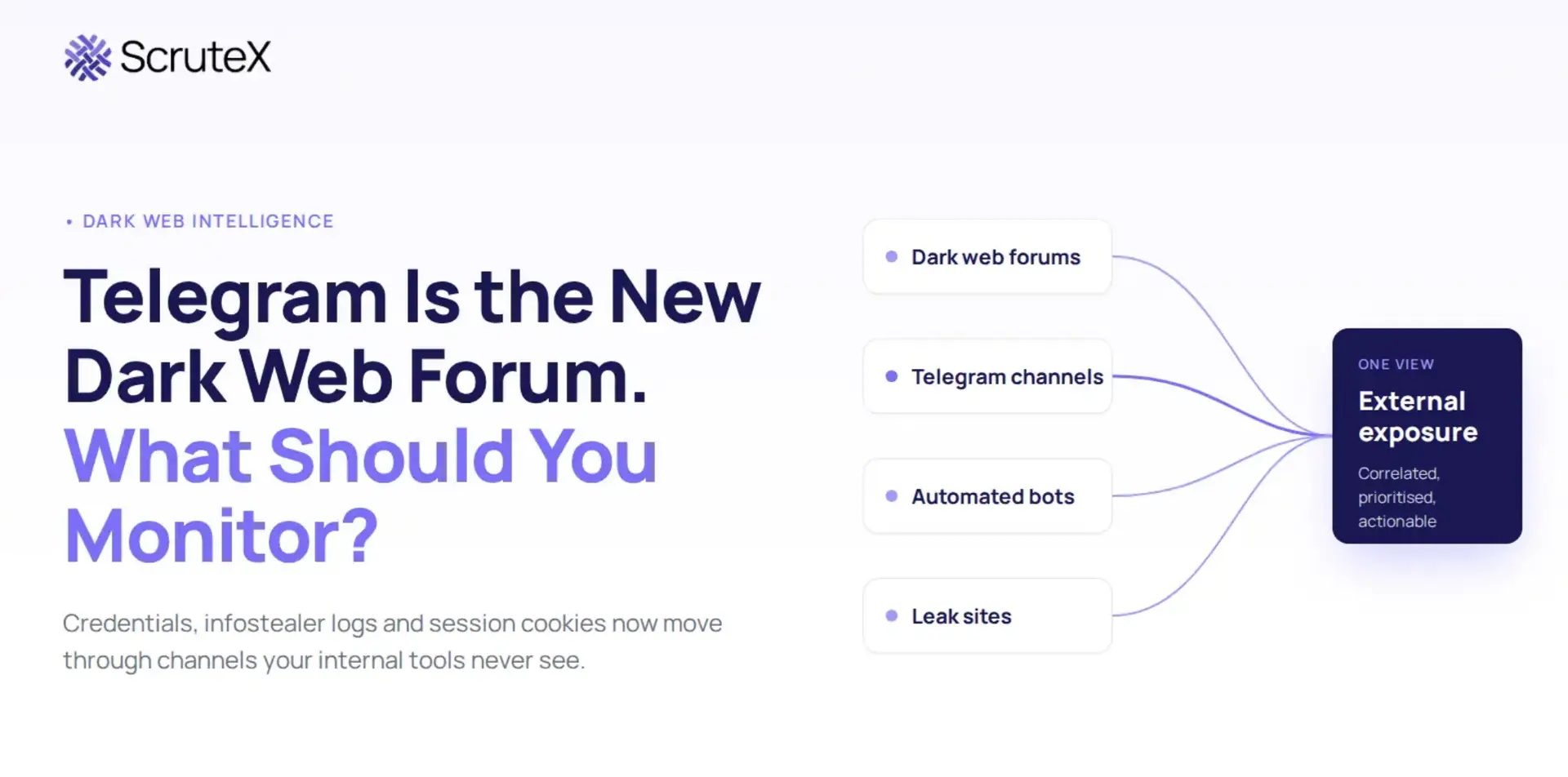
Stolen corporate data used to surface mainly on Tor-hosted forums and marketplaces. Now stealer logs, access listings and phishing kits also move through Telegram channels and bots. Europol's 2025 Internet Organised Crime Threat Assessment (IOCTA) describes the illicit data trade as still rooted in dark web forums but moving towards encrypted messaging apps, Telegram among them.
Key takeaways
- Infostealer logs matter most for enterprises because they can carry session cookies alongside passwords.
- A stolen session may, depending on application controls, skip the password and MFA step. A password reset alone may not close that gap.
- Keyword alerts create noise. Findings need freshness, identity context and correlation before they justify action.
Is Telegram the New Dark Web?
The dark web refers to services reachable only through anonymity networks such as Tor. Telegram is a centrally operated app sold through public app stores, and most of its users are legitimate. Kaspersky notes its chats are not end-to-end encrypted by default.
Criminal communities use it heavily anyway.
USENIX Security 2025 (DarkGram). Researchers analysed 339 cybercriminal activity channels with more than 23.8 million combined subscribers, using a classifier that identified malicious posts with 96% accuracy across 53,605 posts from February to May 2024. The channels shared compromised credentials, pirated software, manipulation tools, malware and exploit kits. Channels moved to new channels after takedowns with little subscriber loss, and the researchers' reports led to the removal of 196 channels over roughly three months. The study measured the channels it identified, not the total volume of crime on Telegram.
NordLayer Intelligence by NordStellar (2026). Across seven cybercrime categories in its monitored pool (86 dark web forums and 1,890 Telegram channels), Telegram's average share of discussion reached 45% in January to May 2026, up from 28% across 2025. The figure is an unweighted average of per-category shares, counts posts rather than confirmed crimes, and reflects a source pool that changed as forums were seized. It does not mean 45% of cybercrime happens on Telegram.
Kaspersky Digital Footprint Intelligence (December 2025). Analysing more than 800 blocked cybercriminal channels from 2021 to 2024, Kaspersky found the share of channels surviving longer than nine months more than tripled in 2023 to 2024. Blocking also rose: monthly takedowns since October 2024 match the 2023 peaks and accelerated through 2025, with early signs of migration to other platforms.
Telegram carries heavy underground activity, enforcement is rising and actors move under pressure. It complements the dark web rather than replacing it.
Why Are Cybercriminals Using Telegram?
Telegram removes friction, which speeds up how exposed data spreads:
- Speed: one post reaches every subscriber at once.
- Automation: Kaspersky describes bots that answer queries, process cryptocurrency payments and deliver stolen cards, stealer logs or phishing kits to hundreds of buyers a day, often with no operator involved.
- Low friction: an invite link replaces forum vetting, and non-expiring file storage hosts large dumps.
- Migration: blocked channels reappear, and DarkGram found giveaways grow audiences for paid material.
A static list of monitored channels decays quickly.
What Types of Cyber Threats Appear on Telegram?
Stolen credentials
Corporate email and password pairs, VPN, SSO, SaaS and cloud logins, and occasionally privileged accounts appear in channels and bot lookups. Europol ranks VPN credentials, email accounts and corporate system access among the most sought-after data. Much of it is recycled: old breach records get repackaged as "fresh" combolists.
Infostealer logs
An infostealer log is the package of data that information-stealing malware collects from one infected device and sends to its operator. Europol names Lumma, RedLine and Vidar among the central families. Depending on family and configuration, a log can hold browser passwords, cookies and session data, autofill entries, browsing history, system details, cryptocurrency wallet data, screenshots, selected files and VPN or application configuration. Not every log contains every category.
Session cookies and tokens
When a user signs in, most web applications issue a session cookie or token. If malware steals it while valid, an attacker may replay it and inherit the session without repeating password and MFA steps. MITRE ATT&CK tracks this as T1539 (Steal Web Session Cookie) and T1550.004 (Use Alternate Authentication Material: Web Session Cookie).
Whether a stolen session works depends on controls you own: session lifetime, device or token binding, conditional access policies, and how fast you can revoke every session for an identity.
This is why MFA, while still one of the strongest identity controls (CISA recommends phishing-resistant MFA), does not remove exposure risk. Stolen sessions and OAuth tokens can outlast password changes. A valid password enables MFA fatigue attacks (T1621) and help desk social engineering. Weak recovery flows, legacy protocols and SaaS tools outside central identity controls may skip MFA entirely. MFA and external credential and session monitoring are complementary controls.
Access, malware, leaks and impersonation
- Corporate access: initial access brokers advertise VPN, RDP, cloud and SaaS access. Europol's IOCTA cites CrowdStrike research showing a 50% rise in advertised access prices during 2024.
- Malware and phishing: infostealers, remote access trojans, loaders, keyloggers and phishing kits sold as a service.
- Data leaks: databases, employee and customer records, documents, source code, API keys and configuration files. Actors recycle and fabricate leaks, so validate every claim.
- Brand impersonation: fake support accounts and lookalike channels that defraud customers and harvest credentials.
Why Does Telegram Create a Visibility Gap for Security Teams?
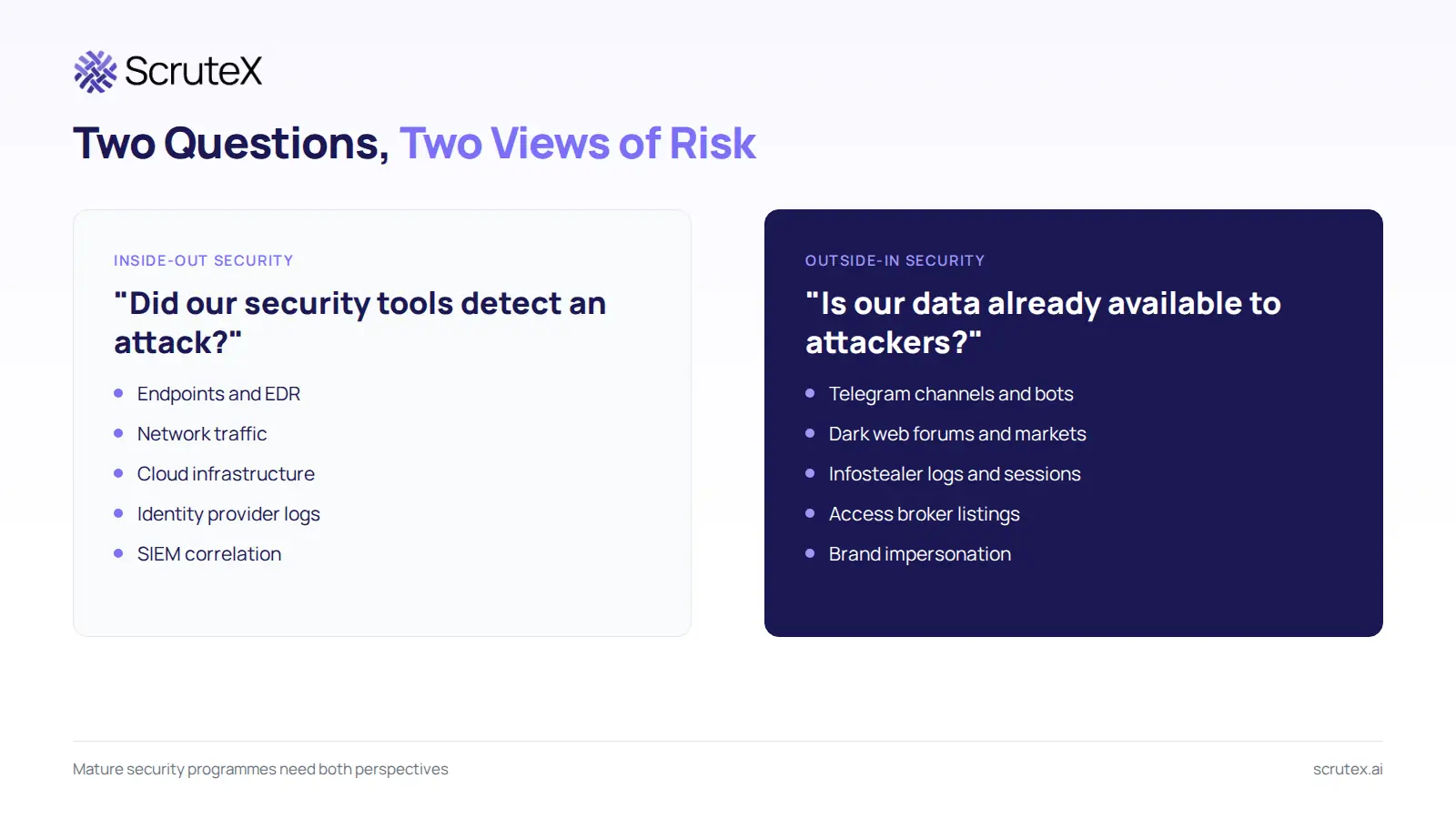
EDR, network detection, cloud security, identity logs and the SIEM watch infrastructure you own. Telegram activity happens on infrastructure you cannot instrument. That separates two questions: inside-out security asks "did our tools detect an attack?", while outside-in security asks "is information about our organisation already available to attackers?" Mature teams need both.
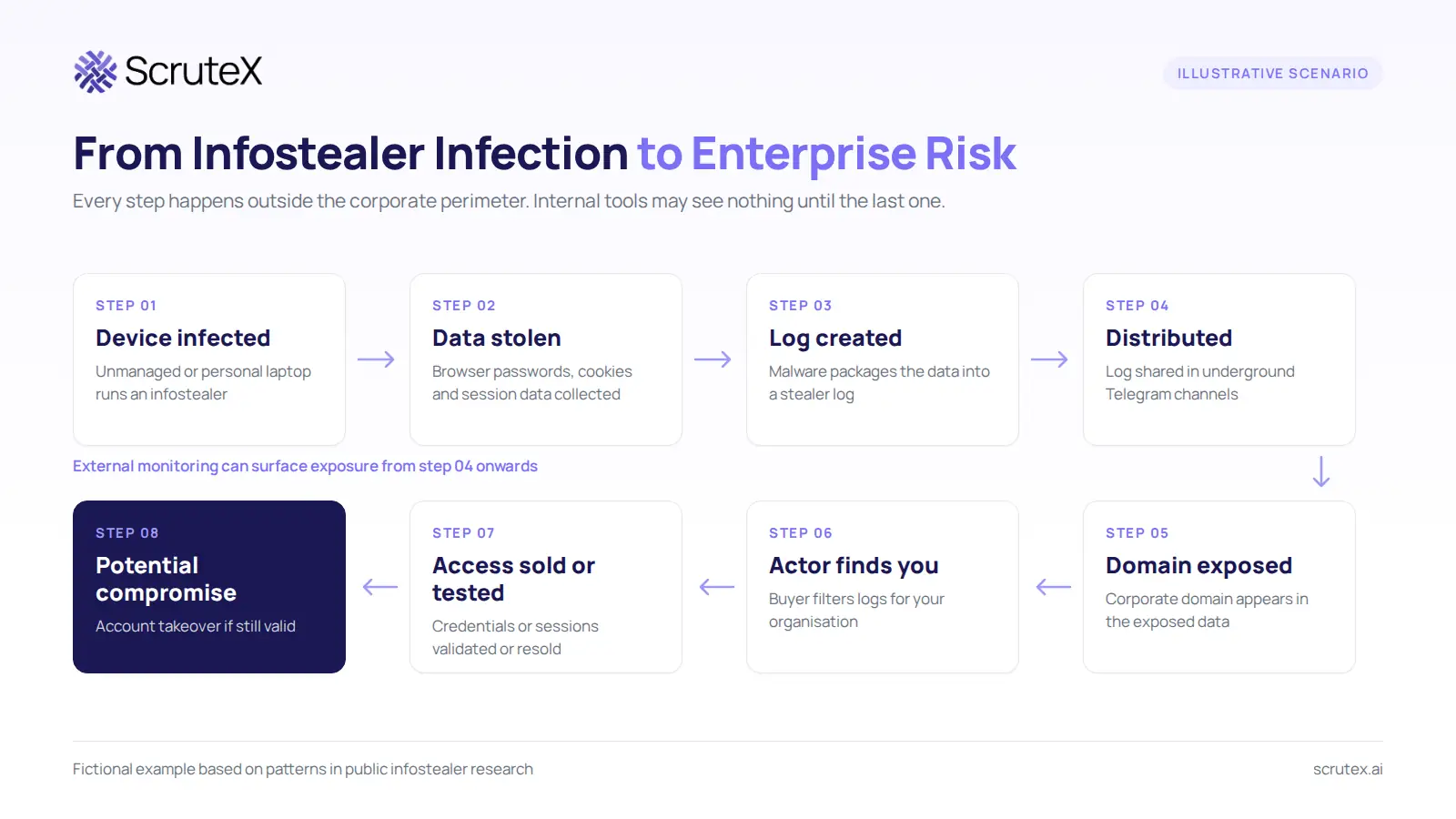
An illustrative scenario (fictional). An account manager at a financial services firm checks work email from a personal laptop. A family member installs a cracked game carrying an infostealer. The malware collects the manager's saved SSO password plus identity provider and CRM cookies, and days later the log appears in a subscription Telegram channel, where a buyer filters for the firm's domain. EDR sees nothing because the laptop is unmanaged. The SIEM sees nothing because nobody has used the credentials yet. The firm is still exposed.
What Should Security Teams Monitor on Telegram?
Monitor assets that indicate impact, not every mention of your name:
- Organisation identifiers: company and subsidiary names, brands, domains, subdomains, email domains, products.
- Corporate identities: where legally and ethically appropriate, corporate addresses, executives, privileged users and high-risk roles. Scope this to security-relevant exposure, not employee surveillance, with privacy and legal sign-off.
- Credentials, sessions and tokens: email and password pairs, VPN, SSO, cloud and SaaS logins, session cookies, API keys.
- Infostealer exposure: domains and identities in logs, malware family, infection date, host details.
- Threat actors: organisation mentions, sector targeting, access advertisements, campaigns.
- Brand abuse and data leaks: fake accounts and support channels, phishing, databases, documents, source code, secrets.
Table 1: Telegram signals and recommended actions
| Signal | Why It Matters | Recommended Security Action |
|---|---|---|
| Corporate credentials | Direct path to email, VPN, SaaS or cloud if still valid | Validate freshness, reset credentials, check authentication logs |
| Infostealer logs | Show an infected device and may carry many credentials and sessions | Identify the identity and host, revoke sessions, investigate the endpoint |
| Session or token exposure | May allow access without password or MFA | Revoke sessions and tokens immediately, review conditional access |
| Threat actor mentions | Can signal targeting or reconnaissance | Assess credibility, enrich with CTI, raise monitoring on named assets |
| Brand impersonation | Defrauds customers and harvests credentials | Capture evidence, report for takedown, warn users where needed |
| Leaked documents | Regulatory, legal and competitive exposure | Verify authenticity, assess sensitivity, involve legal and privacy |
| Source code or API secrets | Exposed keys give direct system access | Rotate secrets, review usage logs, scan repositories for more |
| Phishing infrastructure | Indicates an active or planned campaign | Block domains, report infrastructure, alert targeted users |
How Do You Turn Telegram Signals Into Action?
Searching for your company name returns news reposts, job adverts and similarly named firms. Compare:
- Low context: "CompanyName mentioned in a Telegram post."
- High context: "An SSO credential on the company's primary domain appears in an infostealer log first seen 36 hours ago, alongside identity provider session cookies."
The second shows which identity, which system and how urgent. It requires domain and email matching, entity resolution, credential and stealer log detection, threat actor correlation, deduplication, freshness analysis and severity scoring. The workflow should run signal, then context, then risk, then action, not signal straight to alert.
Freshness drives priority. A five-year-old breach record, a recycled combolist and yesterday's stealer log carry very different odds of working. Record first and last observed dates, source and channel, matched domain and identity, malware family, credential type, redacted evidence, confidence and severity. Last-observed dates also catch an old credential reappearing in a new log, which signals a new infection.
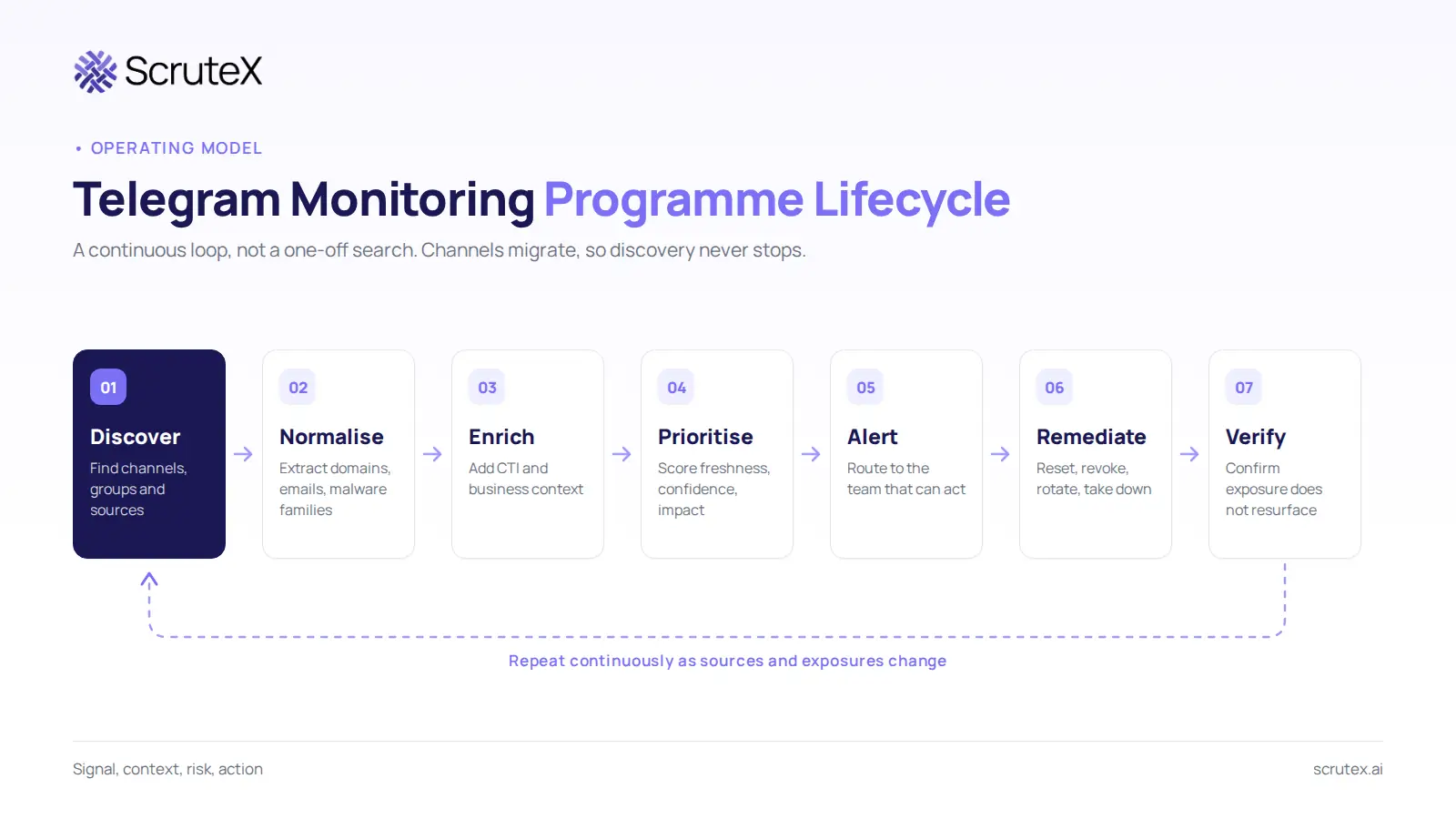
A workable programme runs this lifecycle continuously:
- Discover channels, groups, bots and adjacent sources through vetted collection, never analysts' personal accounts.
- Normalise posts into domains, emails, URLs, usernames, malware families and credential types.
- Enrich with threat intelligence, MITRE ATT&CK mapping and asset ownership.
- Prioritise by freshness, confidence, asset criticality, credential sensitivity and actor relevance.
- Alert the team that can act: identity, SOC, brand or legal.
- Remediate through resets, session revocation, secret rotation, endpoint investigation and takedowns.
- Verify that exposure does not resurface.
What Should Security Teams Do When Corporate Data Appears on Telegram?
Exposed credentials or stealer logs
- Validate the finding against your identity directory.
- Determine freshness from infection and first-seen dates.
- Identify the identity, its role and its access.
- Reset or disable the credentials.
- Revoke sessions and tokens. In many applications a password reset does not end existing sessions, so do both.
- Rotate exposed secrets or API keys.
- Review authentication logs for unfamiliar locations, devices and new MFA enrolments.
- Investigate the endpoint, including whether it is managed.
- Check for password reuse.
- Continue monitoring the identity and host.
Exposed data: validate authenticity, assess sensitivity, identify affected systems, rotate secrets, investigate related activity and preserve evidence. Involve legal and privacy early, as clocks may apply: 72 hours under GDPR, six hours for CERT-In reporting in India, 72 hours for APRA notification under CPS 234. Confirm obligations with counsel.
Brand impersonation: verify the account is not yours, capture evidence, report it, warn affected users and watch for replacement accounts.
Where ScruteX Fits
ScruteX is an external exposure and threat intelligence platform, and Telegram is one source within it. Its Data Exposure Insights module covers the exposure types in this article:
- Telegram Monitoring tracks channels and groups for mentions of your organisation, domains and key personnel, data dumps containing your credentials or documents, and coordinated campaigns.
- Dark Web Monitoring covers forums, marketplaces and hidden services.
- Breached Credentials finds credentials exposed in third-party breaches.
- Malware Infected Machines finds credentials stolen through infostealer logs.
- Leaked Sessions identifies malware-stolen session cookies and maps them to applications such as SSO, email and cloud consoles to prioritise invalidation.
ScruteX connects these with Threat Insights, its curated intelligence on actors and TTPs for your region and sector. It onboards with a domain rather than agents and sends findings to Splunk, Microsoft Sentinel, Jira, ServiceNow, Slack and Teams via integrations, API and webhooks, so teams see what is exposed outside their environment as well as inside it.
How Does Telegram Dark Web Monitoring Fit Into CTI and Exposure Management?
Telegram dark web monitoring is a collection source, not a programme in itself. Its findings feed cyber threat intelligence (actors and targeting), dark web monitoring (extended to messaging platforms), digital risk protection (brand abuse and leaks), external attack surface management (leaked configs pointing to internet-facing assets) and continuous threat exposure management. CTEM, a framework developed by Gartner, Inc., runs through scoping, discovery, prioritisation, validation and mobilisation. Telegram findings feed its discovery and prioritisation stages.
Value comes from correlation. One employee's address appears in a 2021 breach dump, then last week in a new stealer log with identity provider cookies, while a Telegram post advertises "fresh access" to a firm in your sector and country. Separately, each is a queue-bound medium alert. Together they describe a likely active compromise path. The fair case for point tools holds too: large CTI teams with analysts to correlate manually can run best-of-breed feeds well, while smaller teams gain more from a connected view.
The benefits: earlier visibility into exposed credentials and sessions, detection of infections on devices your EDR cannot see, awareness of actor interest and faster investigations. Monitoring improves the odds of early action but does not guarantee prevention.
What Should Organisations Look for in a Telegram Monitoring Platform?
Look for Telegram and dark web coverage that tracks migration; credential, infostealer and session detection; freshness indicators; entity resolution and deduplication; enrichment and prioritisation; redacted evidence; SIEM, SOAR and ticketing integrations; privacy controls; and analyst safety.
Table 2: Telegram, dark web and combined monitoring compared
| Capability | Telegram Monitoring | Dark-Web Monitoring | Combined External Exposure Monitoring |
|---|---|---|---|
| Source coverage | Channels, groups, bots | Forums, marketplaces, leak sites | Both, plus breach, paste, code and cloud sources |
| Speed | Fast redistribution, short-lived sources | Slower, more persistent listings | Catches early spread and persistent listings |
| Credential exposure | Frequent, often bulk and recycled | Frequent, often sold or vetted | Deduplicated across sources |
| Infostealer exposure | Common distribution channel for logs | Log markets and shops | Correlated to identity and host |
| Session exposure | Present in shared log bundles | Present in log markets | Mapped to applications for revocation |
| Threat actor intelligence | Real-time chatter, advertising | Deeper reputation and history | Actor context across both venues |
| Brand impersonation | Fake channels and support accounts | Limited | Linked with domain and social monitoring |
| Correlation | Limited on its own | Limited on its own | Connects findings into one exposure picture |
| Risk prioritisation | Depends on enrichment | Depends on enrichment | Freshness, identity and actor context combined |
Neither Telegram nor dark web monitoring wins every row. Each covers gaps the other leaves.
The Future of Telegram and Cyber Threat Intelligence
Expect more bot-driven automation and faster redistribution. Migration will continue as enforcement rises; Telegram said in September 2024 it would share IP addresses and phone numbers of rule-breaking users with authorities on valid legal requests. The likely future is an underground spread across forums, messaging apps and private venues, not one platform.
What Security Teams Should Do Now
- Add Telegram to your external threat model.
- Monitor credentials and sessions, not only passwords.
- Monitor infostealer exposure, including unmanaged devices.
- Prioritise with freshness and context.
- Document a response workflow covering validation, session revocation and legal.
- Correlate Telegram findings with dark web, breach and actor intelligence.
- Verify remediation continuously, because exposure resurfaces.
FAQ
Is Telegram the new dark web?
No. Telegram is a mainstream messaging app, not a Tor-based network, and most of its users are legitimate. Cybercriminal communities do use it heavily to distribute stolen data, sell tools and advertise access. Research from USENIX, Kaspersky and NordLayer shows Telegram complements dark web forums rather than replacing them, so security teams should monitor both.
Why do cybercriminals use Telegram?
Cybercriminals use Telegram because it is fast and low friction. Channels reach large audiences instantly, bots automate sales and delivery, joining often needs only an invite link, and large files can be shared without external hosting. When Telegram blocks a channel, operators often recreate it and move subscribers with little loss.
What data is commonly exposed on Telegram?
Common exposures include corporate email and password pairs, VPN and SSO credentials, infostealer logs, session cookies, leaked databases, internal documents, source code, API keys and phishing kits. Much of the material is recycled from older breaches, so each finding needs validation for freshness and authenticity before a team acts on it.
Can corporate credentials be found on Telegram?Yes. Corporate credentials regularly appear on Telegram, often inside infostealer logs and combolists.research found 2.05 million infostealer logs exposing enterprise identity credentials in 2025 within its collection. Credentials may come from recent malware infections or from old breaches, so first-seen dates and identity context decide how urgently to respond.
Why are infostealer logs dangerous?
Infostealer logs are dangerous because one log can hold many credentials plus session cookies from a single device. A valid stolen session may let an attacker skip password and MFA checks, depending on session controls. Logs often come from unmanaged personal devices, so internal security tools may never see the original infection.
Should companies monitor Telegram?
Yes, as part of broader external exposure monitoring. Telegram carries a large share of underground discussion and distribution, and data about your organisation can appear there before any attack touches your systems. Monitoring should focus on security-relevant exposure, use vetted collection methods and follow privacy and legal guidance on identity scope.
How is Telegram monitoring different from dark web monitoring?
Telegram monitoring covers channels, groups and bots on a mainstream messaging app, where content spreads fast and sources change often. Dark web monitoring covers Tor-based forums, marketplaces and leak sites, where listings persist longer. The two overlap heavily, and correlating findings across both gives a clearer picture of real exposure.
How can ScruteX help with Telegram monitoring?
ScruteX monitors Telegram channels and groups for organisation mentions, data leaks and campaign activity through its Data Exposure Insights module. It connects those findings with dark web monitoring, breached credentials, infostealer exposure and leaked sessions, and routes prioritised findings into SIEM, ticketing and chat tools, so teams see Telegram exposure as part of one external view.
SCRUTEX CTA
Your security team cannot respond to exposure it cannot see. ScruteX monitors Telegram, dark web sources, breached credentials, infostealer logs and leaked sessions tied to your domains, then sends prioritised findings into the tools your team already uses. Start with a domain. ScruteX offers a free tier with no credit card required.