Telegram Channel Monitoring for Business: What Actually Leaks There
By ScruteXPublished
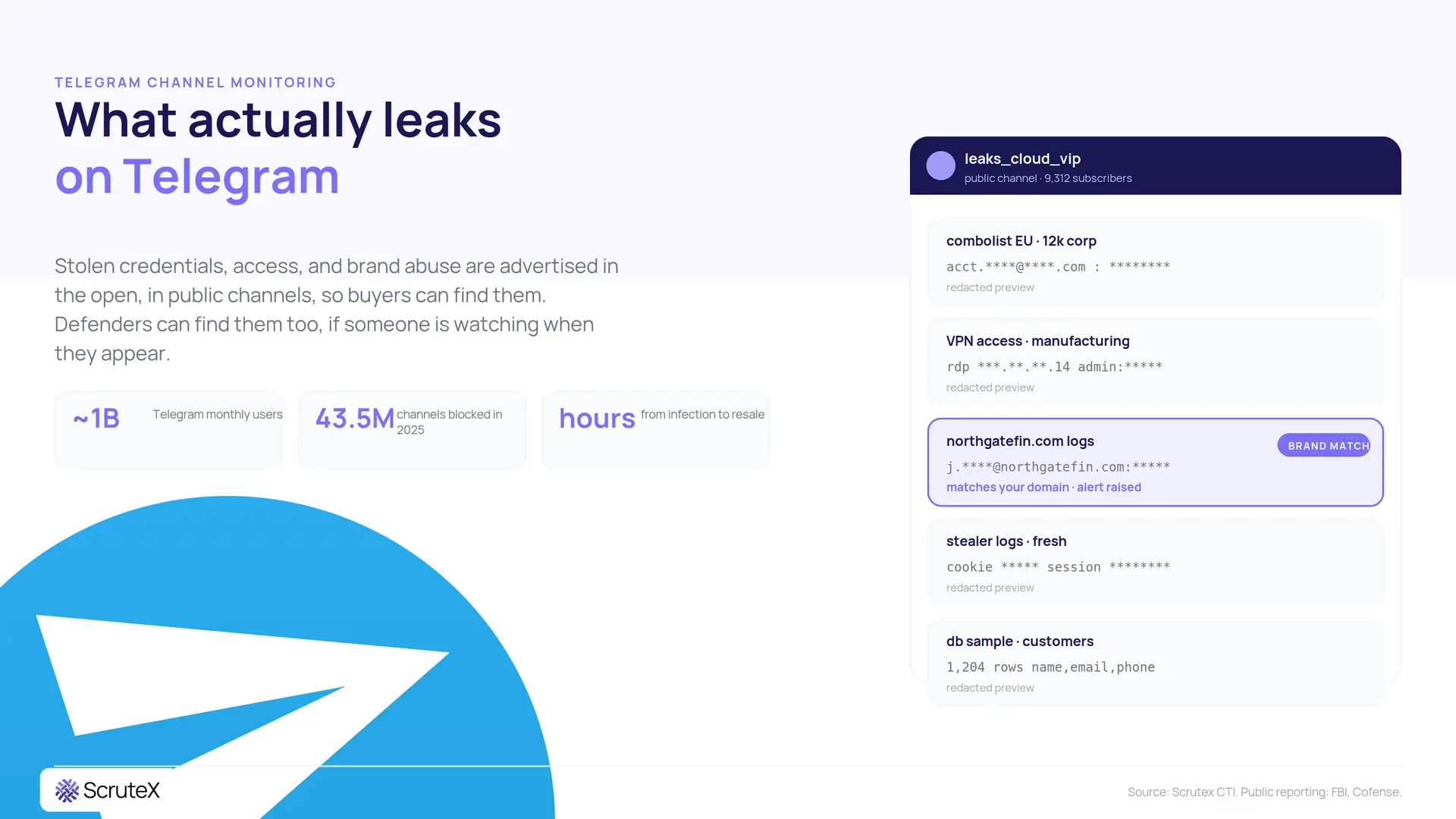
Most security teams watch the news, social media, and a handful of dark web forums. Meanwhile, a copy of their employees' passwords is being sold in a Telegram channel with 9,000 members, in plain sight, for the price of a coffee. The data reached buyers before anyone inside the company knew it existed.
Telegram channel monitoring is the continuous collection and analysis of public Telegram channels, groups, and bots to detect stolen data, leaked credentials, brand abuse, and threat actor activity that references your organisation. It sits inside the wider practice of digital risk protection and dark web intelligence, but it targets a specific place: the messaging platform that has quietly become one of the fastest-moving distribution points for stolen business data.
This guide explains what actually leaks on Telegram, why standard keyword alerts miss most of it, what makes the platform hard to watch, and how a working monitoring process detects exposure earlier. It is written for CISOs, SOC and CTI analysts, security engineers, and risk managers who need to decide whether Telegram belongs in their intelligence coverage. The short answer is that it already does, whether you watch it or not.
What is Telegram channel monitoring?
Telegram channel monitoring is the practice of continuously watching Telegram's public channels, large discussion groups, and automated bots for content that exposes an organisation to risk. That content includes leaked credentials, stealer logs, database samples, source code, phishing kits, impersonation accounts, and threat actor coordination that names a company, its brand, its executives, its domains, or its suppliers.
It is a form of open source intelligence (OSINT). The monitoring focuses on what is publicly reachable: channels anyone can join, groups that admit new members freely, and bots that respond to public queries. It does not mean breaking into private end-to-end encrypted chats. The value comes from the fact that a large volume of criminal advertising, resale, and boasting happens in the open, because reach is the point. A seller who hides their combolist too well cannot sell it.
For a business, Telegram monitoring answers a direct question: is our data, our brand, or our access being discussed, sampled, or sold right now, and how much warning can we get before an attacker acts on it. That warning window is the entire reason to do it.
Why has Telegram become a threat intelligence source?
Telegram reached roughly one billion monthly active users, a scale its founder confirmed publicly in 2025. Telegram passed one billion monthly active users, and the company reported 547 million dollars in profit for 2024. A platform that large, that fast, and that easy to use attracts both ordinary people and criminals for the same reasons.
Several design features make it attractive to threat actors:
- Public channels broadcast to unlimited subscribers, which suits leak advertising and ransomware shaming.
- Large groups allow tens of thousands of members to trade and coordinate in one place.
- Bots automate everything from credential searches to payment validation, turning crime into a self-serve product.
- Low friction means no Tor, no invitation gatekeeping for most channels, and a normal mobile app anyone already has.
- Global reach and anonymity let a seller in one country service buyers everywhere without exposing much about themselves.
Over the past few years, parts of the criminal economy moved off traditional darknet markets and closed forums toward this mix of channels, groups, and bots. Ransomware groups, initial access brokers, and malware operators are turning to Telegram to buy stolen login credentials and malware-as-a-service subscriptions. Reporting on the shift describes Telegram as a fast, low-friction alternative to Tor-based markets that police have repeatedly targeted. When law enforcement took down forums such as BreachForums and LeakBase between 2024 and 2026, a share of that activity reappeared in Telegram-based ecosystems.
The platform did not stay entirely permissive. After the arrest of founder Pavel Durov in Paris in August 2024, Telegram changed its posture. In September 2024 Telegram said it would comply with valid legal requests to share user data, specifically IP addresses and phone numbers. Enforcement scaled up sharply after that. In 2025 Telegram blocked 43.5 million channels and groups, including 952,000 tied to child sexual abuse material and 236,000 linked to terrorism.
That crackdown matters, but it cuts two ways for defenders. Channels get removed, then reappear under new names in a constant cycle. Enforcement removes some content while pushing the rest to move faster and rebuild quietly. For a monitoring team, the result is not a cleaner platform. It is a moving target that still carries a lot of stolen business data.
What business information actually leaks on Telegram?
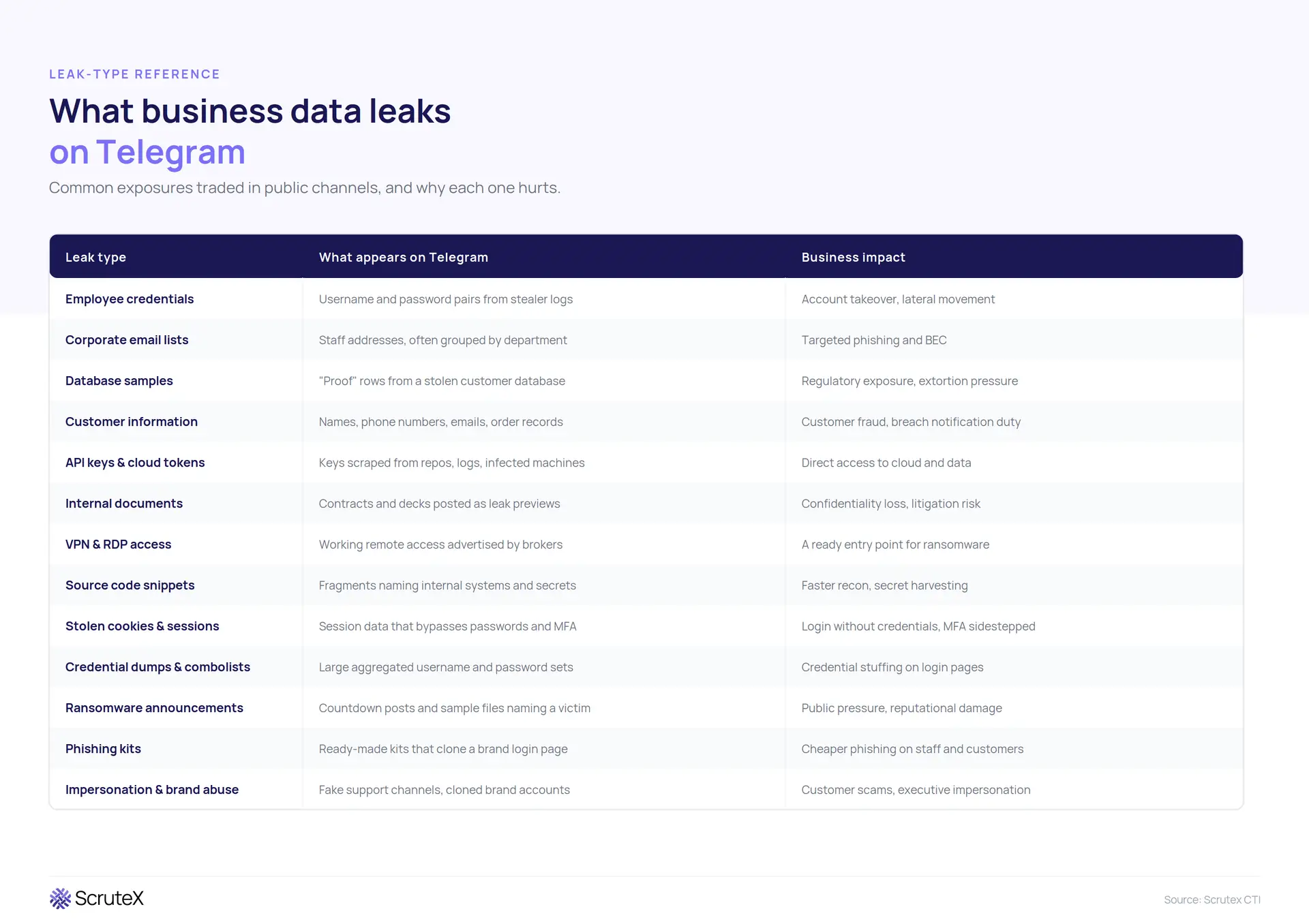
The range is wider than most teams expect. Telegram now concentrates several stages of an attack in one place: raw stolen data, searchable credential databases, access brokerage, and public extortion. The platform acts as a high-speed bridge between compromised credentials and full network compromise, serving ransomware operators, initial access brokers, and hacktivist groups.
The table below maps the common leak types to what they look like in practice and why each one hurts.
| Leak type | What appears on Telegram | Business impact |
|---|---|---|
| Employee credentials | Username and password pairs pulled from stealer logs | Account takeover, mailbox access, lateral movement |
| Corporate email lists | Bulk lists of staff addresses, often by department | Targeted phishing and business email compromise |
| Database samples | Free "proof" rows from a stolen customer database | Regulatory exposure, customer fraud, extortion pressure |
| Customer information | Names, phone numbers, emails, order records | Fraud against customers, brand damage, breach notification duty |
| API keys and cloud tokens | Keys scraped from repos, logs, or infected machines | Direct access to cloud infrastructure and data |
| Internal documents | Contracts, decks, and files posted as leak previews | Confidentiality loss, negotiation and litigation risk |
| VPN and RDP access | Working remote access advertised by brokers | A ready entry point for ransomware affiliates |
| Source code snippets | Fragments naming internal systems and secrets | Faster reconnaissance and secret harvesting |
| Stolen cookies and session tokens | Session data that bypasses passwords and MFA | Login without credentials, MFA sidestepped |
| Credential dumps and combolists | Large aggregated username and password sets | Credential stuffing against your login pages |
| Ransomware announcements | Countdown posts and sample files naming a victim | Public pressure, reputational and financial damage |
| Phishing kits | Ready-made kits that clone a brand's login page | Cheaper, faster phishing against staff and customers |
| Impersonation and brand abuse | Fake support channels, cloned brand accounts | Customer scams, executive impersonation, trust loss |
Two categories deserve extra attention because they are the ones that turn into network intrusions.
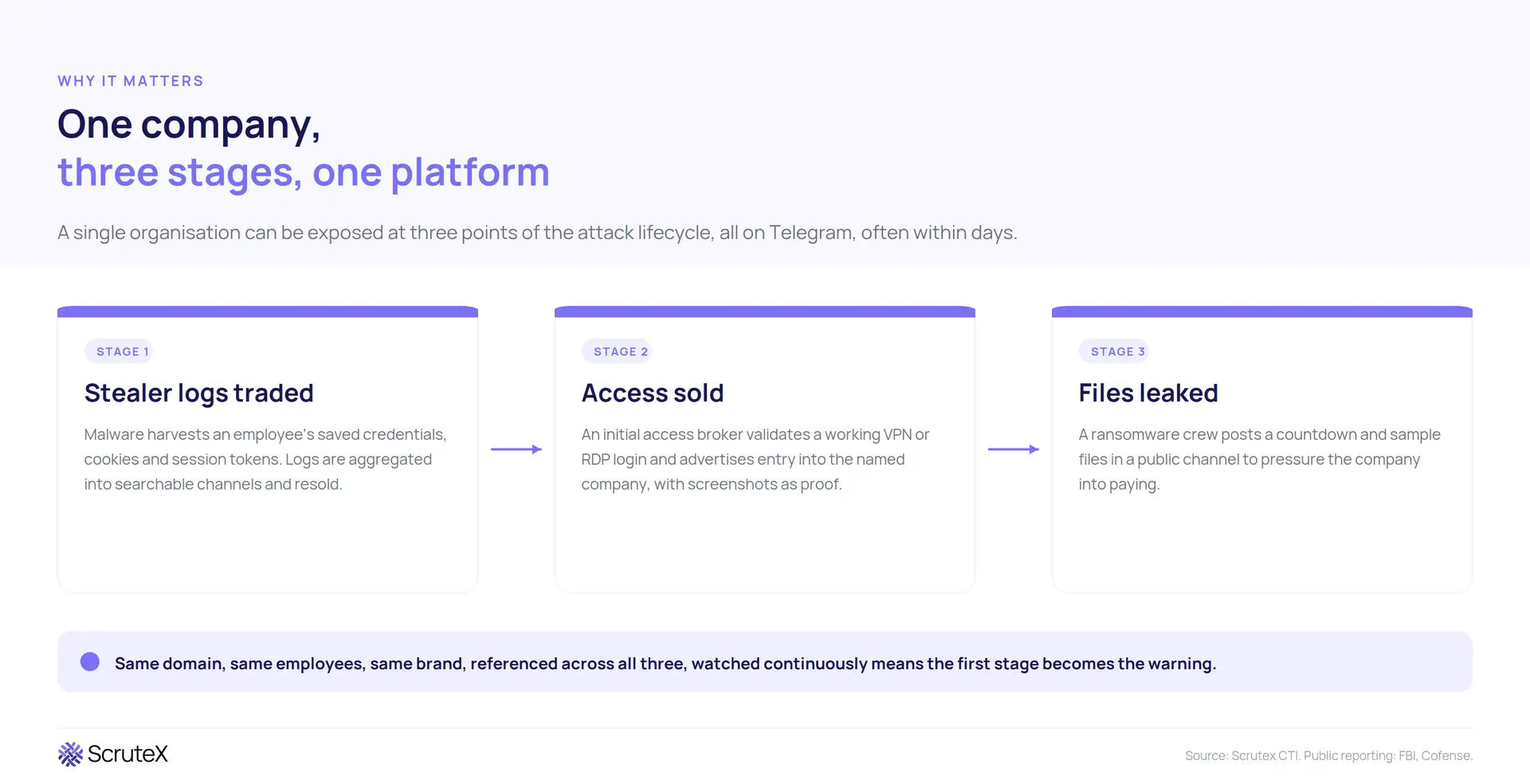
Stealer logs. Malware harvests everything saved in a victim's browser, then ships it to an operator. Malware such as Raven Stealer sends stolen data through Telegram in real time, harvesting credentials, cookies, payment details, and browser information with little user interaction. Those logs are then aggregated into searchable "log clouds" and resold. Access to premium log channels is a paid subscription. Access to VIP stealer log channels typically costs 200 to 400 dollars a month, paid in Monero, giving a limited set of actors early access to premium logs. If one of your employees was infected at home, their corporate session tokens can be sitting in one of those channels within hours.
Initial access. Brokers do not just sell raw data. They sell working entry into named companies and prove it. Brokers advertise direct entry into companies with live proof, such as screenshots of a target's VPN portal or its cloud dashboards. Ransomware crews then use public channels for the extortion phase, posting leak countdowns and sample files to force a payment. A single company can appear at three stages: its stealer logs traded, its access sold, and its files leaked, all on the same platform.
State-linked activity shows up too. In 2025 the FBI warned that Iranian intelligence actors used Telegram bots as command-and-control to run malware against dissidents and journalists, with a group called Handala Hack claiming a related hack-and-leak operation. The FBI reported that Iran's Ministry of Intelligence and Security used Telegram as command-and-control infrastructure to push malware, resulting in intelligence collection, data leaks, and reputational harm.
Why do traditional keyword alerts miss Telegram activity?
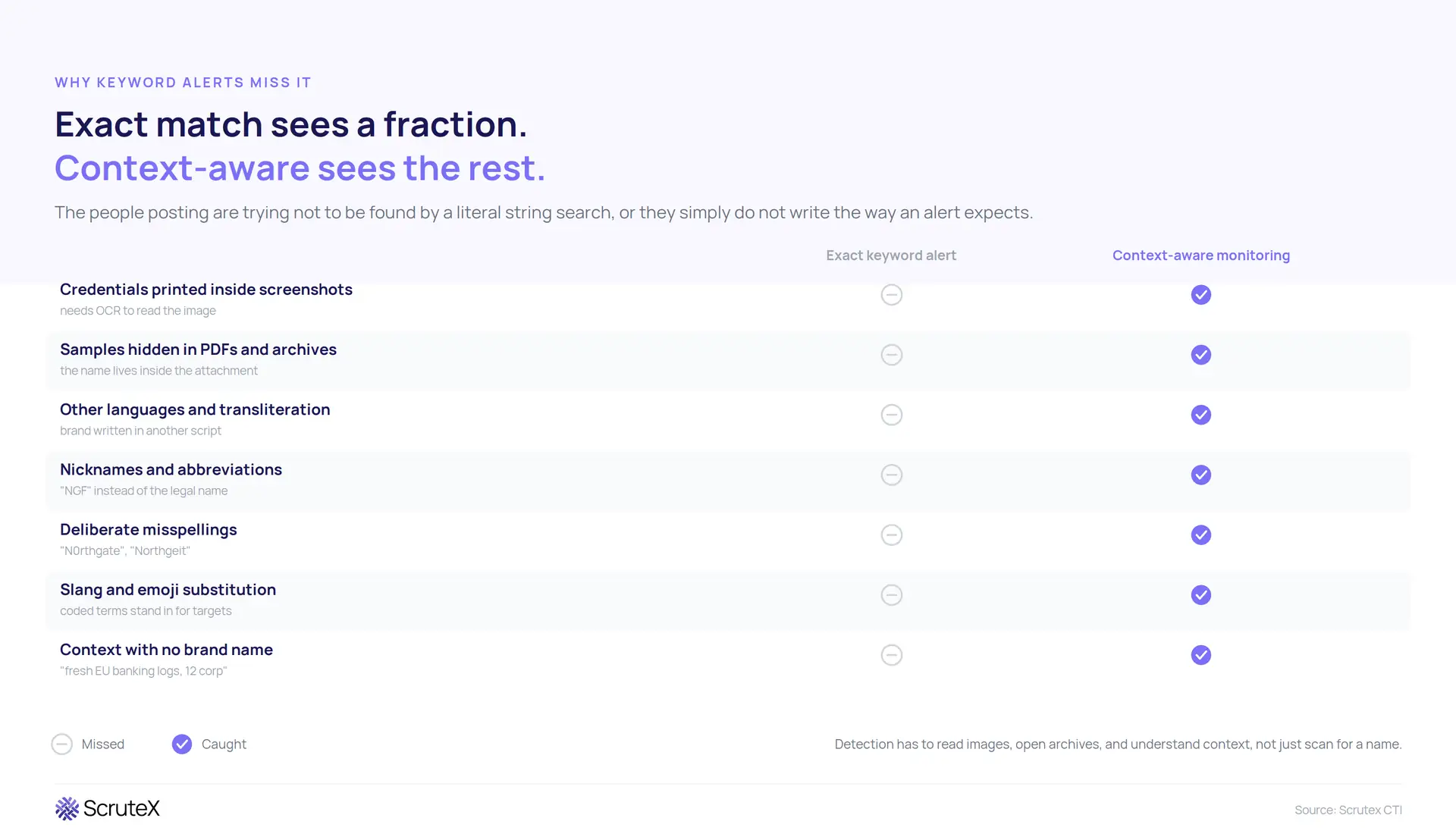
Most brand and breach alerting is built on exact string matching. You register your company name and a few domains, and the system pings you when those strings appear. On Telegram, that approach misses a large share of real activity, because the people posting are trying not to be found by exactly that method, or they simply do not write the way your alert expects.
Here is where exact matching breaks down:
- Nicknames and abbreviations. A company called "Northgate Financial" gets written as "NGF", "northgate", or an internal product name that never contains the legal entity.
- Misspellings. Deliberate or lazy typos ("Northgeit", "N0rthgate") slip past a literal filter.
- Text inside images. A large volume of leak proof is posted as screenshots. Without optical character recognition (OCR), a keyword engine sees an image, not the credentials printed on it.
- PDFs and archives. Samples arrive as PDFs, ZIPs, or RARs. The company name may only exist inside the attachment, not in the message text.
- Multiple languages and transliteration. Russian, Farsi, Chinese, Portuguese, and Arabic channels reference Western brands, sometimes transliterated into Latin script and sometimes not.
- Slang and emoji substitution. Coded terms and emoji stand in for products, targets, and payment, which defeats a plain word list.
- Context. A post that reads "fresh EU banking logs, 12 fresh corp" names no company at all, yet it is directly relevant to a European bank watching for its own exposure.
The lesson is not that keywords are useless. It is that a Telegram monitoring program built only on exact strings will report quiet while a lot happens. Detection needs to read images, open attachments, handle several languages, and understand context, not just scan for a name.
What makes Telegram hard to monitor?
Even with the right detection, the platform itself fights back against clean, continuous coverage. These are the practical obstacles a monitoring team runs into.
- Volume. Active cybercrime channels post constantly. A single group can generate thousands of messages a day, most of it noise around a few relevant items.
- Deleted and edited posts. Sellers remove listings after a sale, and admins purge channels ahead of takedowns. If you were not collecting at the moment of posting, the evidence is gone.
- Invite-only and vetted channels. The most sensitive trading often moves to private or paid groups that require vouching, which limits what public collection can see.
- Language diversity. Coverage that only reads English misses the majority of high-value trading, which happens across many languages.
- Rapid reposting and duplicates. The same leak gets copied across dozens of channels within hours, so raw alerting drowns a team in repeats of one event.
- Media attachments. The actual data hides in images, documents, and archives that a text-only system never inspects.
- Noise and context. Separating a genuine threat from bragging, resold old data, or an outright scam requires judgement, not just a match.
The Telegram removal cycle adds one more problem. Channels are blocked and rebuilt under new names, so a static list of channels to watch decays quickly. Coverage has to rediscover the ecosystem continuously, not rely on a bookmark from last quarter.
How does effective Telegram monitoring work?
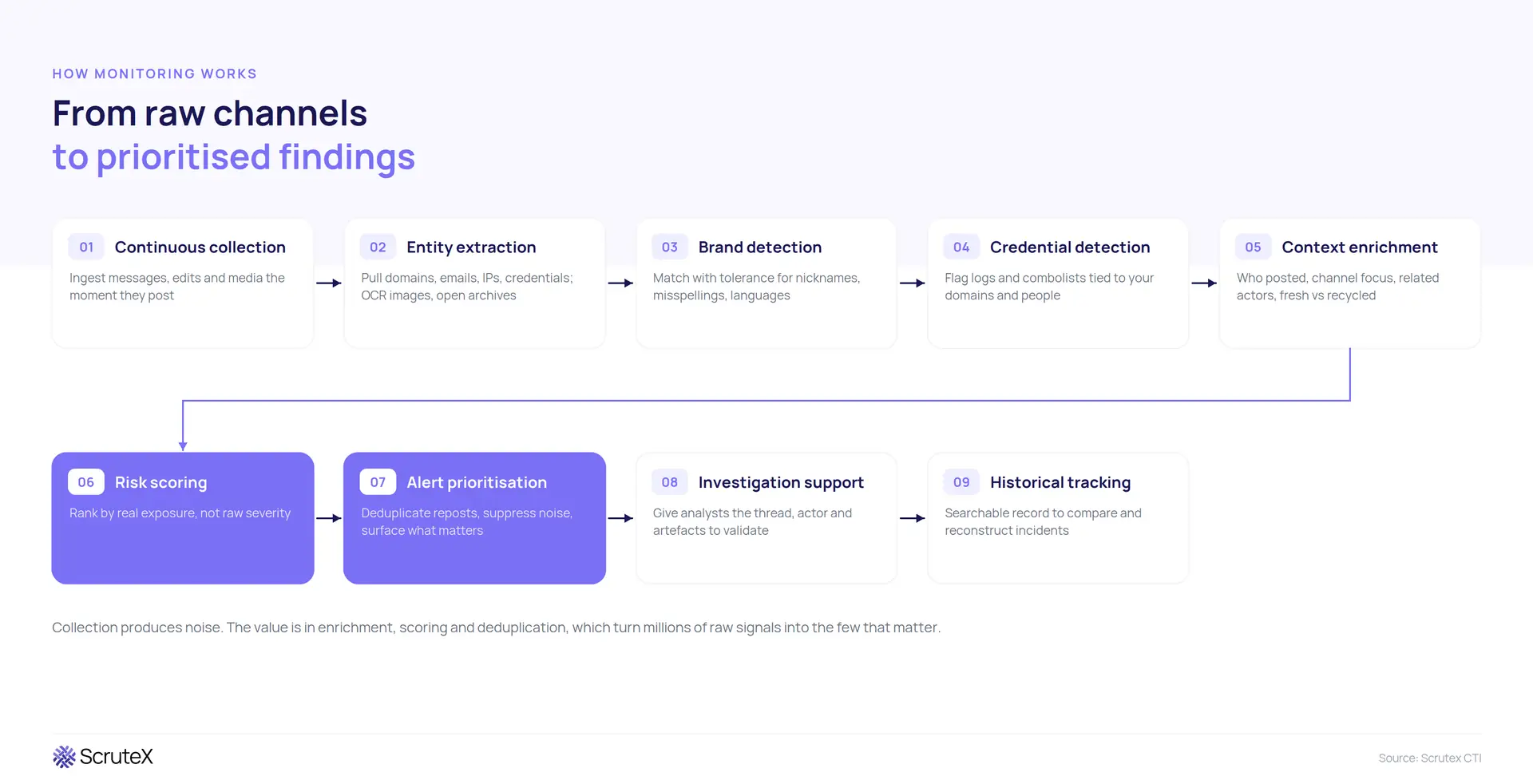
Good monitoring turns a flood of raw messages into a small number of validated, prioritised findings a responder can act on. The workflow below is the same discipline used across dark web and OSINT intelligence, applied to Telegram's structure. It fits inside a continuous threat exposure management approach, where discovery and prioritisation run all the time rather than on a quarterly cadence. (CTEM is a framework developed by Gartner, Inc.)
- Continuous collection. Ingest messages, edits, and media from a broad, self-updating set of public channels, groups, and bots. Capture at the moment of posting so deleted content is still preserved.
- Entity extraction. Pull the structured signals out of unstructured chat: domains, email addresses, IP addresses, credentials, credit card BINs, cryptocurrency wallets, and file hashes. Read text inside images with OCR and open archives to inspect their contents.
- Brand detection. Match against your organisation with tolerance for nicknames, abbreviations, misspellings, and transliteration, not just the exact legal name.
- Credential detection. Identify where the exposed data belongs to your domains, employees, or customers, and flag stealer logs and combolists that contain your addresses.
- Context enrichment. Add who is posting, their history, the channel's focus, related actors, and whether the data looks fresh or recycled from an old breach.
- Risk scoring. Rank each finding by real exposure: a working VPN credential for a live account outranks a duplicate of a five-year-old dump.
- Alert prioritisation. Deduplicate the reposts, suppress noise, and surface only the findings that change what a team should do today.
- Investigation support. Give analysts the surrounding thread, the actor profile, and the artifacts, so they can validate a finding quickly rather than starting from a bare alert.
- Historical tracking. Keep a searchable record so a new finding can be checked against past activity, and so an incident can be reconstructed after the fact.
The point of the sequence is prioritisation. Collection alone produces noise. The value is in the enrichment, scoring, and deduplication that convert millions of raw signals into the handful that matter.
How Scrutex helps businesses monitor Telegram
Scrutex (scrutex.ai) is an AI-powered external security intelligence platform, and Telegram sits inside its continuous discovery across the dark web, Telegram, OSINT, and an organisation's live external attack surface. The tagline the company uses, "External Risk, Fully Visible", describes the intent: one place to see external exposure instead of five disconnected tools.
Setup is agentless. You add your domains and brand keywords, and discovery starts, no software to install on endpoints. From there, several modules cover the Telegram leak types described above.
- Data Exposure Insights watches dark web, paste site, and breach sources alongside Telegram for leaked credentials, stealer logs, exposed sessions, and source code tied to your domains and people. This is the module that catches an employee's harvested session token or a customer database sample before it is widely resold.
- Brand Insights detects impersonation, fake support channels, phishing kits, and executive impersonation that reference your brand across Telegram, DNS, social, and app stores, and supports takedown coordination.
- Threat Insights provides curated threat intelligence mapped to actors, techniques, and indicators, scoped to your region and sector, so a Telegram finding arrives with the context of who is behind it rather than as an isolated line.
Findings do not stop at an alert. The platform enriches each one with actor and campaign context, scores it by real-world exploitability rather than raw severity, and pushes prioritised results into existing SIEM, SOAR, and ticketing tools through a REST API and webhooks. In Scrutex's own measured customer deployments, the company reports a 92 percent reduction in mean time to detect and a 48-hour median remediation time, with the caveat that individual results vary. Those are Scrutex's figures, not an industry benchmark.
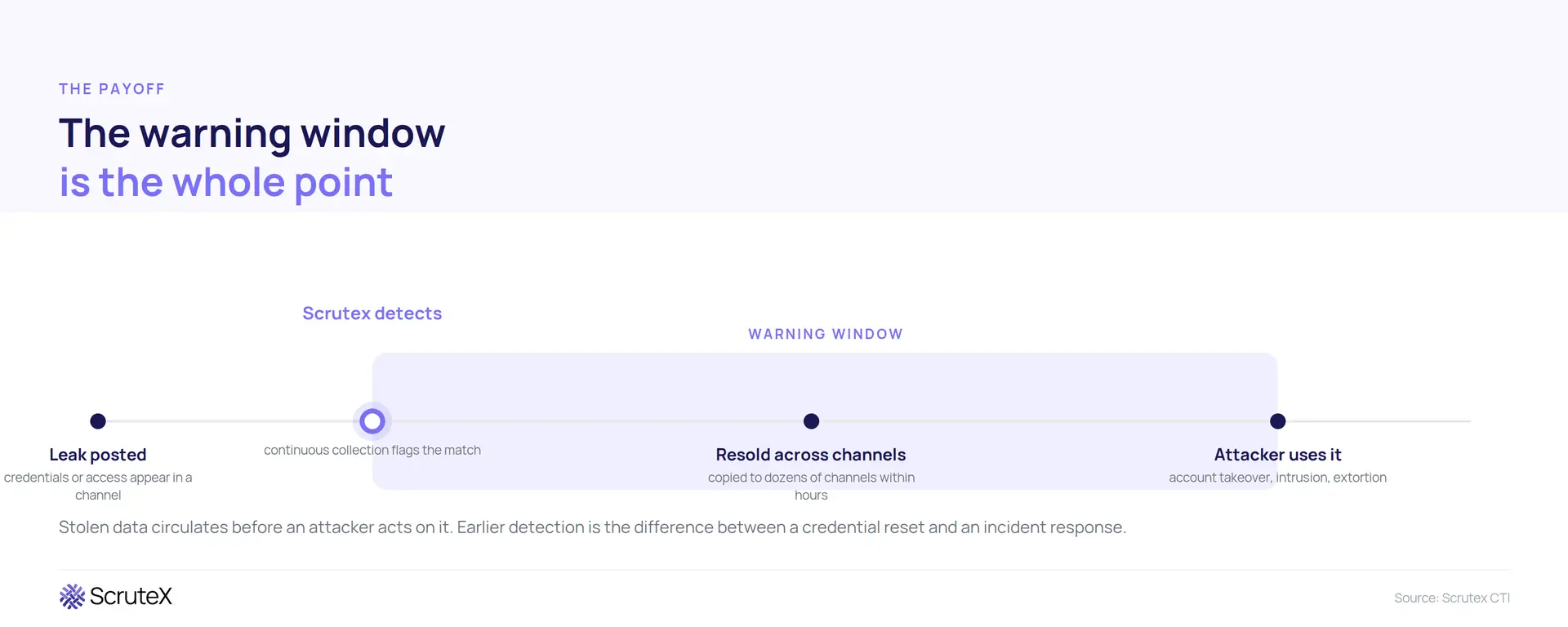
The outcome a security team should care about is the warning window. Stolen data on Telegram circulates for a period before an attacker uses it. Continuous monitoring shortens the gap between a leak appearing and your team knowing, which is the difference between resetting a credential and cleaning up an intrusion. Scrutex offers a free tier with no credit card so a team can test coverage against its own domains before committing.
Best practices for enterprise Telegram monitoring
Telegram monitoring works best as one input into a wider external risk program, not a standalone tool. These practices keep it useful and defensible.
- Monitor executive identities. Track your named leaders. Executive impersonation and fake accounts drive fraud and social engineering, and they surface on Telegram before they hit a target.
- Track corporate domains and subdomains. Register every domain, including acquisitions and regional variants, so credential and phishing findings map back to a real asset.
- Watch supplier and partner names. A breach at a vendor becomes your problem. Add key third parties to coverage so a supplier's leak on Telegram reaches your team early.
- Monitor leaked credentials continuously. Stealer logs are dated within hours. Treat any employee or customer credential that appears as a live incident, not a monthly report item.
- Monitor infrastructure mentions. Watch for your IP ranges, VPN portals, and cloud tenant names. Brokers advertise these directly, sometimes with screenshots.
- Combine Telegram with dark web intelligence. The same leak crosses forums and Telegram within hours. Correlating both gives a fuller picture and cuts duplicate alerts.
- Review alerts continuously, not in batches. The value of a Telegram finding decays fast. A weekly review misses the window that daily or real-time review catches.
- Validate before you escalate. Much of what appears is recycled, exaggerated, or a scam. Confirm a finding is fresh and real before triggering resets or notifications, so responders trust the signal.
Consistency matters more than any single tool. A program that watches the right identities, domains, and suppliers every day, and validates what it finds, will beat an ad hoc search run after an incident is already underway.
Key takeaways
- Telegram is now a primary distribution point for stolen business data, carrying stealer logs, credential dumps, initial access sales, and ransomware extortion, often faster and more openly than traditional dark web forums.
- Exact keyword alerts miss most of it. Nicknames, misspellings, text in images, attachments, and multiple languages defeat literal string matching. Detection has to read images, open archives, and understand context.
- The platform is hard to watch because of volume, deleted posts, invite-only channels, language diversity, and constant reposting, and because blocked channels rebuild under new names.
- Effective monitoring is a workflow, not a search. Continuous collection, entity extraction, enrichment, risk scoring, and deduplication turn noise into a small set of validated findings.
- The payoff is the warning window. Stolen data circulates before it is used. Earlier detection is the difference between a credential reset and an intrusion response.
- Scrutex covers Telegram inside its wider external risk platform, across Data Exposure, Brand, and Threat Insights, with agentless setup and a free tier to test against your own domains.
FAQ
Q: What is Telegram channel monitoring?
A: Telegram channel monitoring is the continuous collection and analysis of public Telegram channels, groups, and bots to detect stolen data, leaked credentials, brand abuse, and threat actor activity that references your organisation. It is a form of OSINT focused on publicly reachable content, and it feeds dark web intelligence and digital risk protection.
Q: Why do threat actors use Telegram?
A: Telegram offers reach, anonymity, ease of use, and automation through bots, without the friction of Tor-based dark web markets. Public channels broadcast to unlimited subscribers, large groups host trading, and bots automate sales and searches, which makes it a fast, low-cost place to advertise and sell stolen data.
Q: Can leaked credentials appear on Telegram?
A: Yes. Stealer logs, credential dumps, and combolists containing usernames and passwords are regularly shared and sold in Telegram channels. Access to premium log channels is often sold as a monthly subscription, and fresh corporate credentials can appear within hours of a device being infected.
Q: Is Telegram part of threat intelligence?
A: Yes. Telegram has become a core source for cyber threat intelligence and dark web monitoring. It concentrates stealer log distribution, initial access brokerage, ransomware extortion, and hacktivist coordination in one place, so a threat intelligence program that ignores it has a blind spot.
Q: What kinds of company data appear on Telegram?
A: Common exposures include employee and customer credentials, corporate email lists, database samples, API keys and cloud tokens, internal documents, VPN and RDP access, source code snippets, stolen session cookies, phishing kits, and brand or executive impersonation accounts.
Q: How can businesses monitor Telegram?
A: Businesses use continuous OSINT and dark web intelligence tools that collect from public channels, extract entities such as domains and credentials, read text inside images, match against the brand with tolerance for misspellings and languages, then score and prioritise findings. Doing this by hand does not scale, so most teams use a platform.
Q: Is Telegram monitoring legal?
A: Monitoring public Telegram channels and groups is generally treated as lawful open source intelligence, since the content is publicly accessible. Organisations should still respect Telegram's terms of service and applicable privacy and data protection laws, and monitoring private end-to-end encrypted chats is a different matter. Confirm your approach with legal counsel for your jurisdiction.
Q: How often should Telegram be monitored?
A: Continuously. Stealer logs and access listings lose value within hours and are often deleted after a sale, so the useful warning window is short. Weekly or ad hoc checks miss most of the opportunity to act before an attacker does, which is why continuous collection and daily or real-time review are the standard.
Q: How is Telegram monitoring different from dark web monitoring?
A: Dark web monitoring focuses on Tor-based forums and markets, while Telegram monitoring watches a mainstream messaging platform. The two overlap heavily, because the same leaks cross both within hours. The strongest programs correlate Telegram with dark web sources to reduce duplicate alerts and build a fuller picture of an exposure.
Q: Can Telegram monitoring detect brand impersonation?
A: Yes. Alongside data leaks, monitoring detects fake support channels, cloned brand accounts, phishing kits that copy a login page, and executive impersonation. These drive customer fraud and social engineering, and they often appear on Telegram before they reach a direct target.
Stolen data on Telegram does not stay hidden. It is advertised to be found by buyers, which means it can be found by defenders too, if someone is watching at the moment it appears. The organisations that get hurt are rarely the ones without the data on Telegram. They are the ones who found out too late.
Scrutex monitors Telegram inside a single external risk platform that also covers the dark web, credential exposure, and brand abuse, so your team sees exposure earlier and acts before an attacker does. You can start with a free scan against your own domains at scrutex.ai.