Ransomware Attacks This Week: 287 Victims Across 51 Groups (November 09 to November 15 2026)
By ScruteXPublished
Summary
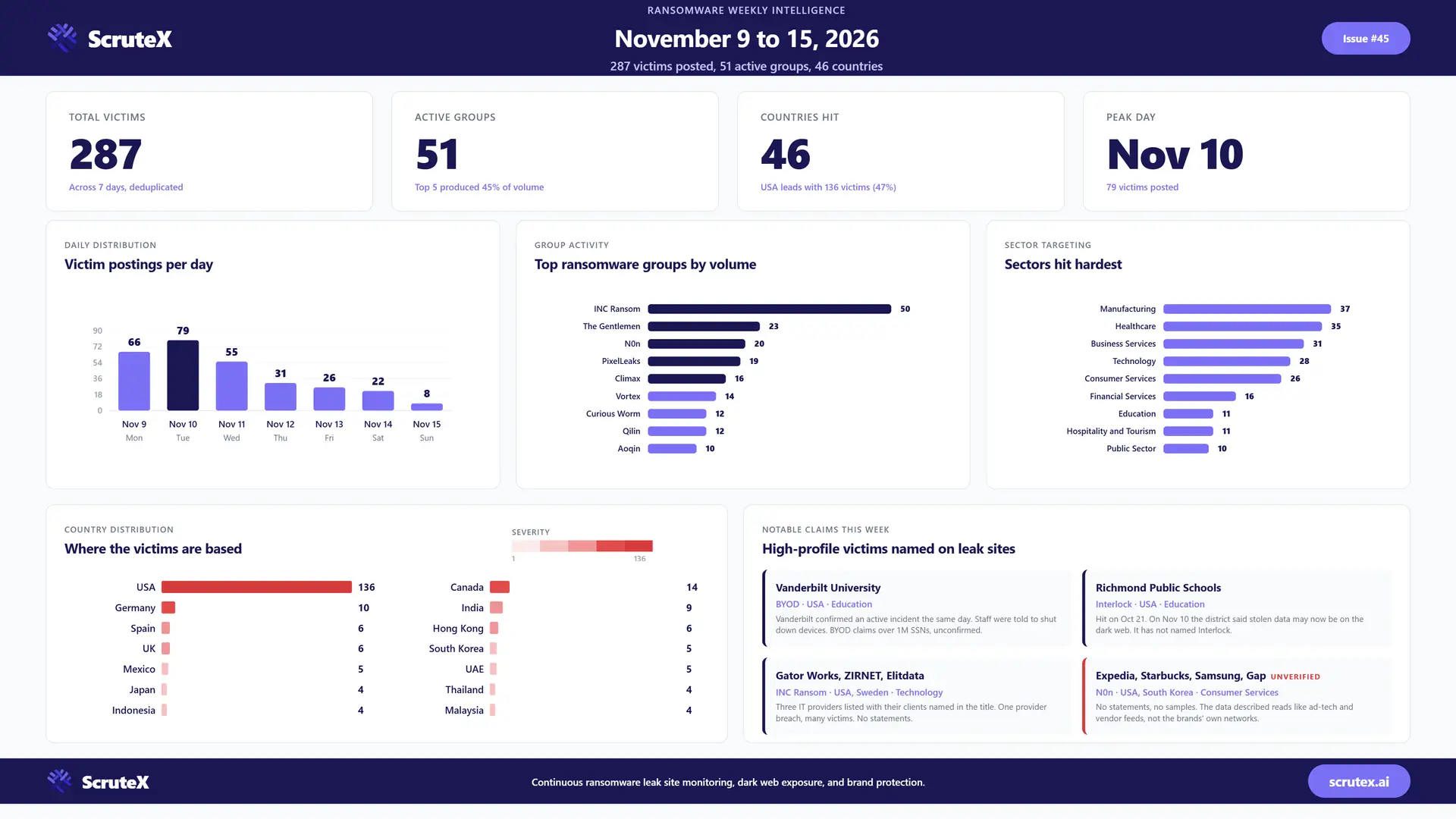
This is the Scrutex ransomware weekly for the November 9 to 15, 2026 window. Our CTI team tracked 287 unique ransomware and extortion victim postings across 51 active groups and 46 countries. That is down 12.5% from 328 in our last issue, which covered October 26 to November 1.
The two groups that drove that last issue went quiet. Qilin fell from 107 listings to 12, and The Gentlemen from 51 to 23. INC Ransom took the top spot instead, with 50 listings, almost all of them on one day. A week earlier we counted one INC Ransom posting.
The most useful thing in INC Ransom's batch is not the count. It is the format. Three of its listings are IT providers posted with their own clients written into the title: Gator Works Computing and three of the firms it supports, ZIRNET and twelve client server backups, and Sweden's Elitdata with a law firm and two companies on its shared platform. One provider breach, several victims, and a listing written to make sure each client knows it.
The second story is turnover. Six brands that posted nothing in our last issue (PixelLeaks, Climax, Vortex, Curious Worm, Aoqin and Osiris) posted 79 victims between them, 28% of the week. Three of them first appeared on a leak site this week. Vortex opened with 14 listings in two days, seven of them in healthcare, including Alexion, Karl Storz and Arthrex.
Four of this week's postings match incidents the victims have already disclosed. Vanderbilt University confirmed an active cyber incident on November 9, the day BYOD listed it. Richmond Public Schools, hit on October 21, said on November 10 that stolen data may have been posted online, and Interlock lists it. York University disclosed a data theft on November 8, and Qilin lists it. Landmark Group disclosed unauthorised access to its Shukran loyalty programme on November 11, and N0n lists it.
The week's biggest brand names are claims with nothing behind them yet: Expedia, Starbucks, Samsung, Gap, VF Corporation, DraftKings and Vertex Pharmaceuticals from N0n, Walgreens from WallStreet, Toyota and Texas Health and Human Services from BYOD, and Raymond James and Computacenter from INC Ransom.
287 postings is still more than a security team can read in a morning. The job is finding the handful that touch your organisation, your suppliers or your IT provider.
A note on how to read the numbers. Each count is a unique organisation named on a leak site during the window. This week we started from 544 raw rows and removed 191 that do not name a new organisation. They were 67 numbered "Company #" slots from N0n, 49 archive file names from a Brain Cipher data dump, 49 rows in which one tracker re-read Booba Project's and Payload's sites and re-emitted victims both groups had posted in late October, 17 anonymous PixelLeaks teasers, and a handful of site banners. We then merged 65 duplicate rows posted under two spellings of the same group. Counts reflect leak site postings, not confirmed compromises, and by the time a victim is posted the intrusion is usually 30 to 90 days old. Our collection does not cover November 2 to 8, so week-on-week comparisons in this issue are against October 26 to November 1.
This Week at a Glance
| Metric | Value |
|---|---|
| Total unique victims posted | 287 |
| Change on last issue | Down 12.5% (from 328, Oct 26 to Nov 1) |
| Active groups | 51 |
| Countries hit | 46 |
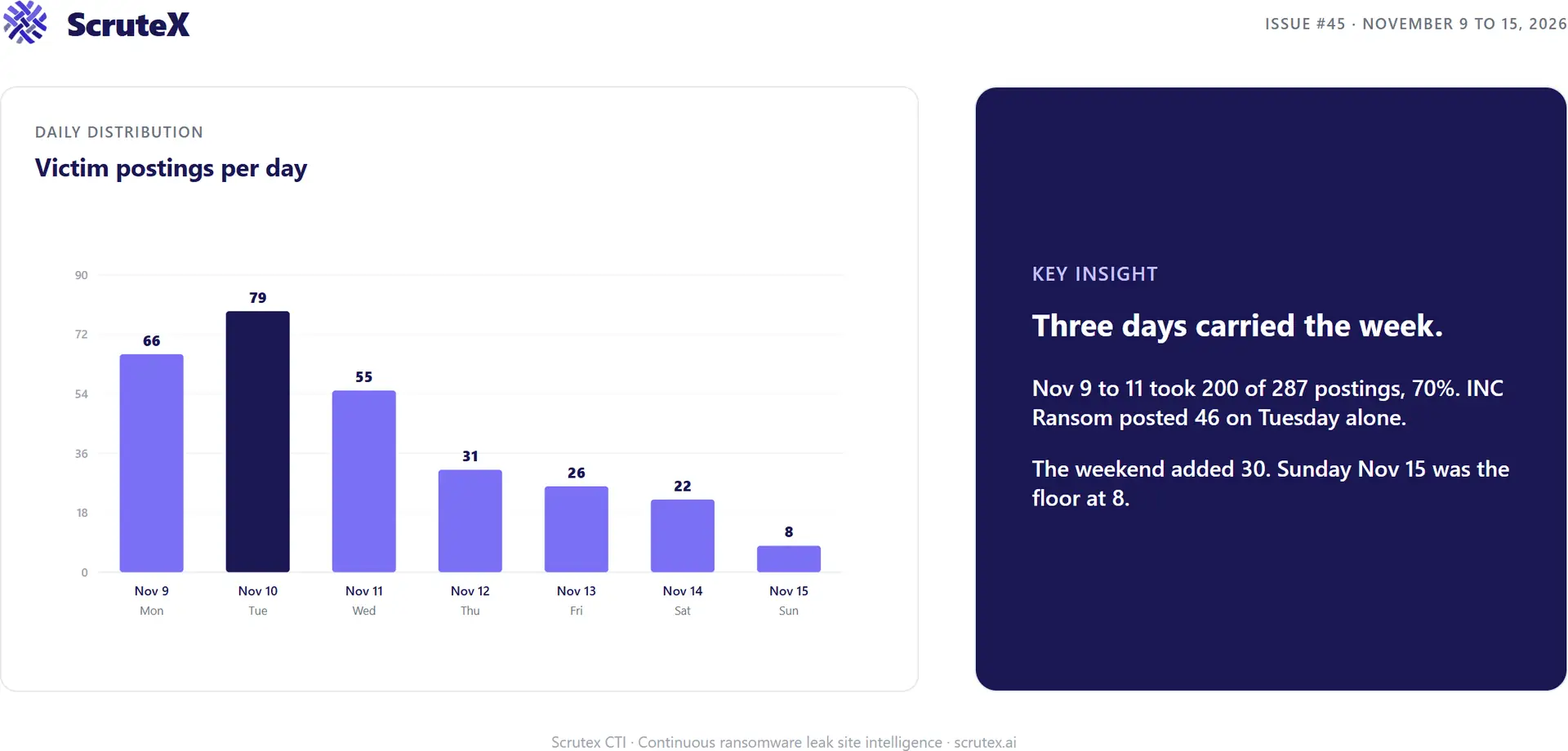
| Heaviest single day | Tuesday November 10 (79 posts, 46 of them INC Ransom) |
| Quietest day | Sunday November 15 (8 posts) |
| Most targeted country | United States (136 victims, 47% of postings) |
| Most targeted sector | Manufacturing (37), then Healthcare (35) |
| Top group by volume | INC Ransom (50, across 18 countries) |
| Share from brands absent last issue | 28% (79 postings from six groups) |
| Confirmed incidents behind a listing | Vanderbilt University, Richmond Public Schools, York University, Landmark Group |
| Notable unverified claims | Expedia, Starbucks, Samsung, Gap, VF Corporation, Walgreens, Toyota, Texas HHSC, Raymond James, Computacenter, Alexion, Karl Storz |
The week ran front to back. Monday took 66 postings, Tuesday 79 and Wednesday 55, so the first three days carried 200 of 287, 70%. Thursday to Sunday ran 31, 26, 22 and 8. Each of the first three days had one driver: Climax and Vortex published their opening batches on Monday, INC Ransom posted 46 on Tuesday, and The Gentlemen made its single drop of 22 on Wednesday.
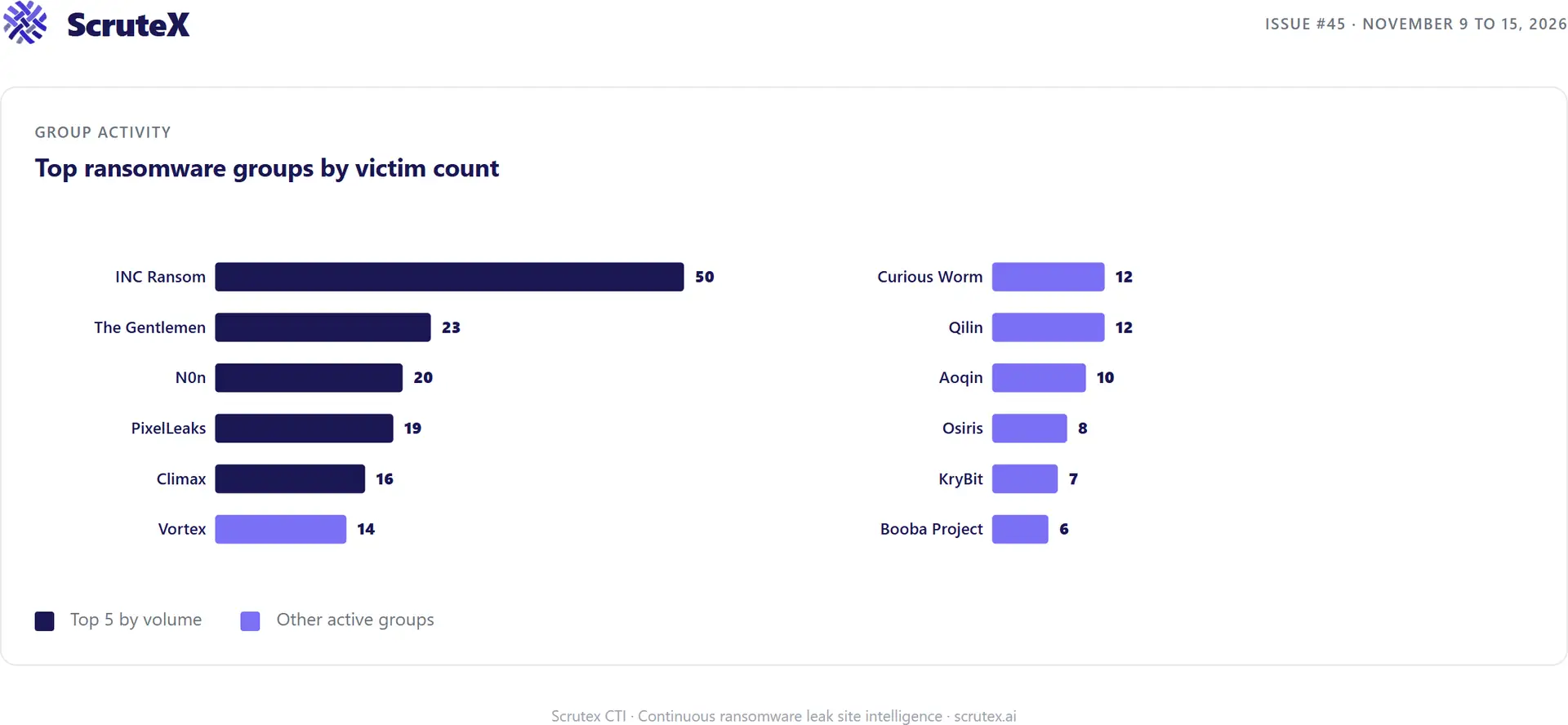
The top five groups took 128 of 287 postings, 45%, close to last issue's level. Below them, 30 groups posted three or fewer victims each.
Group Activity Breakdown
| Rank | Group | Victims | Share | Last issue | Notable Activity |
|---|---|---|---|---|---|
| 1 | INC Ransom | 50 | 17% | 1 | 46 on Nov 10, 18 countries, 25 in the US. Three IT providers posted with their clients. Raymond James, Computacenter, Kalahari Resorts, Coeur Mining, Avolta, Shenwan Hongyuan, Beaver County (PA), Somervell County (TX) |
| 2 | The Gentlemen | 23 | 8% | 51 | 22 in one drop on Nov 11, 17 countries. City of Humboldt (Canada), a Peruvian municipality, a North Macedonian state agency, Esri South Africa, Saudi Arabia's United Pharmacy |
| 3 | N0n | 20 | 7% | 3 | Expedia, Starbucks, Samsung, Gap, VF Corporation, Timberland, Alo Yoga, DraftKings, LiveRamp, Vertex Pharmaceuticals, LEO Pharma, Landmark Group. Plus 67 numbered slots we do not count |
| 4 | PixelLeaks | 19 | 7% | 0 | Godrej & Boyce, PlasmaGen Biosciences, Connectwell (India), SPI Energy, four small US financial advisers, two Hong Kong healthcare firms |
| 5 | Climax | 16 | 6% | 0 | First batch, 10 countries. Nepal Electricity Authority, Setai Hotels, Texmo and Mayur Group (India), Maruki Medical (Japan) |
| 6 | Vortex | 14 | 5% | 0 | First batch, 13 of 14 in the US, 7 in healthcare. Alexion, Karl Storz, Arthrex, Scripps, El Camino Health, SimonMed |
| 7 | Curious Worm | 12 | 4% | 0 | First batch, all bare domains or masked. Five healthcare providers, the law firm Baron & Budd |
| 8 | Qilin | 12 | 4% | 107 | Three universities (UT Arlington, York, Oral Roberts), six US manufacturers and contractors on Nov 15 |
| 9 | Aoqin | 10 | 3% | 0 | Pakistan's Airblue, a Colombian security firm, an Egyptian energy branch, the Brazilian pension fund Sistel |
| 10 | Osiris | 8 | 3% | 0 | All on Nov 11. Methodist Hospitals (Indiana), two German firms, a US law firm |
Also active: KryBit (7), Booba Project, Play, Akira and Settra (6 each), Vexy (5), Audit Team, BYOD, Panzer, Silent Ransom Group and Helix (4 each), and a long tail of Anubis, Black X, Interlock, Dark Project, Bravox, CRPX0, Doommageddon, EndZone, Everest, Global Secret Group, HYFLOCK, MedusaLocker, MetaEncryptor, Netrunner, Scarlett Group, Barracuda, WallStreet, LockBit, SafePay, Emperador, Rhysida, Morpheus, Eclipse, Cloak, Aurora, Orova, PayoutsKing, MajinaHanashi, IAH647 and Everstake, each with one to three listings.
Three observations:
The leaders swapped places entirely. The top two in our last issue posted 158 victims between them. This week they posted 35. INC Ransom went the other way, from one listing to fifty. None of this tells you that Qilin stopped attacking. Leak site posting follows negotiation cycles, and a group that cleared a 79-victim backlog in one day has little left to publish the next week. It does tell you that a weekly chart of group volume is a chart of publishing decisions, not of intrusions.
The Gentlemen kept its weekly rhythm. One midweek drop of 22, as it has run most weeks since September. Four of its 23 are public bodies or suppliers to them: a Canadian city, a Peruvian district municipality, North Macedonia's national agency for EU education programmes and a parking systems vendor to US cities.
Long tail, fresh names. 21 of this week's 51 groups did not appear in our last issue. Some are small crews that publish every few weeks. Six are new or returning brands with meaningful volume, covered below.
INC Ransom and the IT Provider Listings
INC Ransom posted 46 victims on the evening of November 10, carried by two to four independent trackers each, none of them in our earlier issues. The run is broad: 18 countries, accounting and law practices, a Jamaican payments switch, a Hong Kong broker, a Swiss travel retailer, two US counties and a US gold and silver miner.
Three listings stand out because of how they are titled.
- Gator Works Computing (US). Posted with "Smith Law Firm, Beauchamp Edwards Epas, Wise Accounting Tax Service..." in the title. The group describes Gator Works as the sole IT provider for those firms.
- ZIRNET LLC (US). Posted with a string of client domains in the title. The group claims about 2.26 million files, including server backups for twelve clients.
- Elitdata SE (Sweden). Posted with "Advokatfirman Kurt Lundberg HB, Artwood AB, Mantum Group" in the title. The group claims the clients' data sat on shared infrastructure with no meaningful separation between them.
Two more follow the same pattern with less detail: Onmion LLC, posted with three hospitality businesses, and Computacenter, posted with two of its US acquisitions (Pivot Technology Solutions and Sigma Solutions). Tracker estimates put the Gator Works, ZIRNET and Elitdata intrusions in early to late October.
Why the format matters. A small law firm or accounting practice rarely runs its own servers. Its IT provider does, often with one remote management tool and one set of admin credentials reaching every client. When that provider is breached, the extortion crew has a list of second victims, and naming them in the title puts pressure on each one directly. Most of those clients will never appear on a leak site under their own names. They will learn about the incident from their provider, or from a listing like this one.
What we can say about access. SOCRadar reported on October 20 that exposed servers used by INC Ransom and The Gentlemen affiliates contained tooling for CVE-2026-41940 (cPanel and WHM), CVE-2026-35616 (FortiClient EMS) and CVE-2024-57727 (SimpleHelp RMM), and that the operators claimed breaches of more than 49 hosting providers. Unit 42 named INC Ransom among the groups exploiting PAN-OS CVE-2026-0257 in its October 19 to 20 update. We cannot tie any of this week's IT provider listings to a specific flaw. The tooling and the listings point in the same direction.
New and Returning Groups
Vortex. New this week. Its first 14 listings went up on November 9 and 10: Alexion, Karl Storz, Arthrex, Scripps, El Camino Health, SimonMed, Pyramid Healthcare, Solenis, Samtec, Cresa, Bozzuto, AIR Communities, StorageMart and Andersen Construction. Thirteen are US companies and seven are in healthcare or medical devices. Each listing carries a claimed volume, from 32 GB for Cresa to 1.65 TB for Solenis and 2.13 TB and 365,000 files for Alexion. One tracker estimates Karl Storz was breached in mid-September, which would mean Vortex held these intrusions for about two months before opening a leak site. No vendor has published on the group's tooling. One naming note: the Scripps listing points at scripps.org, the San Diego health system, but at least one tracker records it as the E.W. Scripps media company. Neither has commented.
PixelLeaks. First seen November 3, inside the window our collection does not cover. It writes listings in two stages: an anonymous teaser that describes the victim by sector and country ("Logistics SME · Poland", "Plasma protein therapeutics (biopharma) · India"), then a named listing days later. At least four of this week's teasers were later named, including PlasmaGen Biosciences and Godrej & Boyce's Vikhroli campus systems. We count a victim once it is named. Its 19 named victims lean towards India, China and Hong Kong, plus four small US financial advisory firms posted on November 12. Its descriptions talk about verified record sets, not encryption.
Climax. New this week, 16 listings across 10 countries, mostly published on November 9 under one spelling and again on November 10 under another. One tracker estimates the intrusions date from around October 21. The list is mid-market and international: Nepal Electricity Authority, the Indian pump maker Texmo and the Indian Mayur Group, the Setai Hotel Group in Miami, Japan's Maruki Medical Systems and two Korean firms.
Curious Worm. New this week, 12 listings from November 11 to 13. Every one is a bare domain or a masked one, and five are healthcare providers: Lifeline Screening, Raleigh Orthopaedic, Safco Dental Supply in Saudi Arabia, Shannon Health in Ireland and Benchmark Senior Living. One tracker flags some of its listings as unverified. A new brand posting domains with no samples deserves low confidence until data appears.
Aoqin. First seen November 4. Ten listings this week across seven countries, including Pakistan's national carrier Airblue and the Brazilian telecoms pension fund Sistel. Victim reports on a public support forum from late October quote an "AoQin Group" ransom note and describe encrypted Hyper-V virtual disks, which suggests the crew was encrypting before it opened a leak site.
Osiris, returning. Not new. Symantec and Carbon Black documented Osiris in January 2026, linked its operators to former INC Ransom affiliates, and described a POORTRY driver used to kill security tools plus a modified RustDesk for remote access. It posted eight victims on November 11, its first meaningful volume in months, including Methodist Hospitals in Northwest Indiana and two more US healthcare providers.
N0n, naming brands. N0n emerged in September 2026 and steals data without encrypting it. The Register, citing SOCRadar's analysis of an exposed operator server, reported on October 30 that it gets in mostly through stolen or weak credentials, including exposed cloud keys and VPN credential stuffing. Its listings this week read like a consumer brand index. The data it describes for several of them does not read like the brands' own networks: smart TV viewing measurement data for Samsung, search ranking and shopper visitor IDs for Gap, identity graph feeds for LiveRamp. That pattern fits data taken from an advertising, analytics or marketing vendor and filed under its customers' names. No victim and no researcher has confirmed this, so treat it as a working theory. N0n's Starbucks listing first appeared as one of its numbered slots ("Company #147") before it was named. The 67 numbered slots we left out this week may become named listings in later weeks.
BYOD. First seen in September. Four victims counted this week: Vanderbilt University, Texas Health and Human Services Commission, Providence and Toyota. It encrypts as well as steals; Vanderbilt staff reported a BYOD ransom note on screen. After its UNM Health attack in October it handed the hospital decryption keys for free. Its listing for Michigan State University went up again on November 15 with a new download link. The original claim was public by November 2, so we do not count it again.
Sector Targeting Analysis
| Rank | Sector | Victims | Share of labelled | Last issue |
|---|---|---|---|---|
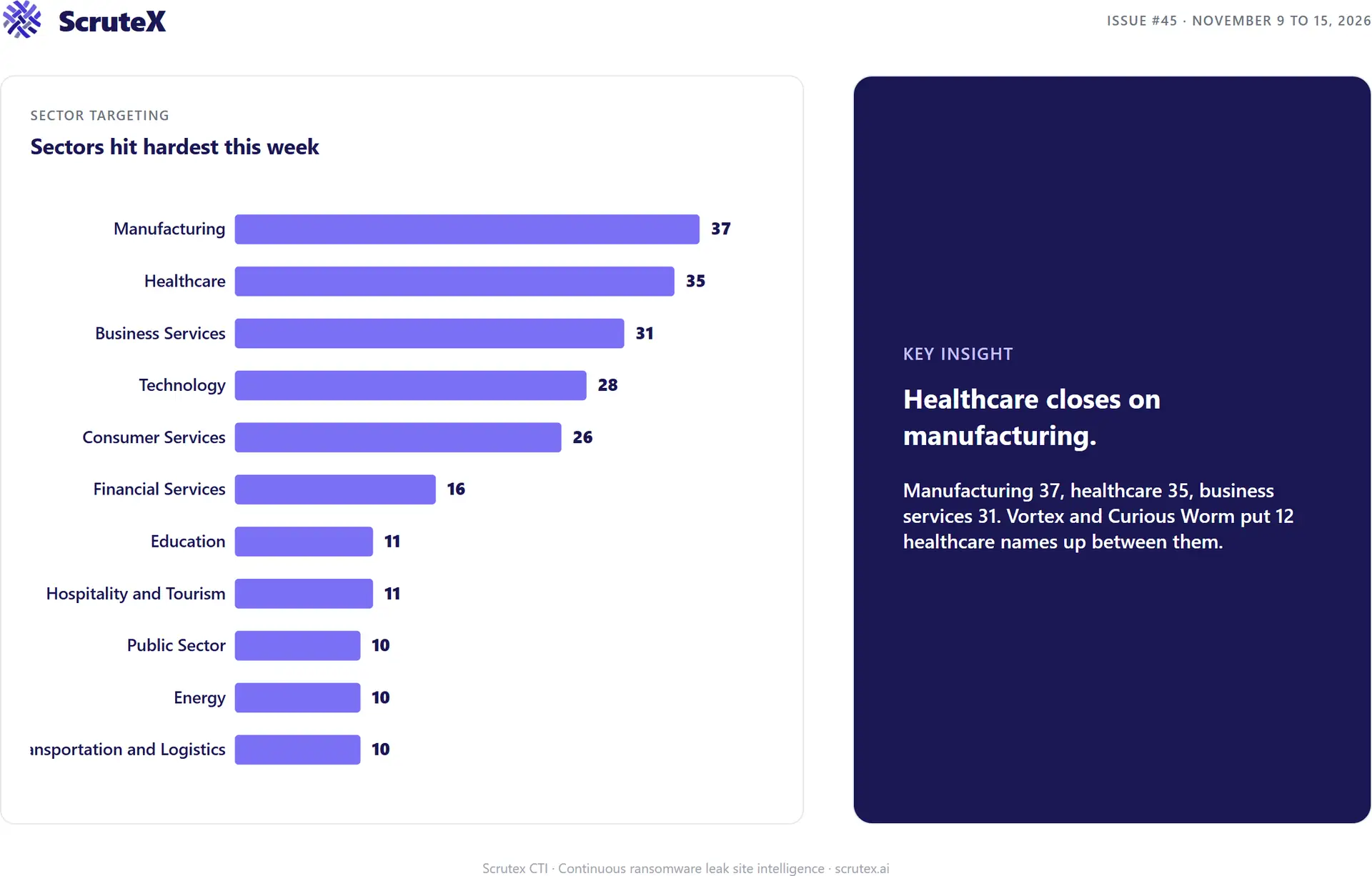
| 1 | Manufacturing | 37 | 16% | 43 |
| 2 | Healthcare | 35 | 15% | 32 |
| 3 | Business Services | 31 | 14% | 44 |
| 4 | Technology | 28 | 12% | 34 |
| 5 | Consumer Services | 26 | 11% | 27 |
| 6 | Financial Services | 16 | 7% | 19 |
| 7 | Education | 11 | 5% | 18 |
| 8 | Hospitality and Tourism | 11 | 5% | 3 |
| 9 | Public Sector | 10 | 4% | 15 |
| 10 | Energy | 10 | 4% | 11 |
| 11 | Transportation and Logistics | 10 | 4% | 17 |
| 12 | Agriculture and Food | 2 | 1% | 3 |
60 of 287 postings carried no sector label and are excluded from the share column.
Healthcare rose while the total fell. 35 postings against 32 last issue, in a week with 41 fewer postings overall. New brands supplied most of it. Vortex listed seven healthcare and medical device firms, Curious Worm five providers, Osiris three, and Booba Project four clinics. Beyond them: Bear Valley Community Hospital in California (Dark Project), Providence (BYOD), the Spanish care home group DomusVi (Black X), and two pharmaceutical companies, Vertex and LEO Pharma, from N0n. The medical device names matter for a different reason than the clinics do. Karl Storz and Arthrex hold surgical device engineering data, and a tracker summary of the Karl Storz listing describes R&D files.
Manufacturing led at 37, spread across a dozen groups with no single driver. Qilin's six US contractors and manufacturers on November 15, Climax's Asian industrial names, PixelLeaks' Indian engineering firms and Akira's three US builders and fabricators make up most of it.
Business services fell from 44 to 31, and the law firm wave of the last two issues eased. Silent Ransom Group posted four (A&O Shearman, Wilentz Goldman & Spitzer and two masked names), against ten last issue. Law firms still appear inside other listings: two of INC Ransom's IT provider titles name law firms among the clients affected.
Education: three universities from Qilin and one confirmed incident from BYOD. UT Arlington, York University and Oral Roberts University (Qilin), Vanderbilt (BYOD), Richmond Public Schools (Interlock) and a Manitoba school division (Interlock). York and Vanderbilt have both disclosed incidents. Richmond has too.
Financial services held at 16, and the names sit around the edge of the banking system: an ACH and payments switch in Jamaica and a Hong Kong broker (INC Ransom), Raymond James (INC Ransom, a bare domain with no detail), a Saudi investment firm and a UAE exchange house (The Gentlemen), and four small US advisory and planning firms (PixelLeaks).
Hospitality jumped from 3 to 11, led by Kalahari Resorts, a minor league baseball club and Minor League Baseball itself (Qilin and Play), and the Setai Hotel Group (Climax).
Country Distribution
| Rank | Country | Victims | Share | Last issue |
|---|---|---|---|---|
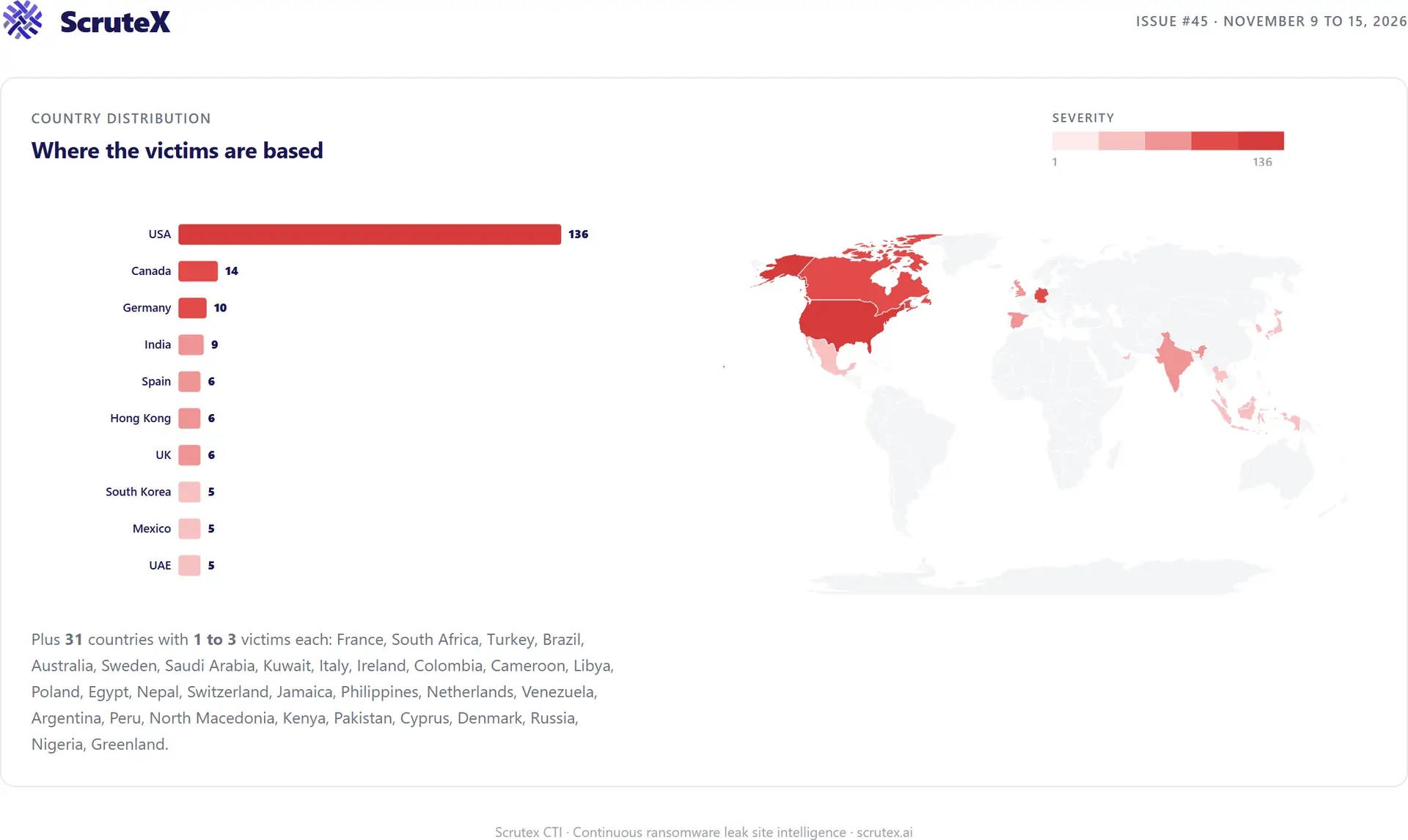
| 1 | United States | 136 | 47% | 142 |
| 2 | Canada | 14 | 5% | 11 |
| 3 | Germany | 10 | 3% | 20 |
| 4 | India | 9 | 3% | 2 |
| 5 | Spain | 6 | 2% | 8 |
| 6 | Hong Kong | 6 | 2% | 0 |
| 7 | United Kingdom | 6 | 2% | 10 |
| 8 | South Korea | 5 | 2% | 1 |
| 9 | Mexico | 5 | 2% | 14 |
| 10 | UAE | 5 | 2% | 1 |
A further 36 countries carried one to four postings each, among them Japan, Thailand, Indonesia, Malaysia, China, France, South Africa, Turkey, Brazil, Australia, Sweden, Saudi Arabia, Kuwait, Italy, Ireland, Colombia, Belgium, Egypt, Nepal, Pakistan, Nigeria, Kenya, Jamaica, Peru, Argentina, Venezuela, North Macedonia, Cameroon, Libya and Greenland. 18 postings carried no country.
The US share rose to 47% from 43%, even as the count dipped. INC Ransom (25), Vortex (13) and N0n (13) put the most US names up.
India went from 2 to 9. PixelLeaks named Godrej & Boyce, PlasmaGen Biosciences and Connectwell Industries. Climax named Texmo and Mayur Group. INC Ransom named the engineering services firm Axiscades, Nandan Terry and the accounting practice Patel Panchal, and Orova named Herminio India Precision Technology. Indian organisations named on a leak site have a six-hour window to report a cyber incident to CERT-In once they become aware of it. A listing is often how they become aware.
Hong Kong appeared with 6, from PixelLeaks (two healthcare firms and a technology platform), INC Ransom (Shenwan Hongyuan's Hong Kong arm), KryBit and The Gentlemen.
Germany halved to 10, with no single group behind it. Mexico fell from 14 to 5 as Qilin's volume dropped away.
For readers outside the US, the regional point holds: this week's new brands spread wide. Climax posted in 10 countries and PixelLeaks in 7, with most of their victims in Asia. Map your incident reporting obligations to your own regime (CERT-In's six-hour window in India, the SEC disclosure rules in the US, GDPR notification in the EU, APRA CPS 234 in Australia) before an incident forces the question.
Notable Claims and Incidents
Every entry below is a claim the actor posted. We say where the organisation or an authority has said something, and rate how far the claim itself can be trusted.
Incidents the victims have disclosed
BYOD lists Vanderbilt University. Posted November 9. Vanderbilt confirmed an active cybersecurity incident the same day and told staff to shut down devices and disconnect from Wi-Fi. Staff reported a BYOD ransom note on screen. BYOD claims to hold more than a million Social Security numbers, which Vanderbilt has not confirmed. Confidence: High that a BYOD ransomware incident occurred. Low on the data claim until samples or a notification letter appear.
Interlock lists Richmond Public Schools. Posted November 9. The Virginia district's network went down on October 21, with ransom notes on staff laptops, and the FBI and Virginia State Police are involved. On November 10 to 11 the district told families that stolen data may have been posted to the dark web, said a forensic audit is under way and offered credit monitoring. It has not named Interlock. Confidence: High that the incident and data theft are real. Medium on Interlock, because the listing matches the district's own timeline but the district has not attributed it.
Qilin lists York University. Posted November 12. York said around November 8 that it had found unauthorised access on October 25 to data submitted through departmental web forms on 14 of its sites, going back to 2007, and that some government ID and financial details were exposed. It is offering two years of credit monitoring and has not named an attacker. Confidence: Medium that Qilin is responsible. The listing followed the disclosure, and the incident as described, web form data and not a network compromise, is narrower than a typical Qilin intrusion.
N0n lists Landmark Group. Posted November 10. The Dubai-based retail group disclosed on November 11 unauthorised access to its Shukran loyalty programme, with names, contact details and dates of birth possibly exposed and payment card data unaffected. It has notified the authorities and has not named an attacker or a vendor. Confidence: Medium. A loyalty programme run on a third-party platform fits the pattern of N0n's other claims this week.
INC Ransom lists Kalahari Resorts. Posted November 10. A breach notice reported to the Texas Attorney General on November 10 says unauthorised network access was detected on October 9 and that names, addresses, dates of birth and Social Security numbers, including employees', may be exposed. We have seen this through secondary reporting, not the AG portal itself. Confidence: Medium.
Claims with no public response
N0n lists Expedia, Starbucks, Samsung, Gap, VF Corporation and DraftKings. Posted November 9 to 14. Expedia's listing, the only one covered in the press, claims hundreds of millions of loyalty account records. Samsung's describes US smart TV viewing data, Gap's describes staff single sign-on identities and shopper visitor IDs, and DraftKings' claims 3 TB. No samples, no deadlines and no statements from any of them. Confidence: Low on each. If N0n took this data from a shared vendor, the brand may have no incident of its own and still have customers' data in play.
Vortex lists Alexion, Karl Storz and Arthrex. Posted November 9 to 10, with claimed volumes of 2.13 TB, 500 GB and 700 GB. A new brand, no samples we have seen, no statements. El Camino Health, also listed, reported a separate email account compromise to the California Attorney General on October 30. Nothing links that incident to Vortex. Confidence: Low.
WallStreet lists Walgreens. Posted November 13 with no detail. Walgreens was listed by another crew in 2025. Confidence: Low.
BYOD lists Toyota and the Texas Health and Human Services Commission. Toyota on November 10, claiming customer data and kiosk devices, carried by a single tracker. HHSC on November 9, with a "final warning and sample" post on November 15. The listing refers to about 94,000 records exposed by an employee, which matches the insider cases HHSC disclosed in 2025, and claims "the actual flaw remained in the system". HHSC has not commented. Confidence: Low on both, though BYOD's confirmed record at Vanderbilt and UNM means its claims deserve to be checked, not dismissed.
INC Ransom lists Raymond James and Computacenter. Raymond James as a bare domain with no detail, Computacenter with two of its US acquisitions in the title. No statements. Confidence: Low.
Silent Ransom Group lists A&O Shearman. Posted November 10, with a claimed 415 GB on the group's mirror site. A&O's last confirmed incident was in 2023. Confidence: Low.
Relisted victims. Three of this week's names were listed by a different group earlier this year. INC Ransom's Kolin (Turkey) was claimed by Qilin in April. Helix's Veritiv was claimed by another crew in September. Bravox's World Wide Fittings was listed by The Gentlemen in July. A second listing can mean a second intrusion, a resold dataset, or a new crew padding its site. Treat it as a reason to check, not as proof of either.
Low signal claims this week. 37 postings are a bare domain and 8 are masked to a few characters, so 242 of 287, 84%, name an organisation in words, similar to last issue. INC Ransom (10), Curious Worm (10), KryBit and Settra account for most of the bare domains.
Updates on earlier claims. BYOD reposted Michigan State University with a new download link. MSU says it has no evidence its central directory was breached. We found no new statements from SAP, SoftwareOne, FPT Software, Ryder, KuCoin, Holcim or the law firms named in our last two issues.
Top CVEs These Groups Are Exploiting
The table covers this week's active groups where a named source supports the attribution. None of this week's new brands (Vortex, Climax, Curious Worm, PixelLeaks, Aoqin) has a published CVE attribution.
| CVE | Product | CVSS | Who is using it | Why it matters |
|---|---|---|---|---|
| CVE-2026-0257 | Palo Alto Networks PAN-OS GlobalProtect, authentication bypass | 7.8 as reported | Qilin, INC Ransom, Settra | Unit 42's October 19 to 20 update names Qilin and INC Ransom. On CISA KEV with known ransomware use. ReliaQuest said in October it expects exploitation to continue for about three more months |
| CVE-2023-27532 | Veeam Backup and Replication, credential exposure | 7.5 | Chained after CVE-2026-0257 by Qilin and INC Ransom | The backup server holds credentials to the rest of the estate, and the backups the victim needs to recover |
| CVE-2024-57727 | SimpleHelp RMM, path traversal | 7.5 | INC Ransom and The Gentlemen affiliates | Found on exposed affiliate servers (SOCRadar, Oct 20). A remote management tool reaches every client an IT provider supports |
| CVE-2026-41940 | cPanel and WHM, authentication bypass | 9.8 as reported | INC Ransom and The Gentlemen affiliates | Same SOCRadar finding. The operators claimed more than 49 hosting provider breaches |
| CVE-2026-35616 | Fortinet FortiClient EMS | 9.1 to 9.8, sources differ | INC Ransom and The Gentlemen affiliates | Same finding. EMS pushes configuration to every managed endpoint |
| CVE-2024-55591 | Fortinet FortiOS and FortiProxy, authentication bypass | 9.8 | The Gentlemen | Named as the group's primary access route alongside VPN credentials without MFA |
| CVE-2024-40766 | SonicWall SonicOS SSLVPN, improper access control | 9.3 | Akira | Long-running Akira access route, documented by several vendors and CISA |
This window's KEV additions worth your attention. CISA added 15 vulnerabilities between November 2 and 15. None is flagged for known ransomware use yet, but four sit on the kind of edge and mail infrastructure these groups go after.
| CVE | Product | Added | Due | What to know |
|---|---|---|---|---|
| CVE-2026-19868 | SonicWall SonicOS SSLVPN, single-factor authentication | Nov 6 | Nov 20 | An MFA bypass on the same VPN Akira has exploited for two years. CVSS 7.1 per SonicWall |
| CVE-2026-116606 | Barracuda Email Security Gateway, authentication bypass | Nov 10 | Nov 13 | Three-day deadline, already passed |
| CVE-2026-111560 | Barracuda Networks multiple products, OS command injection | Nov 10 | Nov 13 | Same three-day deadline |
| CVE-2026-123039 | Check Point multiple products, incorrect permission assignment | Nov 13 | Nov 16 | Reported as local privilege escalation to root. Due today |
The headline this week is the IT provider. INC Ransom's run includes IT providers posted with their clients, and the tooling found on its affiliates' servers targets exactly the software an IT provider runs: remote management, endpoint management and hosting control panels. The edge-device routes from our last issue (PAN-OS for Qilin and INC Ransom, FortiOS for The Gentlemen) have not gone away.
Attribution accuracy note. We list a group against a CVE only where a named source supports it. The SOCRadar finding covers affiliates of INC Ransom and The Gentlemen and does not tie a specific flaw to a specific victim. The Gentlemen's Fortinet link and Akira's SonicWall link are carried forward from published research and were not re-observed this week.
Infrastructure and Operational Shifts
Teasers before names. PixelLeaks posts victims first as anonymous descriptions, then names them days later. N0n does the same with numbered slots, and its Starbucks listing started as "Company #147". Silent Ransom Group still posts initials. For counting, we wait for the name. For a defender, a teaser that matches your sector, country and a distinctive detail ("campus visitor and canteen systems", "Saudi client hosting") is worth treating as a possible early warning about you or a supplier.
Two spellings, one crew, again. Climax posted its whole first batch as "climax" on one day and "Climax Inc" the next. Aoqin posted as "Aoqin" and "aoqin leaks", Vortex as "vortex" and "Vortex" with and without data volumes, Booba Project as "Booba Project" and "booba team". Counted naively, duplicates like these would have added 65 to the week.
Trackers re-reading old listings. One tracker re-read Booba Project's and Payload's sites this week and emitted 49 of their earlier victims again as bare domains with this week's date. Where we could check them, every one matched a victim the group had already named in late October: BASS Medical Group, the City of Big Spring, the Circleville Police Department and the Hudson River Museum for Booba Project, Hauhinco, Kraft Lernen and Miletic GmbH for Payload. A raw count would have put Booba Project second for the week on victims it posted three weeks ago.
Data dumps in the victim column. Brain Cipher published a data dump split into 49 archive parts, and one tracker logged each archive file name as a victim. We excluded them. The dump itself is real and belongs to an earlier victim.
Key Takeaways for Defenders
Ask your IT provider the INC Ransom question this week. Which remote management, endpoint management and hosting tools does it run against your environment, are they patched against CVE-2024-57727, CVE-2026-35616 and CVE-2026-41940, and is your data separated from its other clients? If your provider is small, assume the answer to the last question is no until it shows you otherwise.
Keep hunting on PAN-OS GlobalProtect. Qilin and INC Ransom are both documented on CVE-2026-0257, and INC Ransom posted 50 victims this week. Look for VPN sessions you cannot explain, access to Veeam (CVE-2023-27532) from VPN address space, and domain controller virtual disk access. Rotate any credential that passed through the gateway while it was unpatched.
Patch the November KEV edge flaws. SonicWall SSLVPN CVE-2026-19868 is an MFA bypass on the VPN Akira already favours, due November 20. The Barracuda ESG deadlines have passed and Check Point's falls today.
Healthcare: watch the new brands. Vortex and Curious Worm put 12 healthcare and medical device names up in their first week, and Osiris returned with three more. Medical device makers should treat engineering and R&D repositories as extortion targets, not just patient data.
Check your marketing and analytics vendors, not just your own network. If N0n's big-brand listings came from advertising, analytics or loyalty platforms, the brand never had an intrusion and its customers' data is still exposed. Know which vendors hold your customer records, how much, and how they would tell you.
Leak site appearance is a late signal. Climax's victims were breached around three weeks before they were posted, Vortex's possibly two months. Watching external exposure, leaked credentials and supplier listings as they happen closes that gap.
Most of that is triage before it is defence. Somebody has to read 544 rows, set aside the numbered slots, the file names, the re-reads and the second spellings, and work out which of the 287 that remain touch your organisation, your IT provider or your vendors.
Where Scrutex Fits
Scrutex Threat Insights monitors ransomware leak sites and dark web sources continuously and matches what it finds against your own domains and your named suppliers, so a listing that names your organisation, your IT provider or a vendor holding your customer data reaches you as an alert and not as a line in a weekly roundup. Vendor Insights tracks the third parties that hold your access and your data, the exposure this week's IT provider listings are about. Vulnerability Insights prioritises flaws like CVE-2026-0257 and CVE-2026-19868 by real-world exploitation against your exposed assets, not by raw CVSS. None of them can tell you whether a claim is true. All of them can tell you, quickly, whether it is about you.
Start at scrutex.ai/signup or read more at scrutex.ai/solution/threat.
Frequently Asked Questions
How many ransomware attacks were there in the week of November 9 to 15, 2026?
Scrutex tracked 287 unique victim postings across 51 active groups and 46 countries, down 12.5% from 328 in our previous issue (October 26 to November 1). These are leak site postings, not confirmed compromises, and the intrusion is usually 30 to 90 days older than the posting.
Which ransomware group was most active?
INC Ransom, with 50 listings across 18 countries, 46 of them on November 10. The Gentlemen was second with 23, then N0n with 20. Qilin, which led our previous issue with 107, posted 12.
Why does INC Ransom list IT providers with their clients?
Because one IT provider breach gives the crew several victims. Listings for Gator Works Computing, ZIRNET and Elitdata name the provider's clients in the title, which puts pressure on each client directly. Small firms that outsource their IT may learn about an incident this way before their provider tells them.
Were Expedia, Starbucks or Samsung hit by ransomware?
N0n listed all three between November 9 and 14. None has commented and no samples have appeared. The data N0n describes for several of its brand listings looks like advertising or analytics vendor data, not the brands' own systems. We rate each claim low confidence.
What happened at Vanderbilt University?
Vanderbilt confirmed an active cybersecurity incident on November 9 and told staff to shut down devices. Staff reported a BYOD ransom note. BYOD claims to hold more than a million Social Security numbers, which the university has not confirmed.
Who is Vortex ransomware?
A new extortion brand that opened its leak site on November 9 to 10 with 14 victims, 13 in the US and seven in healthcare or medical devices, including Alexion, Karl Storz and Arthrex. No vendor has published on its tooling, and no listed victim has commented.
Which CVEs should I patch this week?
PAN-OS GlobalProtect CVE-2026-0257 and Veeam CVE-2023-27532 (Qilin and INC Ransom), SimpleHelp CVE-2024-57727, FortiClient EMS CVE-2026-35616 and cPanel CVE-2026-41940 (INC Ransom and The Gentlemen affiliates), and the new SonicWall SSLVPN MFA bypass CVE-2026-19868, due on CISA's KEV list by November 20.
Where can I get this in real time instead of weekly?
Scrutex Threat Insights monitors leak sites and dark web sources continuously and matches findings against your own domains and your named suppliers, so a relevant listing reaches you when it is posted, not in the following Monday's roundup.