Optimizely Supply-Chain Attack (OPTIMJACK): Full Analysis, IOCs and Victim List
By ScruteXPublished
What is the Optimizely supply-chain attack?
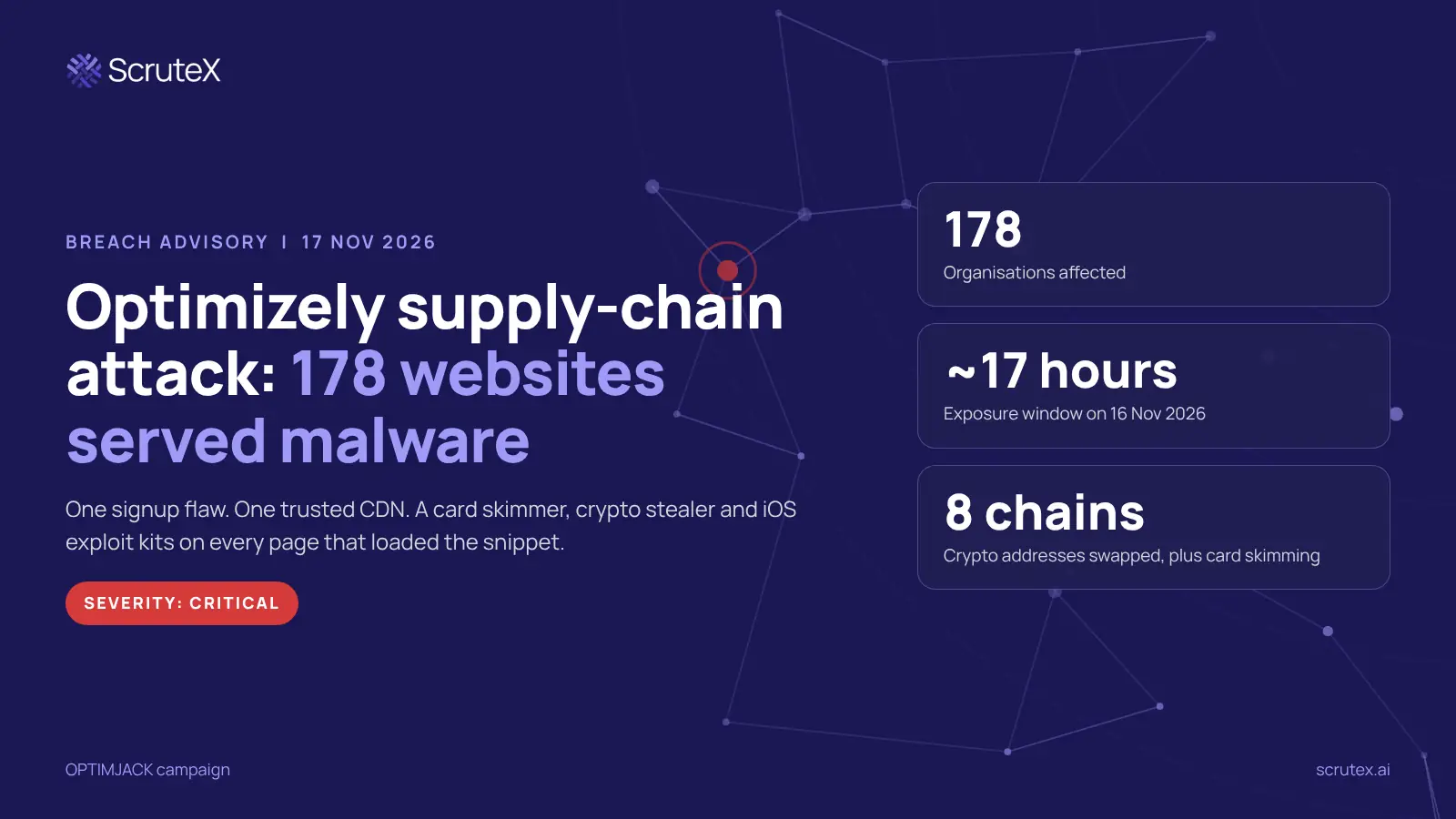
The Optimizely supply-chain attack, tracked as OPTIMJACK, is a 16 November 2026 incident in which an attacker added malicious JavaScript to Optimizely Web Experimentation customer projects. Optimizely's CDN served that code to visitors of 178 organisations for up to 17 hours. It skimmed payment cards, swapped crypto wallet addresses, stole cookies and screenshots, and delivered iOS exploit kits.
Key facts
| Fact | Detail |
|---|---|
| Incident name | OPTIMJACK (Optimizely Web supply-chain attack) |
| Date | 16 November 2026, 04:21 to 21:52 UTC |
| Vendor and product | Optimizely Web Experimentation, component "Snippet Delivery" |
| Attack vector | Vulnerability in the Experimentation account signup flow used to write code into customer Project JavaScript (projectJS) |
| Delivery | cdn.optimizely.com and customer self-hosted snippet paths |
| Organisations affected | 178 (188 infected snippets of 1,611 checked) |
| Payload | Crypto clipper on 8 chains, Luhn-validated card skimmer, cookie and screenshot theft, iOS exploit kits (Coruna, DarkSword) |
| Confirmed losses | About $7,040 in crypto received by attacker wallets by 19:25 UTC |
| Threat actor | Unattributed, financially motivated |
| Vendor status | Fixed; Optimizely status page in "Monitoring" since 17 November 2026, 01:02 UTC |
| Scrutex severity | Critical |
Key takeaways
- No customer server was breached. The code ran inside a vendor script every affected site had chosen to trust.
- Content Security Policy allowlists, consent managers and vendor reputation all passed the malicious code.
- Card fields inside payment provider iframes (Stripe Elements, Adyen) were out of reach. Card fields on the merchant's own page were not.
- Absence from the public victim list does not clear you. The list comes from external sweeps and the real number is likely higher.
- Staging, QA and preview sites were infected at 8 organisations because they shared the production Optimizely project.
Updates
| Date | Update |
|---|---|
| 17-11-2026 01:02 UTC | Optimizely confirms the incident on its status page. Status: Monitoring. |
| 16-11-2026 21:52 UTC | One of 188 infected snippets still carries the loader (TalkTalk). All others cleaned. |
| 16-11-2026 13:43 UTC | Card skimmer added to the payload. |
| 16-11-2026 04:21 UTC | First injection seen, on the BBC's snippet. |
What happened in the Optimizely supply-chain attack?
An attacker exploited a vulnerability in Optimizely Web Experimentation and used it to add malicious JavaScript to customer projects. Optimizely's status page states exactly that: an unauthorised party exploited a vulnerability in Experimentation and used it to add malicious JavaScript to some customer projects. Reporting on the vendor's response describes the flaw as sitting in the account signup flow.
The attacker changed one field, Project JavaScript. Everything else in each customer's snippet stayed intact. Because the file still came from
cdn.optimizely.com with Optimizely's certificate, every affected browser treated the payload as trusted.This was not CDN cache poisoning. Optimizely's CDN served exactly what it was given. The malicious code was saved into customer project configuration and compiled into each snippet like any normal change.
What Optimizely has said
- Cause: an unauthorised party exploited a vulnerability in Experimentation.
- Remediation: the vulnerability is fixed, injected code removed, protections added to stop unauthorised code being delivered, and affected user accounts secured.
- Further actions reported: the vulnerable signup path blocked, sessions ended, tokens revoked, affected accounts reset, code delivery blocked at Cloudflare and affected customers notified.
- Scope: "some customer projects". Optimizely has not published a count, a project list or per-customer exposure windows.
- Customer instructions: none on the status page.
What is still unknown
- How one flaw gave write access to so many unrelated customer projects.
- How long the flaw existed before 16 November.
- Each customer's exposure window. Customers should request their own project modification times.
Optimizely disclosed a separate breach in February 2026 after a voice-phishing attack (suspected ShinyHunters). No link to OPTIMJACK has been shown.
How does Optimizely Web work, and why did browsers trust the code?
Optimizely Web works by having each customer load a JavaScript snippet from Optimizely's CDN, for example
https://cdn.optimizely.com/js/<project-id>.js. The snippet contains Optimizely's code, the customer's experiments and an optional field called Project JavaScript (projectJS). projectJS is custom code the customer writes in the Optimizely dashboard, and it runs on every page that loads the snippet.Some customers serve the snippet from their own domain, such as
opt.scheels.com/js/<id>.js or www.vodafone.com.au/js/<id>.js. Those were affected too, because the content comes from the same Optimizely project.This is the code the attacker added to Zoom's snippet:
The try/catch wrapper means a failure stays silent and the customer's experiments keep working, so nothing visibly breaks.
The three loader variants
| Variant | How it works | Why it matters |
|---|---|---|
| 1. Plain script tag | Loads https://1688360[.]cc/track.js | Used in most snippets |
2. Base64 with atob() | Same URL hidden in Base64 | A search for "1688360.cc" will not find it. Smartsheet's snippet was cleaned, then re-infected with this variant, so the attacker still had write access during cleanup |
3. Inline payload with eval() | Full copy of the payload runs if 1688360[.]cc is blocked | Defeats a CSP that blocks the domain but allows unsafe-eval |
Consent tools did not stop it either. A consent manager controls when a script runs, not what it contains.
What did the malicious code do?
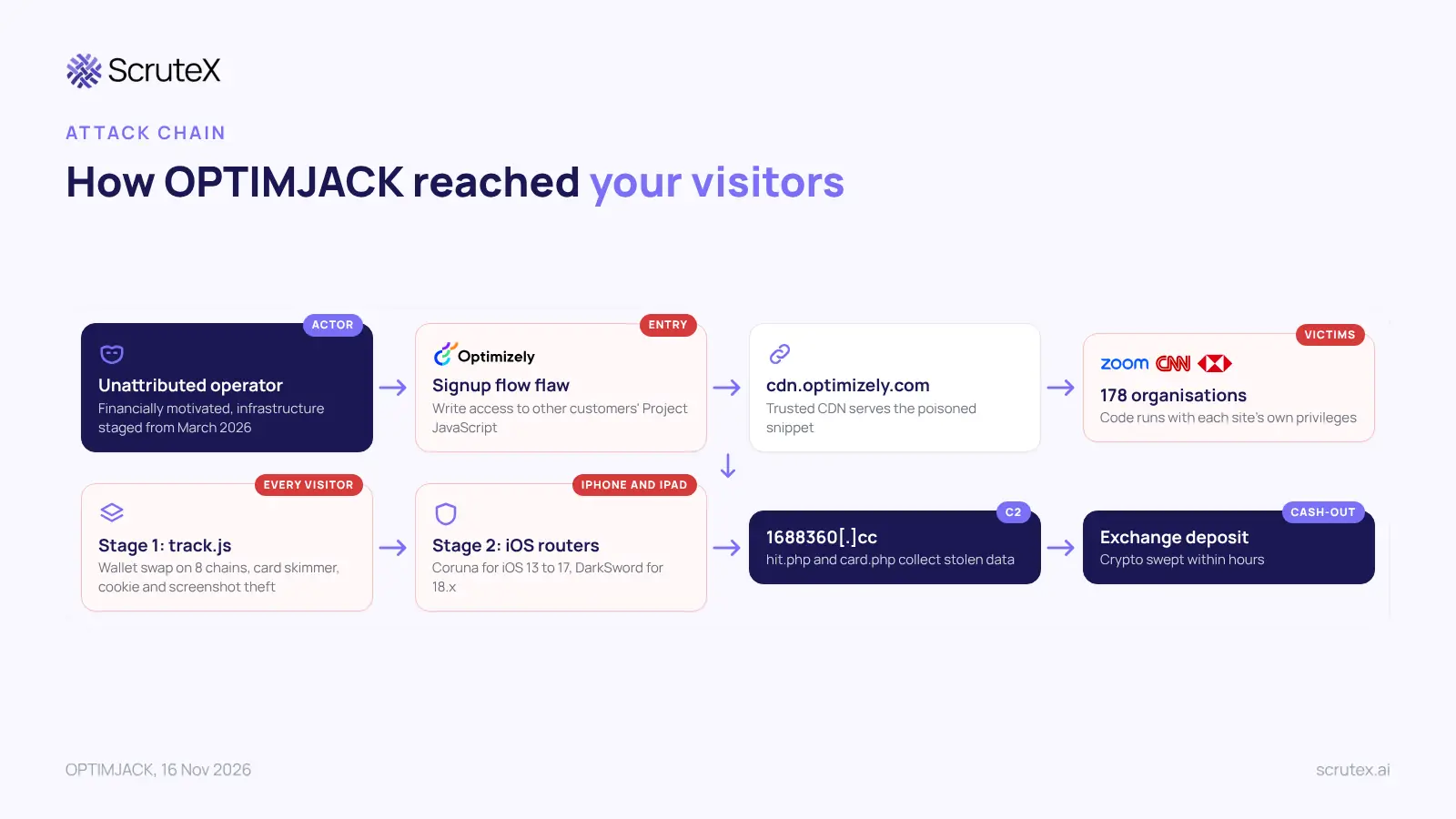
The payload ran in two stages. Stage 1 hit every visitor. Stage 2 targeted iPhone and iPad users.
Stage 1: track.js (about 30 KB, rebuilt 26 times)
- Crypto clipper: replaced wallet addresses for BTC, ETH and EVM chains, TRON, SOL, TON, LTC, BCH and DOGE. It validated checksums before swapping, rescanned the page every 50 ms on pages containing words such as wallet, deposit or send, and rewrote text, form inputs, links and QR images.
- Hooks: copy events, clipboard APIs,
navigator.share,window.open, fetch, XHR andFunction.prototype.call/apply. - Card skimmer (from 13:43 UTC): wrapped fetch, XHR and form submits, kept Luhn-valid card numbers with expiry and CVV, and de-duplicated with
cc_keys in sessionStorage. It could not read cross-origin hosted fields such as Stripe Elements or Adyen iframes. - Data theft: rendered the page to JPEG with html2canvas and sent it with the page URL, up to 8,000 characters of
document.cookieand up to 20 swapped addresses. - Exfiltration: posts to
/hit.phpand/card.phpastext/plainor throughsendBeacon, which avoids CORS preflight.
Stage 2: iOS exploit routing
iPhone, iPad and iPod visitors also loaded two
boot.js router scripts from .icu domains, tagged data-channel-code="02111110". The routers picked an exploit kit by iOS version.| iOS version | Exploit kit and path |
|---|---|
| iOS 13 to 17 | Coruna: /A8/, /JIUJIU888/index.js |
| iOS 18.x | DarkSword: /B9/, /D11/, /D12/ |
| iOS 26 | Fingerprinting chain: /C10/ |
| iOS 18.6 or earlier | Hidden iframe to /JIUJIU888/weifile.html; the page reloads every 60 seconds to retry |
Telemetry posted to
l7bcsnwc7nzr3uo[.]icu/api/iptj. Devices on iOS 18.7.3 or later, or 26.3 or later, are patched.Which companies were affected by the Optimizely attack?
178 organisations across 20 sectors carried the injected loader. Named organisations include Zoom, BBC, CNN, Salesforce, GitLab, IKEA, HSBC, Equifax, Air France-KLM, Ledger, Peacock and Optimizely itself. Salesforce disabled Optimizely across preview and production. Equifax suspended the integration while it audited logs.
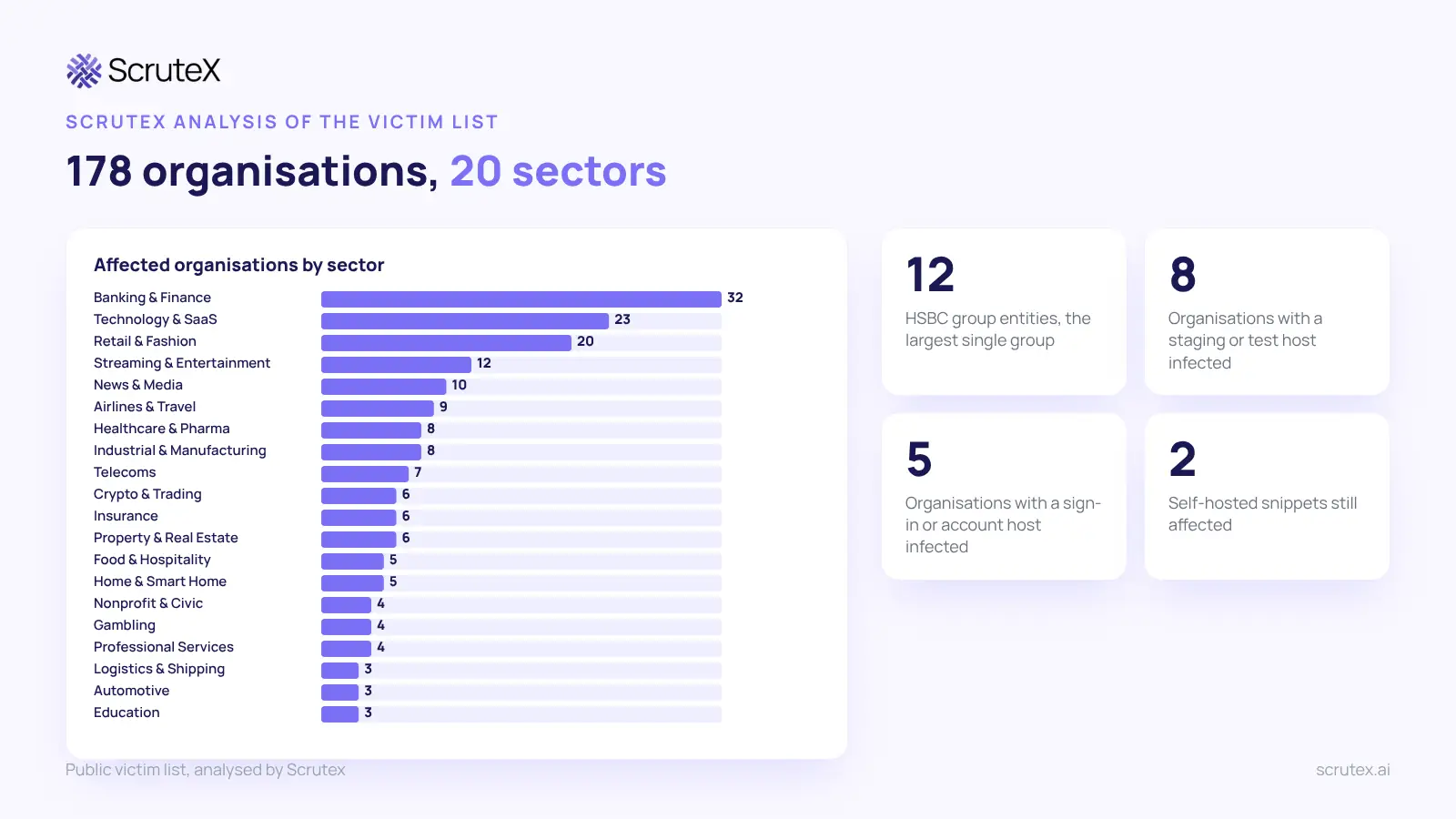
Scrutex analysis of the victim list
Scrutex mapped every affected organisation to its sector, parent group, market and the hosts that carried the code.
| Finding | Count | Why it matters |
|---|---|---|
| Organisations affected | 178 | Real total likely higher |
| Infected domains and hosts | 264 | Includes unpublished extra domains |
| Distinct parent groups | 113 | Several brands share one group account |
| HSBC group entities | 12 | Largest single group, from Mexico to Vietnam and Egypt |
| Organisations with a staging, QA or preview host infected | 8 | Test sites share the production project and get less monitoring |
| Organisations with a sign-in or account host infected | 5 | Equifax sign-in, Optimizely login, ASPCA secure donations: the highest-value cookie theft |
| Organisations with a self-hosted snippet path | 2 | Scheels and Vodafone Australia: own domain, same poisoned content |
| Banking and finance organisations | 32 | Largest sector |
By region, based on each organisation's domains: Global / US 122, APAC 23, Europe 21, Americas 10, Middle East and Africa 2 ("Global / US" covers generic .com, .org and .us domains).
For readers in India and Malaysia: Crocs India is the only .in site on the list. HSBC Malaysia (including HSBC Amanah) and Levi's Malaysia carried the code.
Full list of affected organisations, by sector
Banking & Finance (32): Paychex, HSBC US, Equifax, SmartAsset, HSBC Hong Kong, ABN AMRO, TaxAct, HSBC Mexico, HSBC Singapore, NetCredit, Associated Bank, S-Pankki, Equifax Canada, Equifax UK, The Work Number (Equifax), Funding Circle, HSBC Australia, CashNetUSA, OnDeck, ICS Cards, HSBC UAE, HSBC Malaysia, Rest Super, HSBC Taiwan, HSBC Vietnam, HSBC Egypt, HSBC Philippines, SmartAdvisor Match (SmartAsset), Compare Club, ABN AMRO Lease, Energy Scout, Hang Seng Investment.
Technology & SaaS (23): Zoom, Bitly, Salesforce, GitLab, Optimizely, Mixpanel, Typeform, InMotion Hosting, Wasabi, Perforce / Zend / Puppet, Tableau, Hootsuite, Smartsheet, MuleSoft, Thales / Imperva, Tricentis, Web Hosting Hub, QR Code Generator, ServiceChannel, Brandfolder, Intelex, Enverus, Accruent.
Retail & Fashion (20): IKEA, ASOS, Mattel, American Eagle, Scheels, Ariat, American Girl, StackSocial, Crocs India, Levi's Japan, Todd Snyder, Levi's Indonesia, Just Russel, Loloi Rugs, Levi's Australia, Levi's Malaysia, Levi's Philippines, Levi's Singapore, Levi's Korea, Levi's New Zealand.
Streaming & Entertainment (12): Peacock, D&D Beyond, Wizards of the Coast, NOW TV, Zattoo, Crave, Starz, SkyShowtime, Bravo, SeaWorld, WOW (Sky Deutschland), NOW Italia.
News & Media (10): CNN, BBC, Fox News, NPR, CTV News, Fox Sports, BNN Bloomberg / CP24, TSN, Top Gear, BBC Earth.
Airlines & Travel (9): Alaska Airlines / Hawaiian Airlines, Transavia, Air France-KLM, KLM Netherlands, Trafalgar, Contiki, Insight Vacations, The Travel Corporation, Costsaver.
Healthcare & Pharma (8): Invisalign, Takeda, Covetrus, iTero (Align), Covetrus Pharmacy, myCovetrus, RaySafe (Fluke), Takeda Oncology.
Industrial & Manufacturing (8): Fluke, eMaint (Fluke), Fluke Networks, Vaillant Germany, Fluke Process Instruments, Fluke Biomedical, Landauer, Vaillant Spain.
Telecoms (7): Virgin Media, Virgin Media O2, Vodafone Australia, O2, TPG Telecom, Mint Mobile, TalkTalk.
Crypto & Trading (6): Ledger, IG, OANDA / Coinpass, interactive investor, TMS Brokers, Betashares.
Insurance (6): Asurion / uBreakiFix, Mutual of Omaha, Admiral, Securian Financial, eRenterPlan, AKA (Danish unemployment fund).
Property & Real Estate (6): Buildium (managebuilding.com), Loft Living apartments, Buildium, HireAHelper, Flytte.no (and sister comparison sites), MovingPlace.
Food & Hospitality (5): Restaurant ordering sites (order.online), Heineken, Home Chef, Starbucks Canada, Cinnabon.
Home & Smart Home (5): Resideo, Honeywell Home, myQ (Chamberlain), Chamberlain, First Alert.
Nonprofit & Civic (4): Change.org, ASPCA, UNICEF USA, DonorsChoose.
Gambling (4): Betsson, PokerStars, tombola, Betfred.
Professional Services (4): Freshfields, CohnReznick, Baringa, Cro Metrics.
Logistics & Shipping (3): ShipStation / ShipEngine, Stamps.com, ShipEngine.
Automotive (3): Lucid Motors, O'Brien Glass, Chevrolet dealer network (Bill Rapp and others).
Education (3): Walden University, Perlego, Chamberlain University.
Earlier wave, not counted in the 178
Between 13 and 16 November, the same injector (
webshell[.]lol/get.js) reached sites through other third-party scripts from Kissmetrics, StorifyMe and Minute Media. Affected sites included securitybank.com, faz.net, smh.com.au, vidaXL and foxsports.com. Fox Sports also appears in the Optimizely list.Optimizely attack timeline
All times UTC.
| Date / time | Event |
|---|---|
| 18-03-2026 | TRON wallet later hard-coded in the payload is created |
| 17-09-2026 | Injector webshell[.]lol first seen on Turkish websites, delivered through an SEO backlink panel script on linkforge[.]cc |
| 28-10-2026 | Coruna telemetry domain l7bcsnwc7nzr3uo[.]icu registered |
| 09-11-2026 17:52 | iOS router domains 5vobauua3ojpklx[.]icu and p55abnw2pnsz0bo[.]icu registered |
| 12-11-2026 | 5vobauua3ojpklx[.]icu already serving the Coruna landing page /A8/a.html |
| 13 to 16-11-2026 | Earlier wave through Kissmetrics, StorifyMe and Minute Media scripts |
| 16-11-2026 02:21 | Last clean capture of the BBC snippet |
| 16-11-2026 04:21 | First Optimizely injection seen: BBC snippet loading webshell[.]lol |
| 16-11-2026 04:28 to 05:23 | TLS certificates issued for 1688360[.]cc; domain registered 05:23:08 |
| 16-11-2026 08:10 | First track.js build (crypto clipper only); live on bbc.com by 08:28 |
| 16-11-2026 11:20 | Zoom snippet modified |
| 16-11-2026 13:03 to 13:05 | Stolen USDC on Ethereum swept to an exchange deposit address |
| 16-11-2026 13:18 | 0.0761 BTC (about $4,970) received in one payment |
| 16-11-2026 13:43 | Card skimmer added to track.js |
| 16-11-2026 16:38 | Second iOS router batch registered: eil786npto9u5bq, 1y69gy2mdzaltz1, gm38duxoihbmy5o (.icu) |
| 16-11-2026 17:13 to 17:57 | Second iOS host wired in; Coruna iframe added for iOS 18.6 and earlier; final build Last-Modified 17:56:07 |
| 16-11-2026 19:24 to 19:59 | Sweep finds 186 of 1,611 snippets infected; about $7,040 in crypto received by 19:25 |
| 16-11-2026 20:41 to 21:07 | Cleanup: Ledger 20:41, Smartsheet 20:56, BBC 21:07 |
| 16-11-2026 21:32 | 41 snippets still infected |
| 16-11-2026 21:52 | 1 of 188 still infected (TalkTalk) |
| 17-11-2026 01:02 | Optimizely confirms the incident |
Who is behind OPTIMJACK?
OPTIMJACK is unattributed. No group or country has been named, and Optimizely describes the actor only as an unauthorised party. Scrutex assesses the operator as financially motivated, well prepared and fast-moving. Confidence in any link to a known group is low.
| Attribute | Assessment |
|---|---|
| Motivation | Financial: crypto theft, card data, session cookies. The iOS chain fits the same goal, as the Coruna kit has been used for mass crypto theft |
| Preparation | Wallet created March 2026; injector in use from September 2026; two batches of disposable .icu routers registered ahead of use |
| Hosting | Google Cloud instances in us-central1, Hong Kong and Singapore |
| Tempo | 26 payload builds in under 10 hours and a new router batch mid-attack |
| Operator artefacts | Path and channel names JIUJIU888, weifile and BIGNIAO, numeric C2 domain 1688360[.]cc, affiliate-style channel code 02111110. The channel code suggests the iOS kits are rented or shared under an affiliate model |
Coruna exploit kit lineage
The Coruna loader in this campaign is byte-identical to one seen in research published in October 2026. The kit has moved between very different operators:
- A commercial surveillance vendor's customer (original use).
- UNC6353, suspected Russian espionage activity in Ukraine.
- UNC6691, a Chinese financially motivated cluster running mass crypto theft.
- OPTIMJACK. Shared tooling does not prove a shared operator, so the link to UNC6691 is low confidence.
Operator infrastructure
| Component | Host | Location |
|---|---|---|
C2 (track.js, hit.php, card.php) | 1688360[.]cc, 136.113.106[.]136 | Google Cloud us-central1 |
| iOS routers, batch of 9 November | 5vobauua3ojpklx[.]icu, p55abnw2pnsz0bo[.]icu, 34.96.213[.]201 | Google Cloud Hong Kong |
| iOS routers, batch of 16 November | eil786npto9u5bq[.]icu, 1y69gy2mdzaltz1[.]icu, gm38duxoihbmy5o[.]icu, 34.87.36[.]58 | Google Cloud Singapore |
MITRE ATT&CK mapping
OPTIMJACK used 13 MITRE ATT&CK techniques across 8 tactics.
| Tactic | Technique | How it was used |
|---|---|---|
| Resource development | T1583.001 Acquire Infrastructure: Domains | Disposable .icu routers and 1688360[.]cc |
| Initial access | T1190 Exploit Public-Facing Application | Optimizely signup flow vulnerability |
| Initial access | T1195 Supply Chain Compromise | Malicious code inside a trusted vendor snippet |
| Initial access | T1189 Drive-by Compromise | Visitors infected by loading the page |
| Execution | T1059.007 JavaScript | Loader and track.js run in the browser |
| Execution | T1203 Exploitation for Client Execution | Coruna and DarkSword iOS exploit kits |
| Defence evasion | T1027 / T1140 Obfuscated Files, Deobfuscate | Base64 URL with atob(), inline eval() fallback |
| Credential access | T1539 Steal Web Session Cookie | Up to 8,000 characters of cookies |
| Collection | T1056.003 Web Portal Capture | Card skimmer on forms, fetch and XHR |
| Collection | T1115 Clipboard Data | Copy and clipboard hooks |
| Collection | T1113 Screen Capture | html2canvas screenshots |
| Exfiltration | T1041 Exfiltration Over C2 Channel | /hit.php, /card.php, sendBeacon |
| Impact | T1565.002 Transmitted Data Manipulation | Wallet address swapping in pages and QR codes |
OPTIMJACK indicators of compromise
All 55 indicators. Domains and IPs are defanged; replace
[.] with . before importing. Validate before blocking, and block domains including subdomains.Network: domains
| Type | Indicator | Context | First seen (UTC) | Severity |
|---|---|---|---|---|
| Domain | 1688360[.]cc | Primary C2: /track.js, /hit.php, /card.php, /html2canvas.min.js | 16-11-2026 05:23 | Critical |
| Domain | 5vobauua3ojpklx[.]icu | iOS router (/boot.js, /A8/ Coruna landing page) | 09-11-2026 17:52 | Critical |
| Domain | p55abnw2pnsz0bo[.]icu | iOS router, batch of 09-11; same certificates and IPs as the kit | 09-11-2026 17:52 | High |
| Domain | eil786npto9u5bq[.]icu | iOS router: /JIUJIU888/weifile.html, /JIUJIU888/index.js, Coruna and iOS 26 pages | 16-11-2026 16:38 | Critical |
| Domain | 1y69gy2mdzaltz1[.]icu | iOS router, batch of 16-11 | 16-11-2026 16:38 | High |
| Domain | gm38duxoihbmy5o[.]icu | iOS router, batch of 16-11 | 16-11-2026 16:38 | High |
| Domain | l7bcsnwc7nzr3uo[.]icu | Coruna telemetry (POST /api/iptj) | 28-10-2026 | High |
| Domain | je4ft3gn8vxudum[.]icu | Fallback C2 hard-coded in boot.js | n/a | High |
| Domain | q1ls1ho9x7wsxlu[.]icu | Fallback C2 in boot.js; no longer resolving | n/a | Medium |
| Domain | ios-hack[.]icu | Fallback C2 in boot.js | n/a | High |
| Domain | webshell[.]lol | Injector (/get.js); earlier wave and first BBC injection | 17-09-2026 | High |
| Domain | linkforge[.]cc | SEO backlink panel script that carried the injector | 17-09-2026 | Medium |
Network: IP addresses
| Type | Indicator | Context | First seen (UTC) | Severity |
|---|---|---|---|---|
| IPv4 | 136.113.106[.]136 | Hosts 1688360.cc C2; Google Cloud us-central1 | 16-11-2026 | Critical |
| IPv4 | 34.96.213[.]201 | iOS router batch of 09-11; Google Cloud Hong Kong | 09-11-2026 | High |
| IPv4 | 34.87.36[.]58 | iOS router batch of 16-11; Google Cloud Singapore | 16-11-2026 | High |
Network: URLs
| Type | Indicator | Context | First seen (UTC) | Severity |
|---|---|---|---|---|
| URL | hxxps://1688360[.]cc/track.js | Stage 1 payload (rebuilt 26 times) | 16-11-2026 08:10 | Critical |
| URL | hxxps://1688360[.]cc/hit.php | Exfiltration: screenshot, cookies, page URL, swapped addresses | 16-11-2026 | Critical |
| URL | hxxps://1688360[.]cc/card.php | Card data exfiltration (fields n, e, c, u) | 16-11-2026 13:43 | Critical |
| URL | hxxps://1688360[.]cc/html2canvas.min.js | Screenshot library pulled by the payload | 16-11-2026 | High |
| URL | hxxps://l7bcsnwc7nzr3uo[.]icu/api/iptj | iOS exploit telemetry (POST) | n/a | High |
| URL | hxxps://webshell[.]lol/get.js | Injector script | 17-09-2026 | High |
| URL | hxxps://cdn.confiant-integrations[.]net/gptprebidnative/202611121858/wrap.js | Extra delivery route seen on a news site | n/a | Medium |
| URL | hxxps://www.ae[.]com/resources/aa2a454dda92a6d073ca760a2537f00c14d00114d3583 | Extra delivery route seen on a retail site | n/a | Medium |
Network: paths
| Type | Indicator | Context | First seen (UTC) | Severity |
|---|---|---|---|---|
| URL path | /A8/a.html | Coruna landing page (iOS 13 to 17) | 12-11-2026 | High |
| URL path | /JIUJIU888/index.js | Coruna stage | n/a | High |
| URL path | /JIUJIU888/weifile.html | Hidden iframe for iOS 18.6 and earlier | 16-11-2026 17:13 | High |
| URL path | /B9/ | DarkSword route (iOS 18.x) | n/a | High |
| URL path | /D11/ | DarkSword route (iOS 18.x) | n/a | High |
| URL path | /D12/ | DarkSword route (iOS 18.x) | n/a | High |
| URL path | /C10/ | Fingerprinting chain (iOS 26) | n/a | Medium |
| URL path | /boot.js | iOS router loader on .icu hosts | n/a | High |
File hashes (SHA-256)
| Type | Indicator | Context | First seen (UTC) | Severity |
|---|---|---|---|---|
| SHA-256 | 617df364120adc47fb4f55dcc0c69a9b6c9e108a92c60bc2b64a266254ab02f3 | track.js, first capture | 16-11-2026 | High |
| SHA-256 | 814a963c0da480e2449d9b6664480156e1cd6d731014117401bf635badec3a0f | track.js, 17:13 UTC build | 16-11-2026 17:13 | High |
| SHA-256 | f7b84b9a94f749f8ced3f0112d0a66894e8bbc3b4aa5592021d1b8976a9bad40 | track.js, final build (Last-Modified 17:56:07) | 16-11-2026 17:56 | High |
| SHA-256 | 2f69879f1c5bdfe9c075ef67ddb6405afe992aff89dcf42863567f83237d3ba6 | boot.js on eil786npto9u5bq router | 16-11-2026 | High |
Attacker wallets
| Type | Indicator | Context | First seen (UTC) | Severity |
|---|---|---|---|---|
| BTC | 19g9rZcPeiz8rUvyWpTRyXXhPnjsWrc3kW | Clipper destination. About 0.083 BTC received on 16-11, including 0.0761 BTC at 13:18 | 16-11-2026 | High |
| ETH / EVM | 0xC4026b06D82b0F0B363eda0642D61CfbDc17884e | Clipper destination (ETH, BSC and EVM chains). USDC swept to an exchange deposit address 13:03 to 13:05 | 16-11-2026 | High |
| TRON | THvs6p56XkUiMkJeSc51cAP64u2RsTYqxa | Clipper destination. Wallet in use since March 2026 | 18-03-2026 | High |
| SOL | FVtL8NMYS9PA1v3HE67XUGCtGA9JaZUvqav2fU2LrV5n | Clipper destination | n/a | High |
| TON | UQAgM1VqSZQiJLSG5w-ovurq5CZdxLEK3_7CMmwALTA5e09p | Clipper destination | n/a | High |
| TON (raw) | 0:2033556a49942224b486e70fa8beeaeae4265dc4b10adffec2326c002d30397b | Same TON wallet in raw form | n/a | High |
| LTC | ltc1q3wp7g6ds0ggg6fl6kncpa4sepn0q3qfacgred5 | Clipper destination. About 17 LTC received | 16-11-2026 | High |
| BCH | qzkaaf8n6grmpr0d9lx8xutn3r9lk722f566hhpe58 | Clipper destination | n/a | High |
| DOGE | DBEGrxRF7KMSuhTS4c1MFviStU6efdMnu5 | Clipper destination | n/a | High |
Browser and code artefacts
| Type | Indicator | Context | First seen (UTC) | Severity |
|---|---|---|---|---|
| JS global | window._k7 | Set by track.js | n/a | High |
| JS global | window.__k7b | Set by track.js | n/a | High |
| JS global | window._cc | Set by track.js (card skimmer) | n/a | High |
| JS global | window._qxc | Set by track.js | n/a | Medium |
| JS global | window._shot | Set by track.js (screenshot) | n/a | Medium |
| Storage key | sessionStorage cc_* | Card skimmer de-duplication keys | n/a | High |
| HTML attribute | data-channel-code="02111110" | On injected boot.js script tags (iOS loader) | n/a | High |
| Channel code | BIGNIAO | Coruna telemetry channel code | n/a | Medium |
| Code string | atob( | Base64 loader variant inside projectJS | n/a | Medium |
| Code string | eval( | Inline payload fallback variant inside projectJS | n/a | Medium |
| Code string | 1688360 | Plain loader string | n/a | High |
How to check whether your site was affected
- Inspect every Optimizely project. Review projectJS and all experiment custom code, including self-hosted snippet endpoints. Look for
atob(,eval(and any loader you did not write. A search for "1688360" alone will miss variants 2 and 3. - Fix your own exposure window. Record your snippet's Last-Modified header and ask Optimizely for your projects' modification times.
- Search logs back to 16-11-2026 00:00 UTC. Proxy, DNS, WAF, RUM and CSP violation reports, for every host in the IOC tables. A blocked request still proves the code ran.
- Review write access. List every user, API token and integration that can edit Optimizely projects. Remove anything unexpected.
- Crawl your own pages. Check for the
window._k7andwindow.__k7bglobals andcc_sessionStorage keys in a headless browser. - Run a canary test. Paste a test wallet address on a staging page carrying the snippet and compare what is submitted. The payload is keyword gated, so an obvious test page may not trigger it.
What should you do now?
Within 24 hours
- If you have not verified your snippet, pause Optimizely on checkout, login and wallet pages.
- Rotate Optimizely user credentials, API tokens and webhook secrets.
- Block the IOCs after validation.
- Invalidate sessions and rotate any secret held in a non-HttpOnly cookie for users active on 16 November.
- Treat cards typed into your own form fields on 16 November as compromised. Brief your acquirer and card issuers and plan customer notification.
- Crypto platforms: add the attacker wallets to transaction screening and review outbound transfers made on 16 November.
Within 7 days
- Tighten CSP: a restrictive
script-src, nounsafe-eval, deliberate use ofstrict-dynamic, and a narrowconnect-src. - Run CSP in Report-Only alongside enforcement to catch new script hosts and data destinations.
- Remove non-essential third-party tags from checkout, login and account pages.
- Reconcile card and crypto support tickets from 16 to 18 November against the exposure window.
- Organisations in India: assess the CERT-In 6-hour reporting requirement if visitor data was affected.
Structural fixes
- Move card capture into cross-origin hosted fields from your payment provider.
- Meet PCI DSS 6.4.3 and 11.6.1: an authorised inventory of every payment-page script, and tamper detection on page content.
- Do not rely on Subresource Integrity for Optimizely: the snippet changes on every publish. Monitor the content instead.
- Add third-party script owners to vendor risk reviews, with change alerting on what each script loads.
Advice for your customers
- Check crypto transfers made on 16 November against the address on the wallet or hardware-wallet screen, not the copied value.
- Watch card statements and report unknown charges.
- Update iPhones and iPads to iOS 18.7.3 or later, or 26.3 or later.
- If compromise is suspected, reboot, change passwords stored in the keychain and move funds to a fresh wallet. High-risk users should consider Lockdown Mode.
Are you exposed?
Check these five things. All of them are answerable from your own systems today.
- ☐ Does any page you own load an Optimizely snippet, from
cdn.optimizely.comor from a path on your own domain such as/js/<id>.js? - ☐ Did your snippet's Last-Modified header change on 16-11-2026, and has Optimizely given you your project's modification times?
- ☐ Does your Content Security Policy still allow
unsafe-eval, or allowconnect-srcto any host? - ☐ Are card fields on your checkout rendered on your own page rather than inside your payment provider's hosted iframe?
- ☐ Do your UAT, staging or preview sites share the production Optimizely project, and does anyone monitor them?
What Scrutex finds here
Scrutex fingerprints the technologies running on each of your internet-facing hosts, so it can list every site that loads an Optimizely snippet, including the staging hosts and self-hosted paths nobody put in the asset register. It matches your vendor register against active incidents, so a vendor compromise reaches your team as a finding against named assets rather than as a news headline. It also maps campaign indicators such as the OPTIMJACK C2 and wallet set to your sector, so you know which IOCs to block today.
Scrutex sees what your public pages load from the outside. It does not run inside your visitors' browsers, so it cannot prove what an individual session executed on 16 November. Your own CSP and RUM logs answer that.
What that looks like
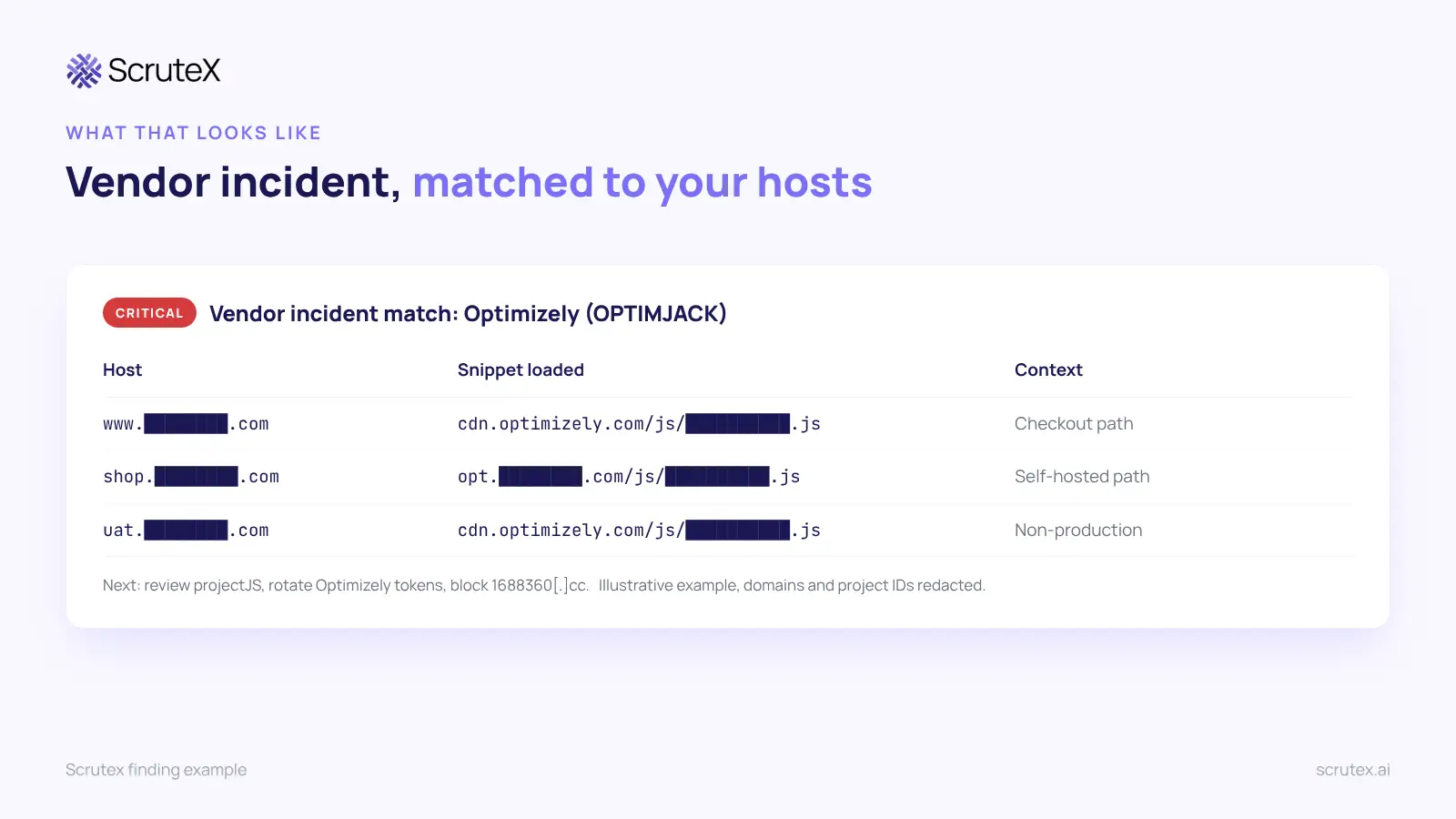
Illustrative example. Domains and project IDs redacted.
Which of your sites load Optimizely?
Create a free ScruteX account with your domain and see every internet-facing host that loads a third-party script such as Optimizely, including staging and self-hosted paths. Free tier, no credit card, no agent to install.
If third-party vendors are your problem: Vendor Insights, which tracks incidents at the suppliers in your register and ties them to your assets.
If you need the indicators in your controls today: Threat Insights, which maps active campaigns and IOCs to your sector.
Go deeper: Vendor security assessment template, for adding script-level questions to your next vendor review.
Go sideways: External attack surface management best practices, because the staging sites in this incident are the assets most registers miss.
FAQ
What is the Optimizely supply-chain attack?
The Optimizely supply-chain attack is a 16 November 2026 incident in which an attacker abused a vulnerability in Optimizely Web Experimentation to add malicious JavaScript to customer projects. Optimizely's CDN served it to visitors of 178 organisations, where it skimmed cards, swapped crypto addresses, stole cookies and screenshots, and delivered iOS exploit kits.
What is OPTIMJACK?
OPTIMJACK is the name of the campaign that hijacked Optimizely snippets. It refers to the injected loader and the
track.js payload served from 1688360[.]cc.Which companies were affected by the Optimizely breach?
178 organisations, including Zoom, BBC, CNN, Salesforce, GitLab, IKEA, HSBC, Equifax, Air France-KLM, Ledger, Peacock and Optimizely itself. Banking and finance is the largest sector with 32 organisations.
Was my site affected if it is not on the public list?
Not necessarily safe. The public list comes from external sweeps of 1,611 snippets, and the real number is likely higher. Check your own projectJS and snippet history.
How long were websites exposed?
Up to about 17 hours. The first injection was seen at 04:21 UTC on 16 November 2026, and all but one snippet was clean by 21:52 UTC.
Does Content Security Policy stop this kind of attack?
Only partly. A CSP that allowlists
cdn.optimizely.com lets the loader run. A tight connect-src and a policy without unsafe-eval would have blocked the data theft and the inline fallback.Were Stripe and Adyen payment forms affected?
No. Hosted payment fields inside cross-origin iframes were out of the skimmer's reach. Card fields rendered directly on the merchant's own page were exposed.
Who is behind OPTIMJACK?
No group has been named. The operator is financially motivated and reused the Coruna iOS exploit kit, which has been linked to other clusters, including UNC6691. Scrutex rates any attribution as low confidence.
Is Optimizely safe to use now?
Optimizely says the vulnerability is fixed and protections are in place. Until it publishes the root cause and per-project exposure times, keep the snippet off checkout, login and wallet pages and review projectJS after every publish.