Java4Shell (CVE-2026-114938): OpenJDK RCE Explained, Affected Versions and Fixes
By ScruteXPublished
What is Java4Shell?
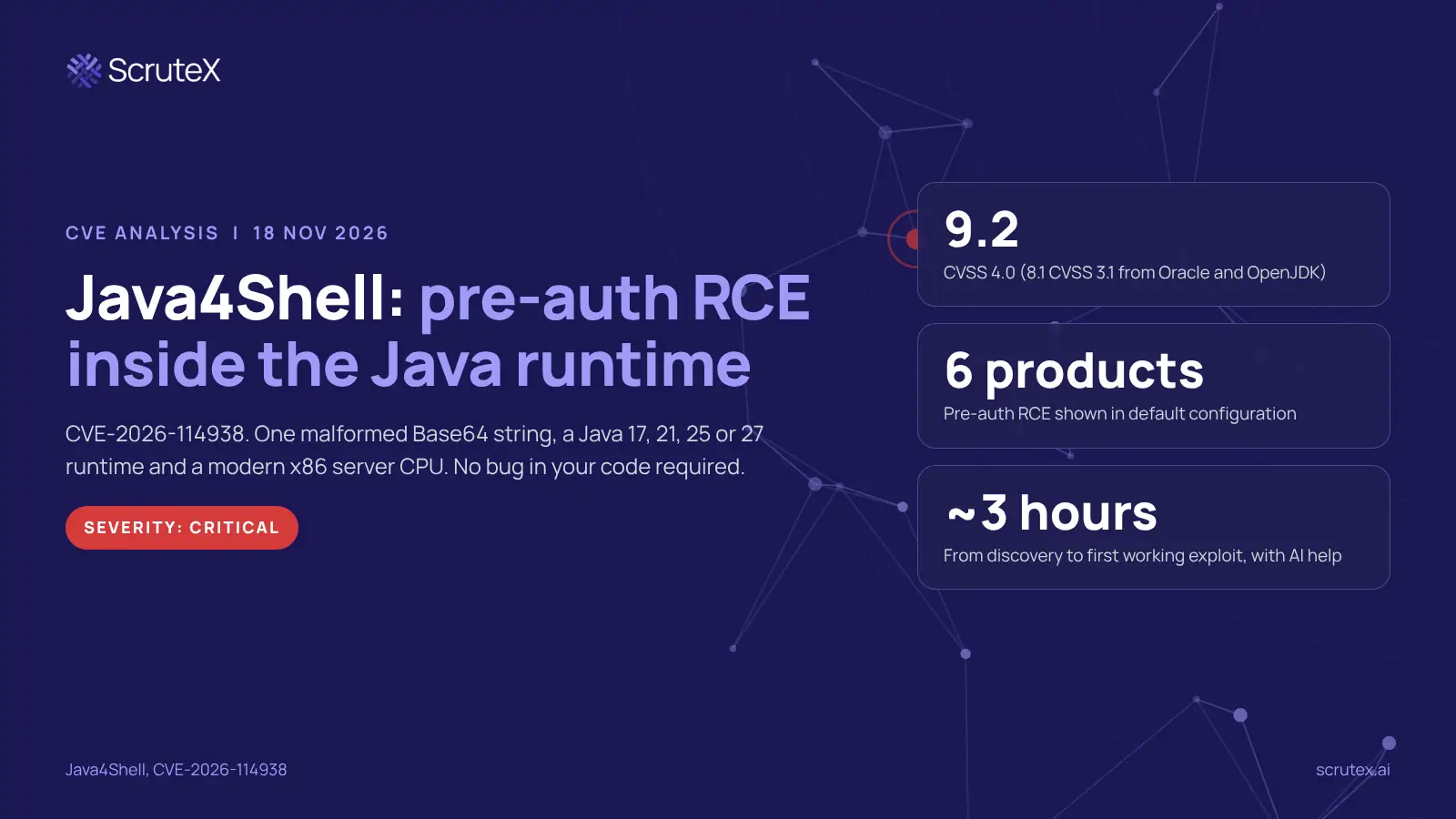
Java4Shell (CVE-2026-114938) is a heap overflow in the AVX-512 Base64 decoder built into the HotSpot Java virtual machine. One malformed Base64 string can corrupt memory and lead to remote code execution, before any login, in Java 17.0.6 and later, 21, 25 and 27 running on recent Intel and AMD server CPUs. Oracle and OpenJDK shipped fixes on 17 November 2026.
Key facts
| Fact | Detail |
|---|---|
| CVE | CVE-2026-114938 ("Java4Shell") |
| Component | HotSpot JVM, x86-64 AVX-512 Base64 decode intrinsic (hotspot/compiler) |
| Bug class | Heap out-of-bounds write caused by an integer underflow in the store mask |
| CVSS | 9.2 CVSS 4.0 (Calif); 8.1 CVSS 3.1 (Oracle and OpenJDK), AV:N/AC:H/PR:N/UI:N/S:U/C:H/I:H/A:H |
| Affected Java | 17.0.6 to 17.0.21.x, 21, 25 and 27 before the November 2026 builds; Oracle 8u511b33-perf |
| Not affected | Standard Java 8 and 11, Java 17.0.0 to 17.0.5, ARM64 hosts |
| CPU requirement | x86-64 with avx512f, avx512bw, avx512vbmi and bmi2 (Intel Ice Lake or newer Xeon, AMD Zen 4 or newer) |
| Impact shown | Pre-auth RCE on default Keycloak, Jira, Confluence, Jenkins, JFrog Artifactory and PingFederate; heap memory disclosure ("JavaBleed") |
| Patch | Oracle 17.0.21.1, 21.0.13.1, 25.0.5.1, 27.0.1.1, 8u513-perf (17 November 2026) |
| Workaround | Start the JVM with -XX:-UseBASE64Intrinsics and restart |
| Exploited in the wild | No, as of 18 November 2026. Not in CISA KEV |
| Scrutex severity | Critical |
Key takeaways
- Java4Shell is a bug in the Java runtime, not in your code. No vulnerable library or application flaw is needed.
- Three conditions must all be true: an affected JVM, an x86-64 CPU with AVX-512 VBMI, and untrusted Base64 reaching the decoder. On a busy login endpoint, the third is the default.
- Identity providers, CI/CD and collaboration tools are the first targets. Keycloak, PingFederate, Jenkins, Artifactory, Jira and Confluence fell pre-auth in default configuration.
- A patched package does nothing until the JVM restarts, and OS updates do not touch a JDK bundled inside a product or container image.
- Details leaked before the patch and the researchers built working exploits with AI help in about three hours. Expect exploitation attempts soon.
Updates
| Date | Update |
|---|---|
| 18-11-2026 | No exploitation in the wild reported. Not in CISA KEV. Downstream OpenJDK distributions still releasing fixed builds. Cisco Talos publishes Snort coverage. |
| 17-11-2026 | Oracle's November Critical Security Patch Update and the OpenJDK Vulnerability Advisory go live at 21:00 UTC. Calif publishes its write-up. CISA issues an alert urging immediate patching. |
| 16 or 17-11-2026 | Details circulate before the patch. South Korea's NCSC warns public institutions of an unauthenticated Java RCE. |
How does Java4Shell work?
Java4Shell works by abusing a padding-handling error in hand-written AVX-512 assembly that HotSpot uses to speed up
java.util.Base64 decoding. A stray "=" in the final block makes the output length negative, the store mask becomes all ones, and a 64-byte vector write lands past the end of the destination array.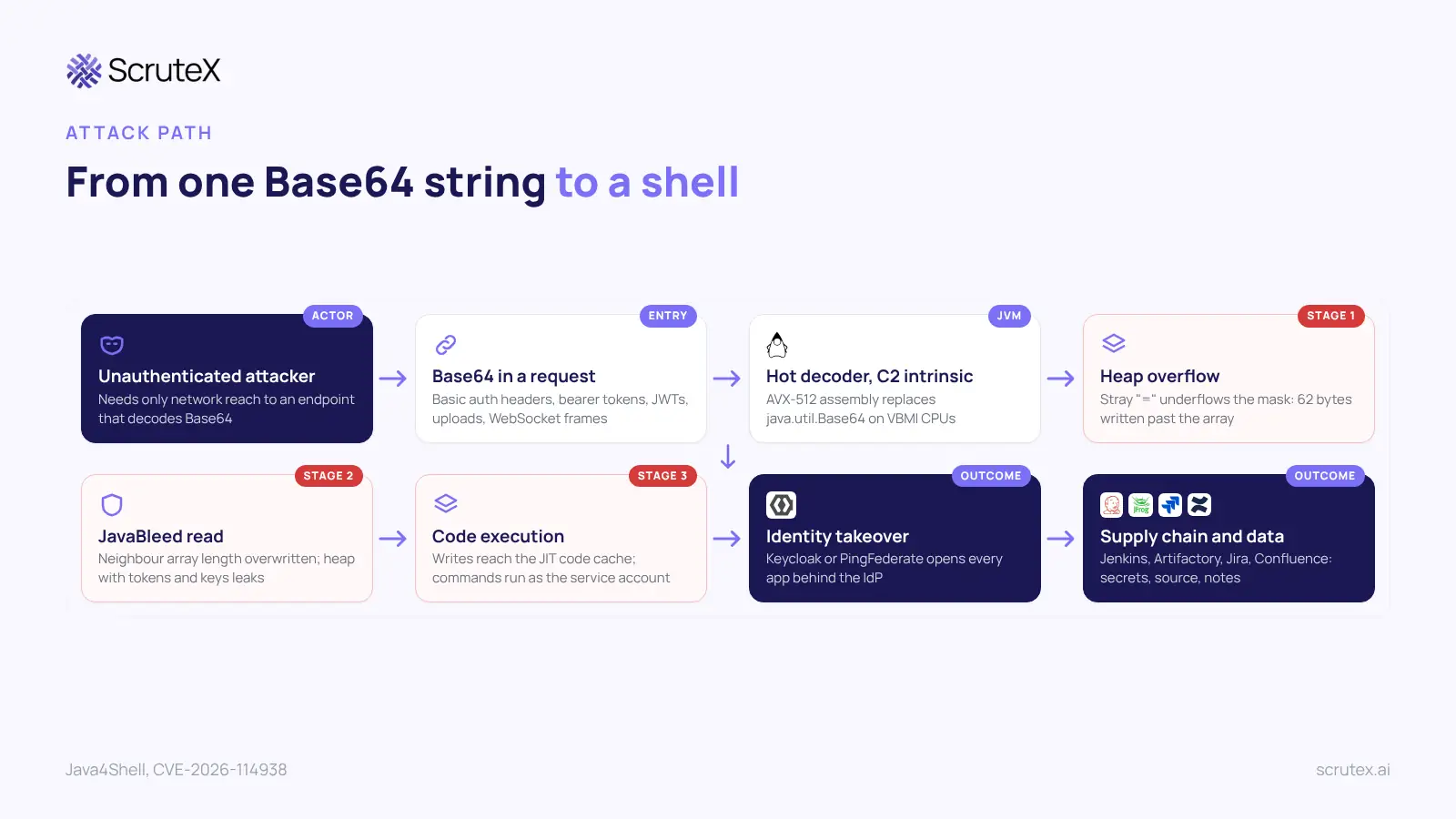
- A fast path added for speed. Intel engineers contributed an AVX-512 Base64 decode intrinsic (JDK-8268276) in 2021. On capable CPUs the C2 JIT compiler swaps it in for
java.util.Base64.Decoder, includinggetDecoder()andgetUrlDecoder(). - Warm-up switches it on. The intrinsic only runs once the decode method gets hot enough for C2. Calif's trigger warms it with 200,000 valid decodes. A production login endpoint does that on its own.
- A padding-only tail breaks the mask. When the remaining input is only padding,
output_lenunderflows to -1 or -2.bzhiq(-1, output_len)leaves the store mask fully set andevmovdqubwrites all 64 bytes. - Memory corrupts before Java says no. On Java 21 and later, 64 "A" characters plus "=" (Java 17 needs 128) make the decoder size a 50-byte array, store 64 bytes from offset 48, and only then throw
IllegalArgumentException. The overrun is 62 bytes. The application logs an ordinary bad-input error. - Remote heap grooming. Calif shaped TLAB and G1 region layout from the network, splitting requests and holding parts on the server. Misses crash the JVM, so attackers retry.
- From write to code execution. One overwritten array length gives a writer; a second gives a reader that leaks heap memory ("JavaBleed"). Data-only attacks then reach the JIT code cache and JVM hooks to run code as the service account.
What the attacker controls, and what limits it
Byte 0 of the stray store is fully controlled and byte 1 partly (4 bits). Bytes 48 to 63 of the store are always
0x9a. That is enough to bump an adjacent array's length field, the primitive the whole chain builds on. Upwind measured damage to the next heap object in 97% of rounds with an exact-size output buffer.The limits are real. There is no universal exploit: each product needs its own heap layout and timing. Reverse proxies that buffer whole request bodies (the nginx default) break some chains, but WebSocket frames bypass that buffering. Failed attempts crash the JVM, which is noisy, and a crash is itself a denial of service.
Which Java versions are affected by Java4Shell?
Java4Shell affects Java 17.0.6 through 17.0.21.x, and every Java 21, 25 and 27 build released before the November 2026 updates. Standard Java 8 and 11 do not contain the vulnerable decoder. Java 18 to 20, 22 to 24 and 26 carry the code but are end of life, so they need an upgrade, not a patch.
Oracle affected and fixed builds
| Product | Affected build | Fixed build (17-11-2026) |
|---|---|---|
| Oracle Java SE 8 Enterprise Performance Pack | 8u511b33-perf | 8u513-perf |
| Oracle Java SE 17 | 17.0.21.0.3 and earlier | 17.0.21.1 |
| Oracle Java SE 21 | 21.0.13.0.3 and earlier | 21.0.13.1 |
| Oracle Java SE 25 | 25.0.5.0.3 and earlier | 25.0.5.1 |
| Oracle Java SE 27 | 27.0.1.0.3 and earlier | 27.0.1.1 |
| Oracle GraalVM for JDK | 17.0.21.0.3, 21.0.13.0.3 | 17.0.21.1, 21.0.13.1 |
| Oracle GraalVM Enterprise Edition | 21.3.20.0.3 | 21.3.20.1 |
OpenJDK lines
| Java line | Status |
|---|---|
| 8 (standard) | Not affected |
| 11 | Not affected |
| 17 | 17.0.0 to 17.0.5 clean; 17.0.6 to 17.0.21.x affected |
| 21 | All builds before 21.0.13.1 affected |
| 25 | All builds before 25.0.5.1 affected |
| 27 | All builds before 27.0.1.1 affected |
| 18 to 20, 22 to 24, 26 | Carry the code; end of life, upgrade |
OpenJDK fix tags are 17.0.21.1+4 and 21.0.13.1+4. Upwind reproduced the bug on Temurin 17.0.6, 17.0.21, 21.0.13 and 25.0.5, and found 11.0.33 and 17.0.5 clean.
Downstream OpenJDK distributions (status at 18-11-2026)
| Distribution | Status |
|---|---|
| Amazon Corretto | Fixed: 17.0.21.1.2, 21.0.13.1.2, 25.0.5.1.2, 27.0.1.1.4. Amazon Linux packages still pending. Amazon scores it 8.8 and says some environments need a low-privileged authenticated user |
| Azul Zulu | Fixed PSU builds 17.70.201, 21.54.201, 25.38.201, 27.30.201; CPU builds 17.69.204, 21.53.202, 25.37.202 (no CPU build listed for Zulu 27) |
| Red Hat build of OpenJDK, RHEL | No fix listed yet; Red Hat rates it Critical |
| Eclipse Temurin | No fixed release announced yet |
| Microsoft Build of OpenJDK | No fixed release announced yet |
| SAP SapMachine, BellSoft Liberica | Not confirmed by the vendor |
| Bundled JREs in products and appliances | Fixed only when the product vendor ships a new release |
Three version traps
- "We are on 17.0.11 or 21.0.3, so the AVX3 Base64 bug is fixed." That was JDK-8321599, an older data-loss bug in the same decoder. Java4Shell reproduces on 21.0.13.
- "We only run Java 11." Check again. Products often bundle their own newer JRE, and Jenkins, Keycloak and current Atlassian releases run on 17 or 21.
- "The package is patched." A patched package does nothing until the JVM restarts. Container images need a rebuild and redeploy.
Which CPUs are affected?
Java4Shell only reaches the vulnerable code path on x86-64 CPUs that expose all four of avx512f, avx512bw, avx512vbmi and bmi2 to the operating system. That means Intel Xeon Ice Lake or newer and AMD Zen 4 or newer. ARM64 is not affected.
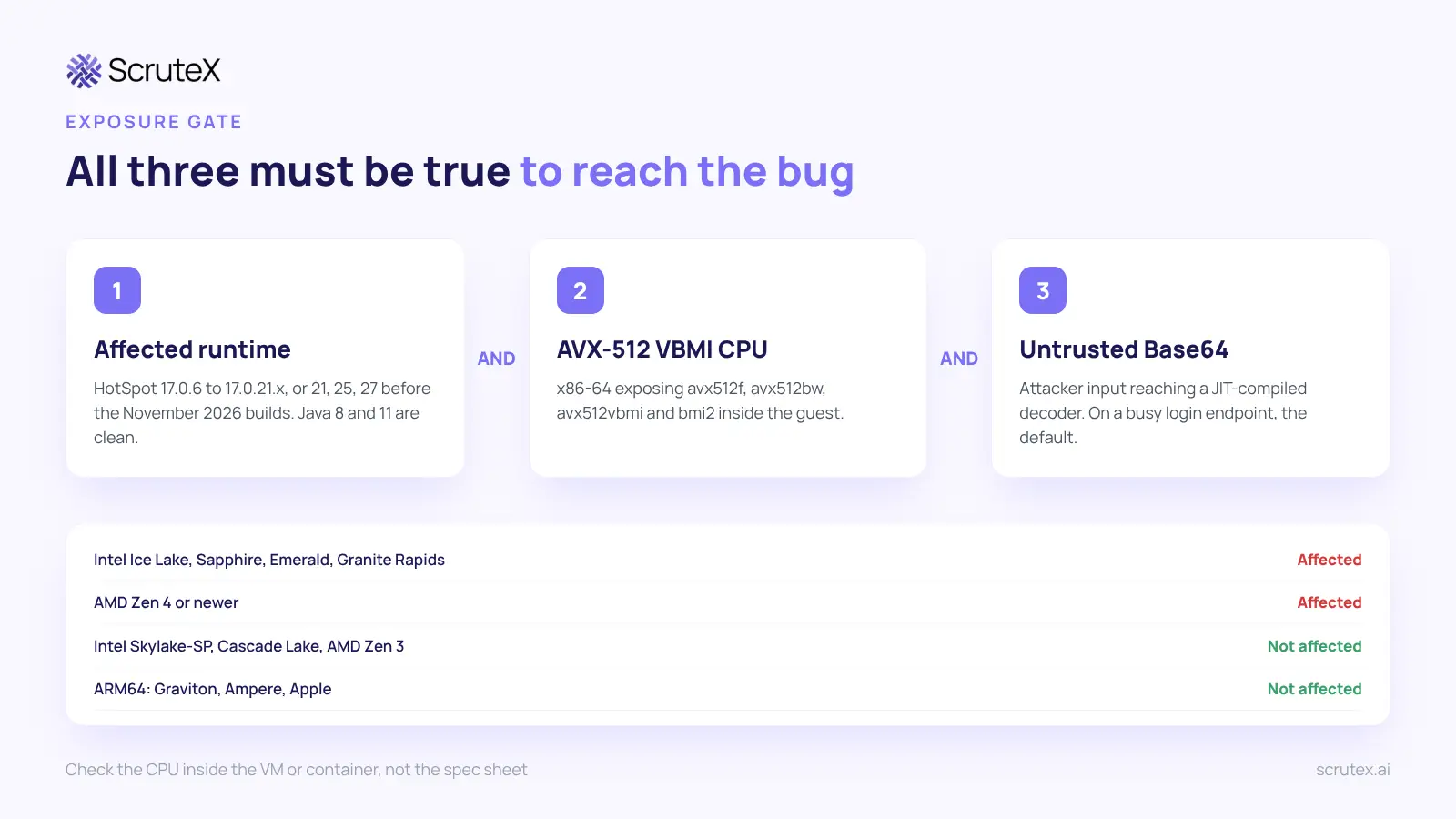
| CPU family | AVX-512 VBMI | Status |
|---|---|---|
| Intel Xeon Ice Lake-SP (3rd gen) | Yes | Affected |
| Intel Sapphire Rapids, Emerald Rapids, Granite Rapids | Yes | Affected |
| AMD EPYC and Ryzen, Zen 4 or newer | Yes | Affected |
| Intel Skylake-SP, Cascade Lake | No | Not affected |
| AMD Zen 3 and older | No | Not affected |
| ARM64 (Graviton, Ampere, Apple) | n/a | Not affected |
On AWS, c6i, m6i and r6i (Ice Lake), c7i and m7i (Sapphire Rapids) and c7a and m7a (Zen 4) carry VBMI. Graviton does not. Upwind reproduced the bug on an AWS c6i instance.
The CPU gate sets patch order. It does not close findings: an instance resize or live migration can move a JVM onto an affected CPU without any code change.
Which products are exploitable?
Calif demonstrated pre-authentication remote code execution against default installs of six products, and post-authentication code execution against five more. Both lists are incomplete: any code path that Base64-decodes request data is a candidate. Calif notes OpenJDK runs at 90% of Fortune 500 companies.
| Exploitability | Products |
|---|---|
| Pre-auth RCE, default configuration | Keycloak, Atlassian Jira, Atlassian Confluence, Jenkins, JFrog Artifactory, PingFederate |
| Post-auth code execution | Apache Kafka broker, Apache Solr, Elasticsearch, Gerrit, Spinnaker |
| Reachable decode paths | Sample Apache Struts and Spring Boot apps, Spring Security, Tomcat and Jetty 12 Basic auth, Auth0 java-jwt |
| Client side | Java programs that open TLS connections to a malicious server (exploit by samczsun) |
Base64 reaches the decoder through ordinary request data: Basic auth headers, bearer tokens, JWTs, file uploads and WebSocket frames. Internet exposure is not required. Any internal service that decodes untrusted Base64 is reachable from an attacker foothold.
What a successful attack gives the attacker
- Identity takeover. A compromised Keycloak or PingFederate hands over every application that trusts the identity provider.
- Software supply chain. Jenkins and Artifactory hold source code, build secrets, signing keys and release artefacts.
- Knowledge theft. Jira and Confluence hold designs, credentials pasted in tickets and incident notes.
Is Java4Shell being exploited in the wild?
No exploitation in the wild has been reported as of 18 November 2026, and CVE-2026-114938 is not in CISA's Known Exploited Vulnerabilities catalog. CISA issued an alert on 17 November urging immediate patching, with input from Canada's Cyber Centre.
Weaponisation is partial. Calif withholds its product exploit chains and published only a safe local trigger that warms the decoder, feeds it a malformed string and checks for overwritten bytes. Trigger-only third-party code circulated publicly on 17 November, including a GitHub "reproduction kit" with a remote trigger mode that Scrutex has not validated. Other teams reproduced crashes and memory leaks without code execution.
No threat actor, campaign or infrastructure is linked to Java4Shell. Scrutex rates the likelihood of exploitation within 30 days as high, for five reasons:
- It leaked early. Details circulated before the patch, so some actors had a head start.
- It is cheap to rebuild. Calif built its chains "almost autonomously with AI": an AI coding agent found the bug in about an hour and produced a first working exploit about two hours later, for under $200 in tokens. The trigger, root cause and grooming approach are now public.
- The target list is proven. Confluence, Jira and Jenkins flaws have repeatedly been exploited soon after disclosure, for example Confluence CVE-2022-26134 and CVE-2023-22515, both in CISA KEV.
- Attackers will spray blind. Nobody can see a target's CPU remotely, so expect malformed Base64 sprayed at login and token endpoints. On affected hosts that shows up as JVM crashes and restart loops before any successful chain.
- The patch tail is long. Bundled JREs in appliances and vendor products update on the vendor's schedule. Log4Shell showed that tail lasts years.
The first signal to expect is crashes, then RCE. Treat the likelihood rating as analyst judgement, not observed activity.
Java4Shell timeline
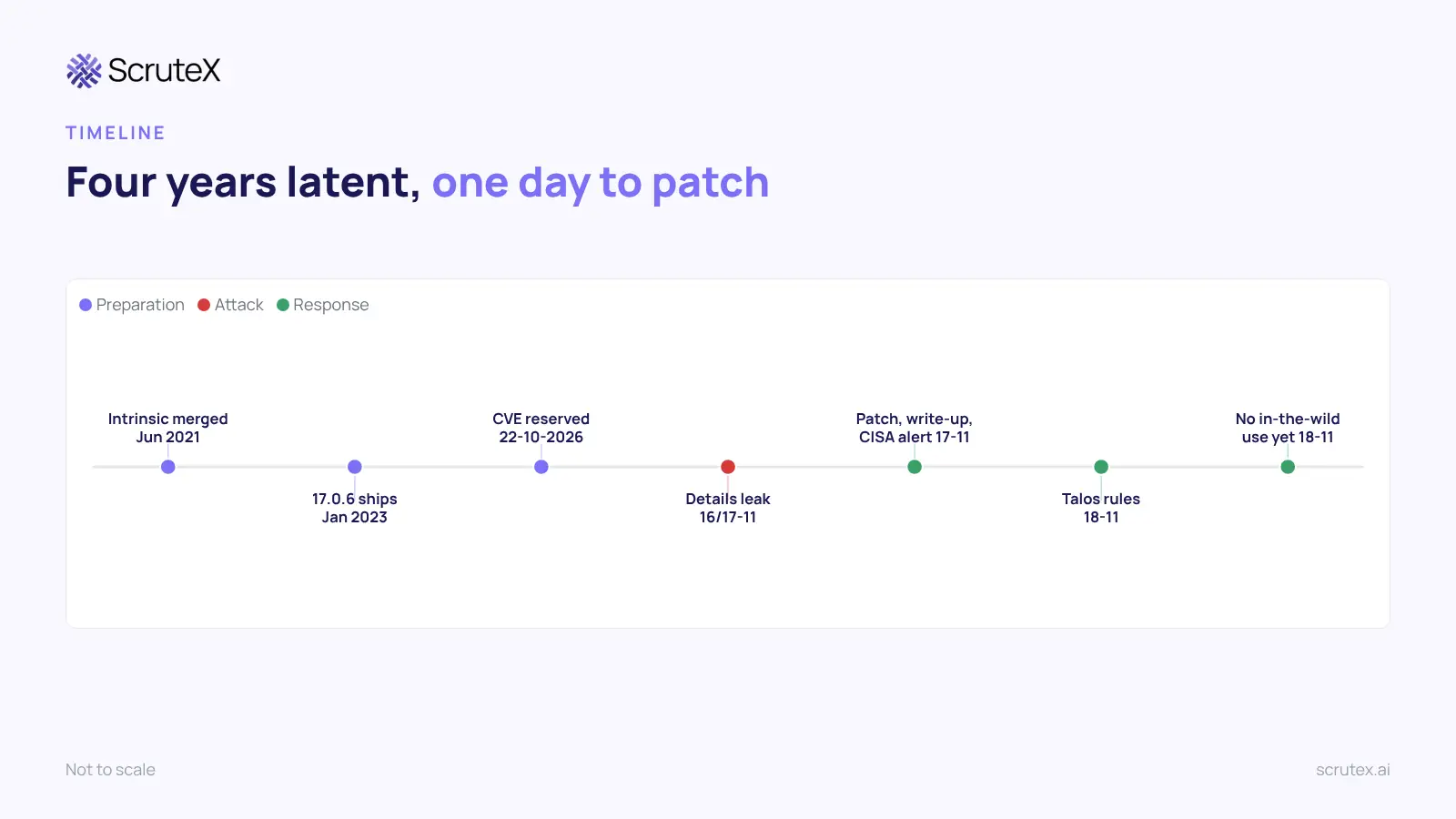
| Date | Event |
|---|---|
| June 2021 | AVX-512 Base64 decode intrinsic (JDK-8268276) merged into mainline OpenJDK, shipping in JDK 18 (March 2022) |
| 09-11-2022 | Backport integrated into jdk17u-dev, citing a roughly 19x decode speed-up |
| 17-01-2023 | OpenJDK 17.0.6 released with the backport |
| 2024 | A separate decoder bug, JDK-8321599 (data loss), fixed in 17.0.11 and 21.0.3. Not the Java4Shell fix |
| 09-09-2026 | A related malformed input appears in a public OpenJDK pull request; nothing ties it to the later leak |
| 22-10-2026 | CVE-2026-114938 reserved. Calif reports the bug to Oracle in late October |
| 16 or 17-11-2026 | South Korea's NCSC warns public institutions; details circulate before the patch |
| 17-11-2026 | Calif confirms it found and reported the bug and says details have leaked |
| 17-11-2026 21:00 UTC | Oracle's November CSPU (11 Java SE fixes) and OpenJDK Vulnerability Advisory 2026/11/17 go live; Calif publishes its write-up and safe trigger; CISA alert |
| 17-11-2026 | Amazon Corretto fixed builds available; third-party reproduction kit appears on GitHub |
| 18-11-2026 01:53 UTC | Cisco Talos publishes Snort coverage (SIDs 1:67502 to 1:67513, 1:301754) |
| 18-11-2026 | No exploitation reported; downstream fixes still rolling out |
The vulnerable code was a performance feature. It sat in production Java for almost four years until a researcher asked an AI agent to audit JIT intrinsics.
Java4Shell vs Log4Shell: what is different?
Java4Shell and Log4Shell both give remote code execution through ordinary request data in Java services. The difference is where the bug lives, and that changes how you find it.
| Log4Shell (CVE-2021-44228) | Java4Shell (CVE-2026-114938) | |
|---|---|---|
| Where the bug is | Log4j library | The JVM itself (HotSpot) |
| What you inventory | Library versions in your code and dependencies | JVM vendor, build and host CPU, per service and per image |
| Trigger | A JNDI string that gets logged | A malformed Base64 string that gets decoded |
| Hardware dependency | None | x86-64 with AVX-512 VBMI only |
| Exploit reliability | Near universal | Product-specific; failed attempts crash the JVM |
| Fix | Upgrade the library | Upgrade the runtime and restart, or rebuild the image |
| Hidden copies | Shaded and nested JARs | Bundled JREs in products, appliances and base images |
Log4Shell taught teams to find a vulnerable library. Java4Shell needs no vulnerable library: the runtime and the processor under it are the attack surface. A team that already knows which JVM build runs on which CPU can scope this in hours.
MITRE ATT&CK mapping
Nine techniques across seven tactics. "Demonstrated" means researchers showed it; "Expected" is the Scrutex forecast.
| Tactic | Technique | Status | How it applies |
|---|---|---|---|
| Reconnaissance | T1595.002 Vulnerability Scanning | Expected | Malformed Base64 sprayed at Basic auth, token and SSO endpoints |
| Resource development | T1588.006 Obtain Capabilities: Vulnerabilities | Observed | Details leaked before the patch; trigger published 17-11 |
| Resource development | T1588.005 Obtain Capabilities: Exploits | Observed | Third-party reproduction kit with remote trigger mode on GitHub |
| Initial access | T1190 Exploit Public-Facing Application | Demonstrated | Pre-auth RCE on Keycloak, Jira, Confluence, Jenkins, Artifactory, PingFederate |
| Execution | T1203 Exploitation for Client Execution | Demonstrated | Java client compromised by a malicious TLS server |
| Credential access | T1212 Exploitation for Credential Access | Demonstrated | JavaBleed heap read of session tokens, keys and secrets |
| Execution | T1059.004 Unix Shell | Expected | JVM spawning sh or bash after a successful chain |
| Persistence | T1505.003 Web Shell | Expected | Implants dropped into Jira, Confluence or Jenkins web roots |
| Impact | T1499.004 Application or System Exploitation | Demonstrated | Failed grooming crashes the JVM; repeated attempts deny service |
How to detect Java4Shell exposure and exploitation
No indicators of compromise exist yet. With no observed exploitation there are no attacker IPs, domains or hashes to block. Hunt on behaviour and close exposure by inventory.
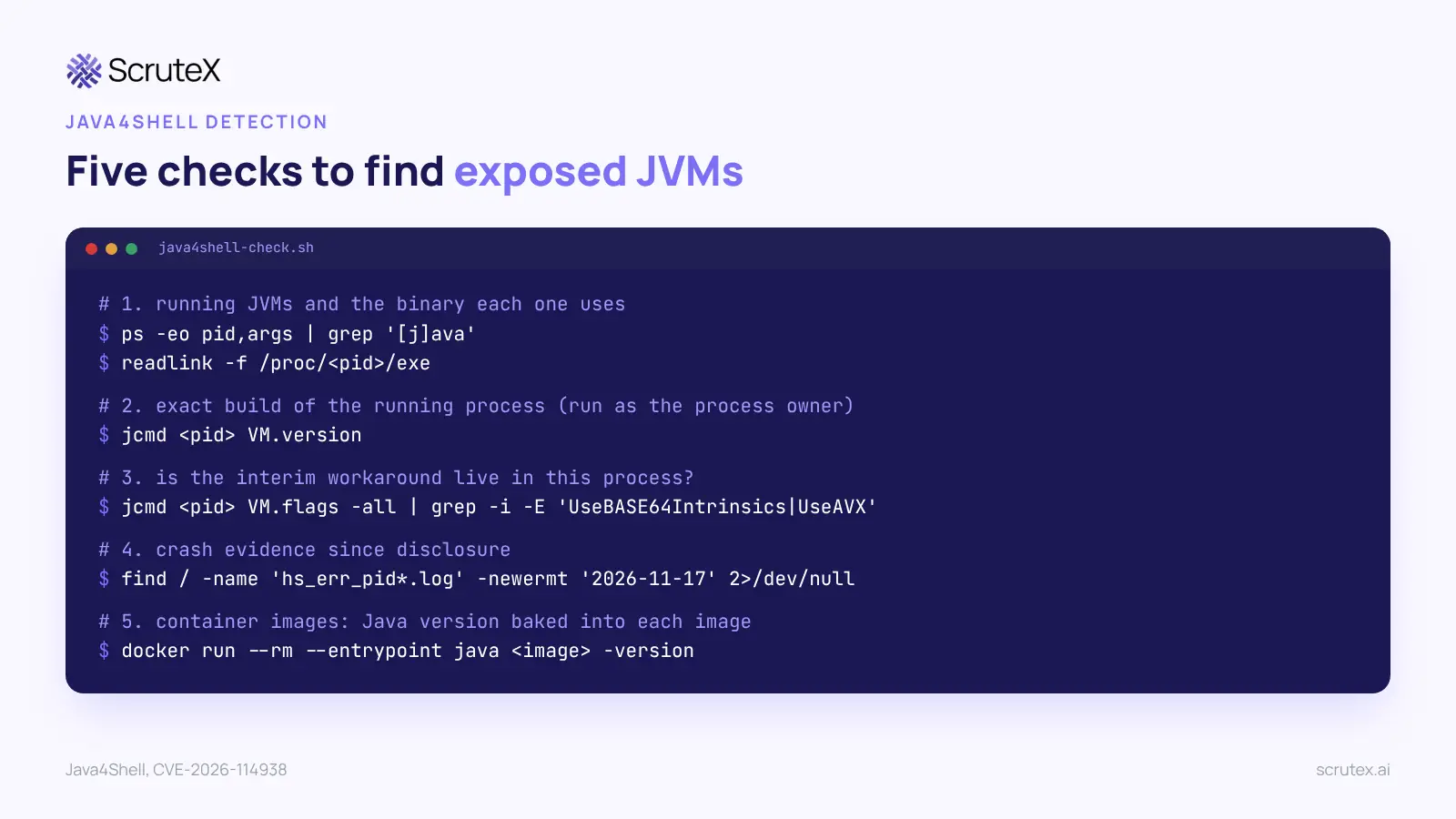
- Inventory running JVMs, not installed packages. Include JREs bundled in products and container images. Confirm the build of the running process, as the process owner.
- Apply the CPU gate to set order. Hosts with all four CPU flags go first. Hosts without them still get patched.
- Deploy network signatures. Cisco Talos Snort 2 SIDs 1:67502 to 1:67513; Snort 3 adds 1:301754. Community Snort 3 and Suricata rules followed. A custom rule can match a Base64-alphabet token of 32 or more characters that ends in "=" and whose length is not a multiple of 4. Start with Authorization headers, then query strings and bodies.
- Hunt in logs since 17-11-2026. Look for bursts of
IllegalArgumentExceptionfromjava.util.Base64$Decoder, newhs_err_pid*.logfiles, restart loops, a Java process spawningsh,bash,curlorwget, unknown Java runtimes, and unexpected outbound connections from identity or CI hosts. - Use scanner coverage. Qualys QIDs 389494 (Java4Shell), 389610 (Oracle Java SE CPU November 2026) and 389608 (Corretto November 2026). Version checks miss bundled runtimes, so pair them with step 1.
Detection signals at a glance
| Signal | Where to look | What it means |
|---|---|---|
| Talos SIDs 1:67502 to 1:67513, 1:301754 | IDS on traffic to Java services | Trigger attempts |
| Base64 token, 32+ characters, ends in "=", length not a multiple of 4 | Authorization headers, query strings, bodies | Possible trigger attempt |
IllegalArgumentException bursts from java.util.Base64$Decoder | Application logs | Malformed input reaching the decoder |
New hs_err_pid*.log files and restart loops | Host file system, orchestrator events | Failed grooming attempts |
Java process spawning sh, bash, curl, wget | EDR, process logs | Possible successful chain |
| Unexpected outbound connections from IdP or CI hosts | Firewall, proxy | Possible post-exploitation |
Treat as suspected compromise: an internet-facing Keycloak, PingFederate, Jenkins, Artifactory, Jira or Confluence host on an affected CPU that logged JVM crashes or Base64 exception bursts after 17-11-2026. Preserve the
hs_err files and heap state before restarting.Read these signals with care. Bad Base64 and JVM crashes have benign causes, and a successful chain may leave neither. None of these signals proves compromise, and their absence does not prove safety.
Is there a workaround for Java4Shell?
Yes. Where a fixed build is not yet available, start the JVM with
-XX:-UseBASE64Intrinsics and restart it. This disables the hardware-accelerated Base64 path and worked on every affected version Upwind tested, on any architecture. Verify it with jcmd <pid> VM.flags -all, and test performance on Base64-heavy services.CISA's compensating controls: validate and restrict Base64 input at the application boundary, enforce size limits, and limit unauthenticated access.
Workaround mistakes to avoid
| Mistake | Why it hurts |
|---|---|
-XX:DisableIntrinsic=_base64_decodeBlock on its own | Stops the JVM starting. Set through JAVA_TOOL_OPTIONS, it takes down a fleet |
-XX:UseAVX=2 pushed fleet-wide | x86 only: ARM64 JVMs fail to start with it. It also costs more performance than the Base64 flag |
| Treating proxy request buffering as a fix | It breaks some chains, not all, and WebSocket bypasses it |
| Marking ARM or non-VBMI hosts as closed | A resize or migration can change the CPU; patch them on the normal cycle |
| Patching the package without restarting | The running JVM keeps the vulnerable code until it restarts |
What should you do now?
Patch priority
| Order | Systems | Why |
|---|---|---|
| 1 | Internet-facing identity providers: Keycloak, PingFederate | Pre-auth RCE shown; one IdP opens every app behind it |
| 2 | Internet-facing Jira, Confluence, Jenkins, Artifactory | Pre-auth RCE shown; source, secrets and build pipelines |
| 3 | Other internet-facing Java services handling logins, tokens or uploads | Same decoder reachable before authentication |
| 4 | Internal Kafka, Solr, Elasticsearch, Gerrit, Spinnaker; outbound Java clients | Post-auth or client-side chains shown |
Within 24 hours
- Patch internet-facing identity, CI/CD and collaboration systems first, then restart the JVM.
- Where no fixed build exists yet, apply
-XX:-UseBASE64Intrinsics, restart and verify withjcmd. - Move admin and login interfaces behind VPN or management networks until patched.
- Enable the Talos SIDs or equivalent IDS rules on traffic to Java services.
- For any host matching the suspected-compromise test, rotate identity provider signing keys, CI secrets and service tokens.
Within 7 days
- Patch every remaining JVM on affected CPUs, including internal Kafka, Solr, Elasticsearch, Gerrit and Spinnaker.
- Rebuild container base images and redeploy. OS updates do not touch a JDK baked into an image or a product.
- Ask each product vendor for a release that bundles a fixed runtime, and record a date for each.
- Patch Java clients that open outbound TLS: integration services, crawlers and monitoring agents.
- Assign an owner and a deadline to every system waiting on a vendor build.
Structural fixes
- Inventory runtimes the way you inventory libraries: JVM vendor, build and host CPU, per service and per image.
- Give the Java runtime its own patch SLA. Oracle now ships monthly; OpenJDK advisories are quarterly plus out-of-band.
- Keep identity providers and build systems off the open internet where the business allows.
- Organisations in India: assess the CERT-In 6-hour reporting requirement if you suspect exploitation. Organisations in Malaysia: NCII entities should assess notification duties under the Cyber Security Act 2024 (Act 854).
Are you exposed?
Check these five things. All of them are answerable from your own systems today.
- ☐ Do you run Keycloak, PingFederate, Jenkins, Artifactory, Jira or Confluence on x86-64 with internet or partner access?
- ☐ Does any running JVM (
jcmd <pid> VM.version) report 17.0.6 or later, 21, 25 or 27 below the November 2026 build? - ☐ Do those hosts list
avx512vbmiin/proc/cpuinfoinside the guest? - ☐ Has any of them written an
hs_err_pidfile since 17-11-2026? - ☐ Do any vendor products, appliances or container images you run bundle their own Java runtime, and do you know its build?
What Scrutex finds here
Scrutex identifies internet-facing Keycloak, PingFederate, Jenkins, Artifactory, Jira and Confluence instances across your domains and subdomains and flags them for CVE-2026-114938 review. It watches dark web forums and Telegram channels for Java4Shell exploit trade and target lists that name your assets. It tracks the same exposed services across your vendors, so a supplier's unpatched Jira reaches you as a finding.
Scrutex sees only what is externally observable. It cannot read a JVM's build or a host's CPU flags, so confirming the runtime stays with your team.
What that looks like
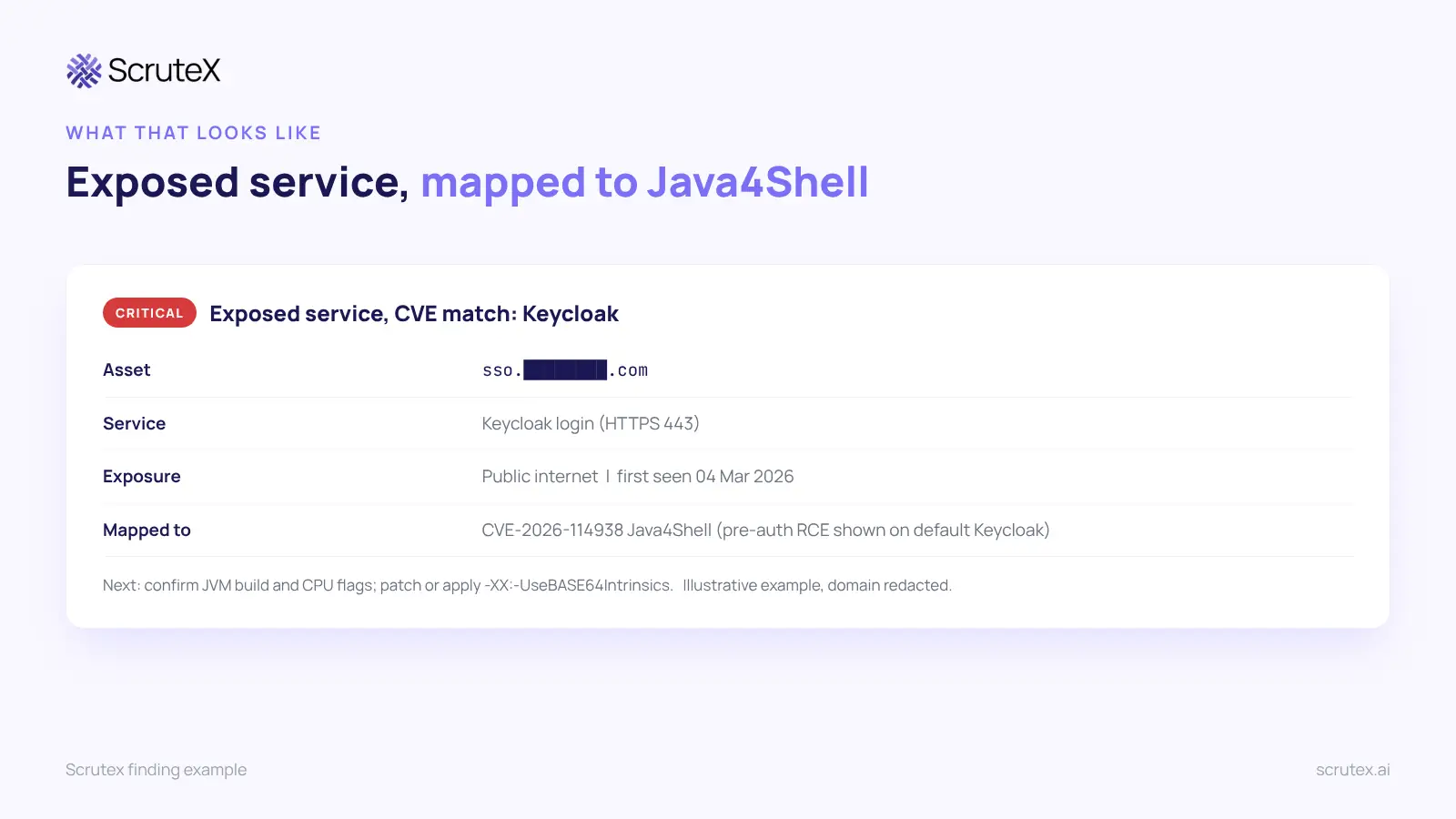
Illustrative example. Domain redacted.
Which Java4Shell targets can attackers reach on your domain?
Create a free Scrutex account with your domain and see which internet-facing Keycloak, Jira, Confluence, Jenkins, Artifactory and PingFederate instances sit on your external attack surface. Free tier, no credit card, no agent to install.
If you need exposed services mapped to CVEs: Vulnerability Insights, the place to start for internet-facing Java services.
If you want to watch exploit chatter as this develops: Threat Insights, which tracks exploit trade and actor activity.
Go deeper: External attack surface management best practices, because the forgotten Jenkins or staging Keycloak is where Java4Shell lands first.
Go sideways: What is CTEM, for turning one emergency patch into a repeatable exposure process.
FAQ
What is Java4Shell?
Java4Shell (CVE-2026-114938) is a heap overflow in the AVX-512 Base64 decoder inside the HotSpot JVM. A malformed Base64 string can corrupt memory and lead to remote code execution in Java 17.0.6 and later, 21, 25 and 27 on recent Intel and AMD CPUs.
Is Java 11 affected by Java4Shell?
No. Standard Java 8 and 11 do not contain the vulnerable decoder. Check whether your products bundle their own newer runtime, as many run on Java 17 or 21.
Is Java on ARM affected by Java4Shell?
No. ARM64 hosts such as AWS Graviton, Ampere and Apple silicon are not affected. Only x86-64 CPUs with avx512f, avx512bw, avx512vbmi and bmi2 reach the vulnerable code.
Which Java version fixes Java4Shell?
Oracle fixed it in 17.0.21.1, 21.0.13.1, 25.0.5.1, 27.0.1.1 and 8u513-perf on 17 November 2026. Amazon Corretto and Azul Zulu have fixed builds; Temurin, Microsoft and Red Hat had not announced fixes as of 18 November.
What is the workaround for CVE-2026-114938?
Start the JVM with
-XX:-UseBASE64Intrinsics and restart it. Verify with jcmd <pid> VM.flags -all. Do not use -XX:DisableIntrinsic=_base64_decodeBlock on its own, because the JVM will not start.Is Java4Shell being exploited in the wild?
Not as of 18 November 2026, and it is not in CISA KEV. A public trigger exists and details leaked before the patch, so Scrutex rates exploitation within 30 days as likely.
Which products are vulnerable to Java4Shell?
Researchers showed pre-auth RCE on default Keycloak, Jira, Confluence, Jenkins, JFrog Artifactory and PingFederate, and post-auth code execution on Kafka, Solr, Elasticsearch, Gerrit and Spinnaker. Any service that decodes untrusted Base64 on an affected JVM and CPU is a candidate.
How is Java4Shell different from Log4Shell?
Log4Shell was a bug in the Log4j library; Java4Shell is a bug in the JVM itself. You find Log4Shell by scanning dependencies, and Java4Shell by inventorying JVM builds and host CPUs.