The Hidden External Attack Surface: What Attackers Can Discover About Your Organisation Before You Know It
By ScruteXPublished
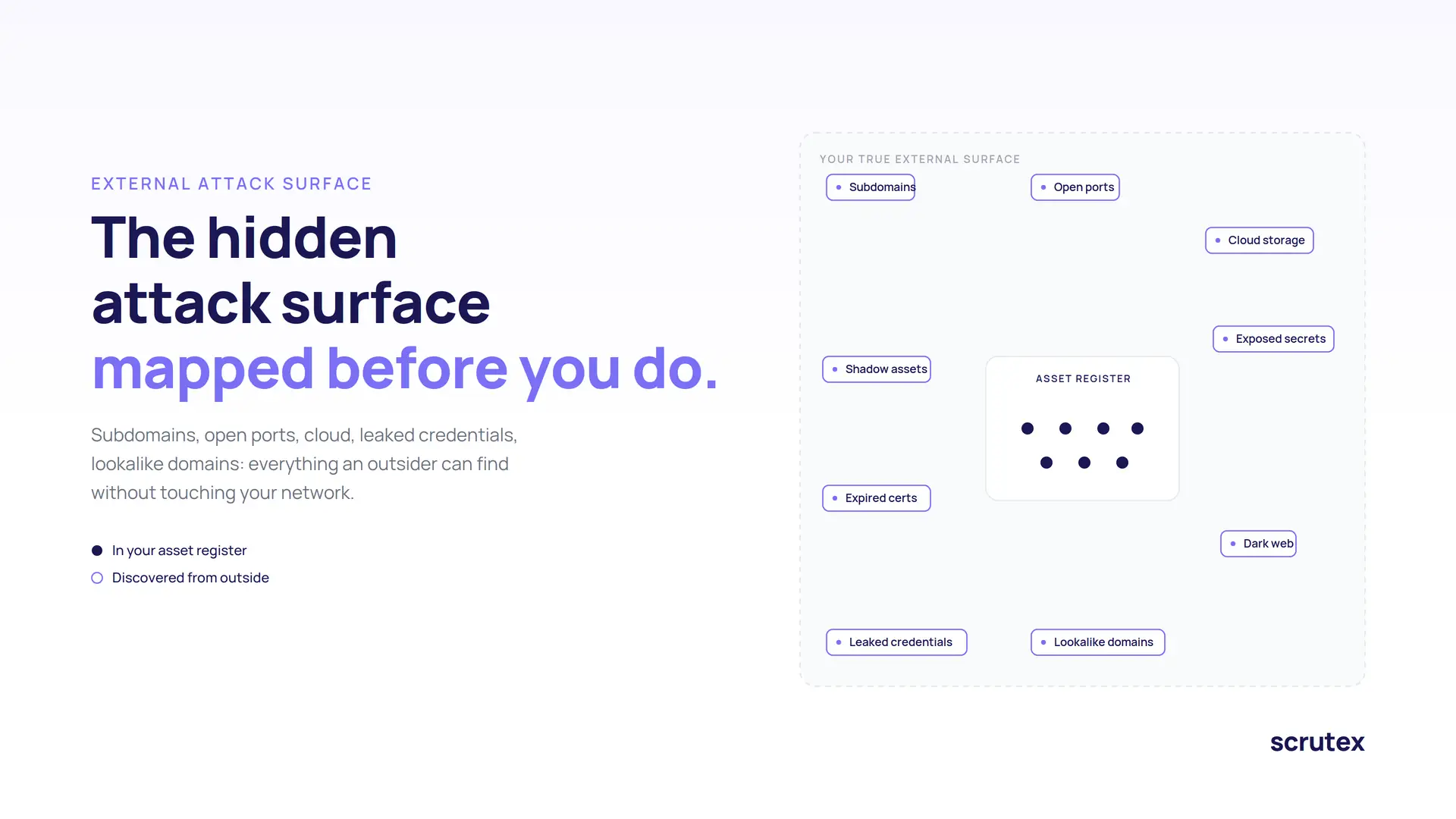
An attacker researching your organisation does not start with your firewall. They start with a search box. Before anyone inside your company logs a ticket, an outsider can list your subdomains, spot the admin panel you forgot to take down, read the API key a developer pasted into a public repo, and find the lookalike domain already sending mail as your finance team. None of that requires a single packet against your internal network.
Your external attack surface is every internet-facing asset, credential, and brand signal an attacker can find without touching your internal network: subdomains, open ports, cloud storage, leaked passwords, exposed secrets, lookalike domains, and dark web mentions. Attackers map it with public tools before you do, because most organisations inventory their own assets on a quarterly schedule while attackers scan continuously. The gap between what you think you run and what is actually reachable is where breaches begin.
This post walks the attacker's discovery path in order, the same order a competent adversary or a red teamer follows during reconnaissance. It covers what each layer exposes, why internal tools miss it, and where the defender can get ahead. External attack surface management is the discipline of finding these things first, and it starts with accepting that your asset register is a guess.
What is the external attack surface, and why is it bigger than your asset register?
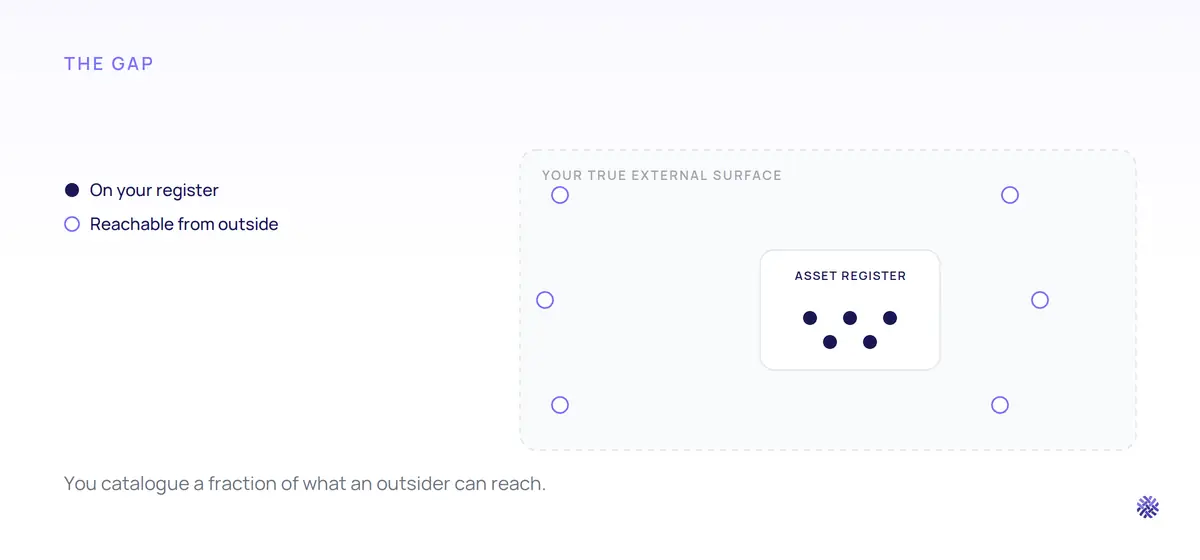
The external attack surface is the set of assets and signals reachable from the public internet that an attacker can enumerate, probe, or abuse. It includes domains and subdomains, IP ranges, open ports and services, TLS certificates, cloud storage and compute, exposed applications and APIs, credentials that have leaked, secrets committed to public code, and impersonation infrastructure such as typosquat domains and fake apps.
The reason it matters is a measurement problem. Most organisations maintain an asset register that reflects what they meant to deploy, not what is actually live. Marketing spins up a campaign microsite. A contractor stands up a staging box for a demo and never tears it down. An acquisition brings in a domain estate nobody has reconciled. Each of these is internet-facing on day one and absent from the register indefinitely.
The scale of that gap is measurable. In one first scan against an ASX-listed financial services client, Scrutex returned more than 30 internet-facing assets against a manual register of 20. Nine were unknown, including a staging environment for a client-facing application. That is not an unusual result. It is the normal state of an organisation that discovers its own footprint periodically while the internet indexes it in real time.
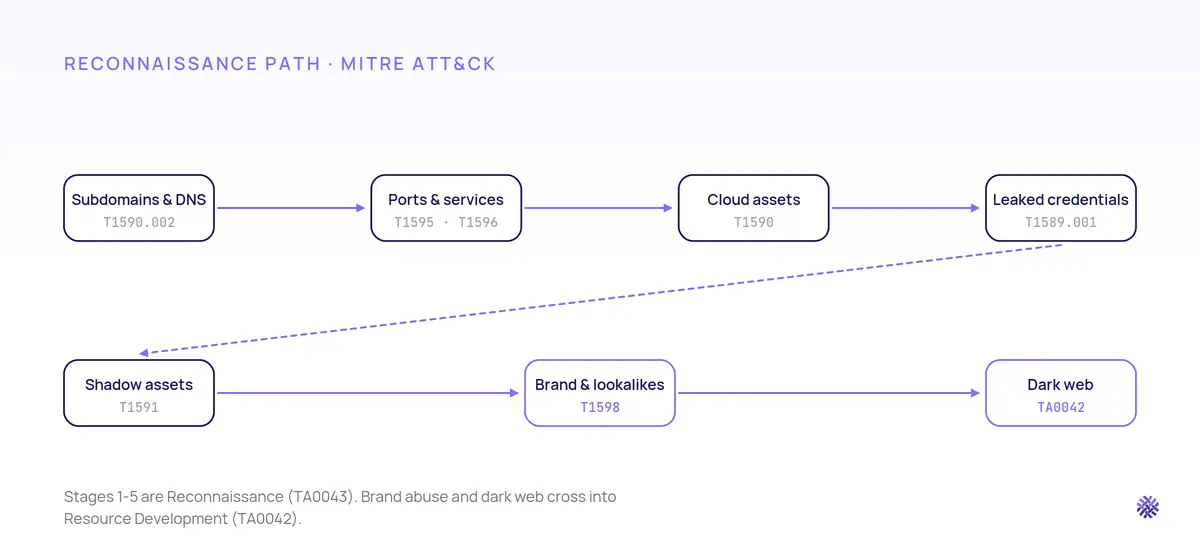
Attackers exploit this asymmetry deliberately. The MITRE ATT&CK framework places this activity in the Reconnaissance tactic, with techniques such as Gather Victim Network Information (T1590) and Active Scanning (T1595). These are the first moves in the kill chain, and they happen entirely outside your visibility unless you are watching the same surface the attacker is watching.
How do attackers discover your subdomains and forgotten assets?
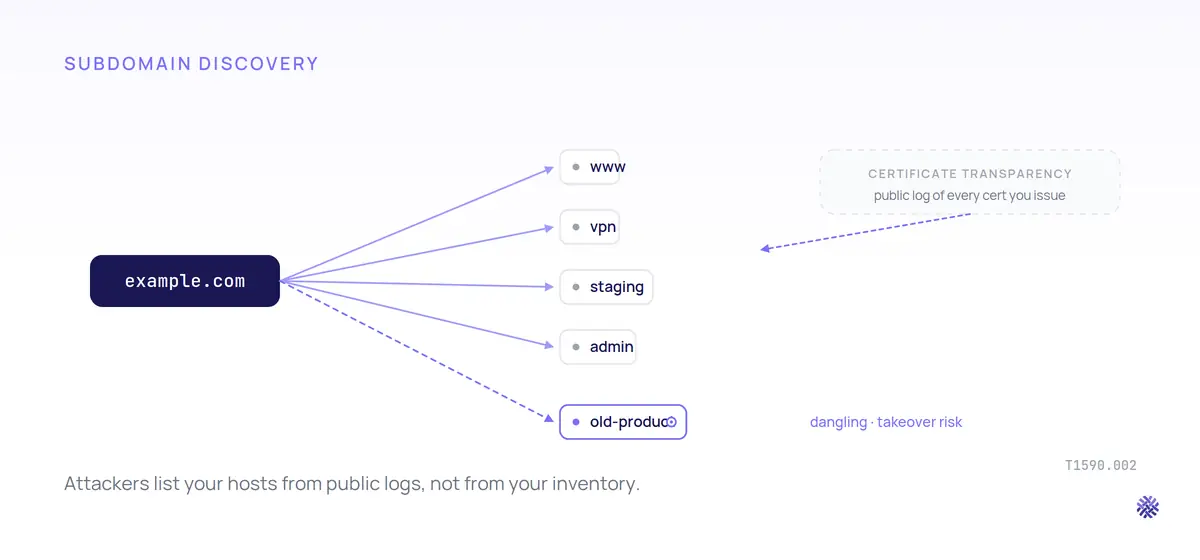
Subdomain enumeration is the opening move, and it is almost free. Every time you provision a TLS certificate, the certificate is logged in public certificate transparency logs. An attacker queries those logs and gets a list of hostnames you have certified, including internal-sounding ones like vpn, admin, jira, and staging. Tools that scrape these logs turn certificate issuance into a live map of your subdomains. You advertised them by securing them.
DNS enumeration adds more. Attackers brute-force common subdomain names, pull historical DNS records, and cross-reference passive DNS databases that record every resolution seen in the wild. What comes back is often a set of hosts the security team has never audited.
The sharpest risk in this layer is the dangling subdomain, which leads to subdomain takeover. It works like this: a subdomain has a CNAME record pointing at a cloud service, say a storage bucket or a SaaS app. The team decommissions the service but leaves the DNS record in place. An attacker notices the record points to an unclaimed resource, registers that resource themselves, and now controls content served from your trusted subdomain. From there they can host phishing pages on your own domain, capture session cookies, or bypass same-origin protections. The defender left a pointer to nothing, and the attacker filled the nothing.
This maps to Gather Victim Network Information: DNS (T1590.002) in ATT&CK. The defensive requirement is not a one-time subdomain audit. It is continuous reconciliation of DNS records against the resources they point to, because a subdomain that was safe last quarter becomes a takeover target the moment its backing service is retired.
What do exposed ports and services reveal to an attacker?
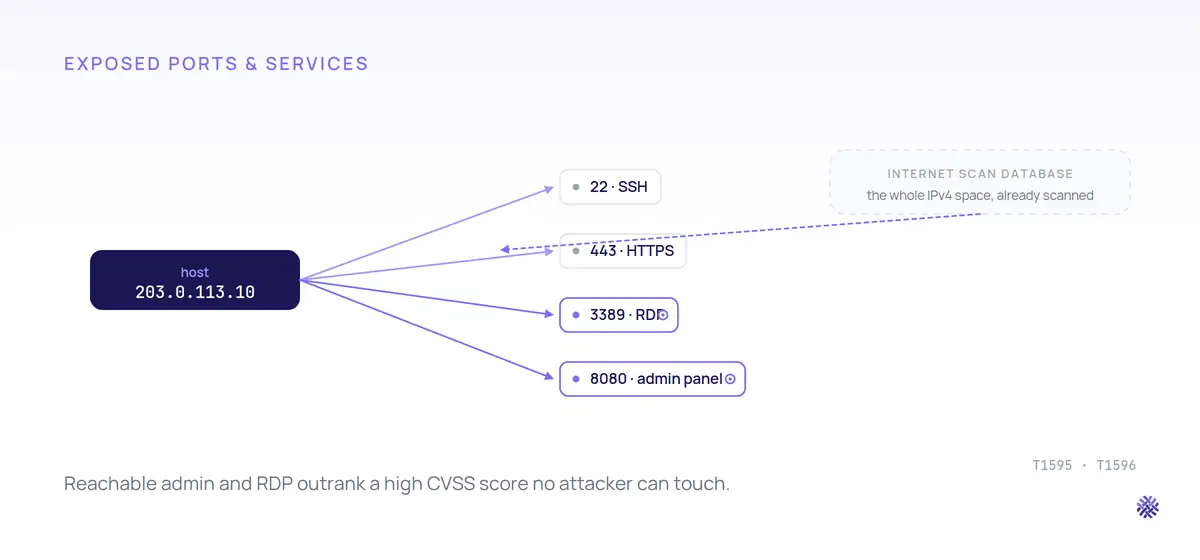
Once an attacker has your hosts, they scan for open ports and fingerprint the services behind them. Internet-wide scan databases like Shodan and Censys have already done most of this work, so the attacker often does not scan you at all. They query a database that scanned the entire IPv4 space and filter for your IP ranges. ATT&CK calls this Search Open Technical Databases (T1596).
What turns up is revealing. Exposed remote desktop and SSH invite brute-force and credential-stuffing. An admin panel or database console reachable from the public internet is a direct target. Outdated software versions announce known vulnerabilities in their banners. An expired or misconfigured certificate suggests a host nobody is maintaining, which usually means nobody is patching it either.
The mistake defenders make here is ranking these findings by raw CVSS score alone. A CVSS 9.8 on an internal host with no external path is a lower real risk than a CVSS 7.5 on an internet-facing service that a working exploit already targets. Attackers do not prioritise by CVSS. They prioritise by what is reachable and what has a weaponised exploit. Effective external attack surface management does the same: it enriches each finding with exploitability and reachability, so the queue reflects what an attacker could actually use rather than what a scanner rated most severe.
That distinction is where regulatory pressure now sits too. Under CISA's Known Exploited Vulnerabilities catalog, a vulnerability that is being exploited in the wild carries a fixed remediation window for US federal agencies, and many private and regional bodies (APRA CPS 234 in Australia, RBI and CERT-In guidance in India, DORA and NIS2 in the EU) push the same logic: patch what is exploited and exposed first. You cannot meet that obligation on assets you have not discovered.
How much of your cloud is exposed without you knowing?
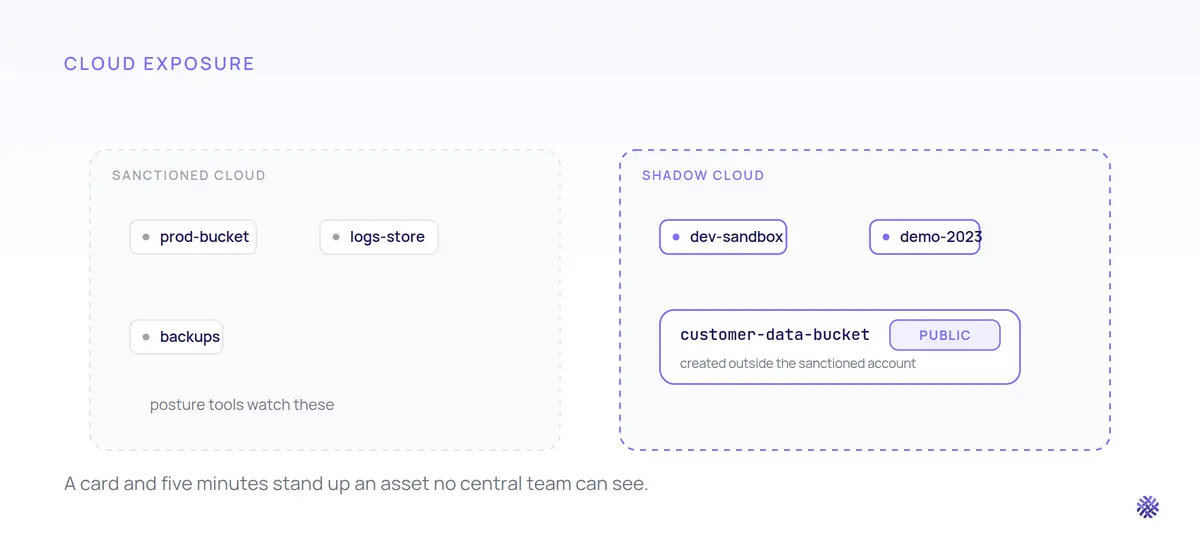
Cloud multiplies the discovery problem because it decentralises who can create an asset. A developer with a corporate card can stand up a storage bucket, a container registry, or a public compute instance in minutes, and that resource is internet-facing before any central team knows it exists. The register never catches up.
Attackers hunt for a handful of predictable failures. Publicly readable object storage is the classic one: a bucket set to public that holds backups, logs, or customer data. Misconfigured cloud storage has been behind a long run of data exposure incidents, not because the attack is clever but because the default gets overridden by someone in a hurry. Orphaned cloud assets are the second failure: a project spun up for a proof of concept, billed quietly, and forgotten, still serving an old application with old dependencies.
Shadow cloud is the third and hardest. This is cloud infrastructure created outside the sanctioned accounts, often on a personal or team subscription, invisible to the central security team and to any cloud posture tool pointed only at the official accounts. An attacker enumerating your organisation's footprint from the outside does not care which account paid for the asset. They see a host that resolves to your brand and probe it the same way. Your visibility is scoped to your accounts. Their visibility is scoped to your name.
The defensive move is outside-in discovery to complement inside-out posture management. A cloud posture tool tells you whether the assets you know about are configured correctly. External discovery tells you which assets exist at all. You need both, and the second one is the one most programmes are missing.
Where do leaked credentials and secrets actually come from?
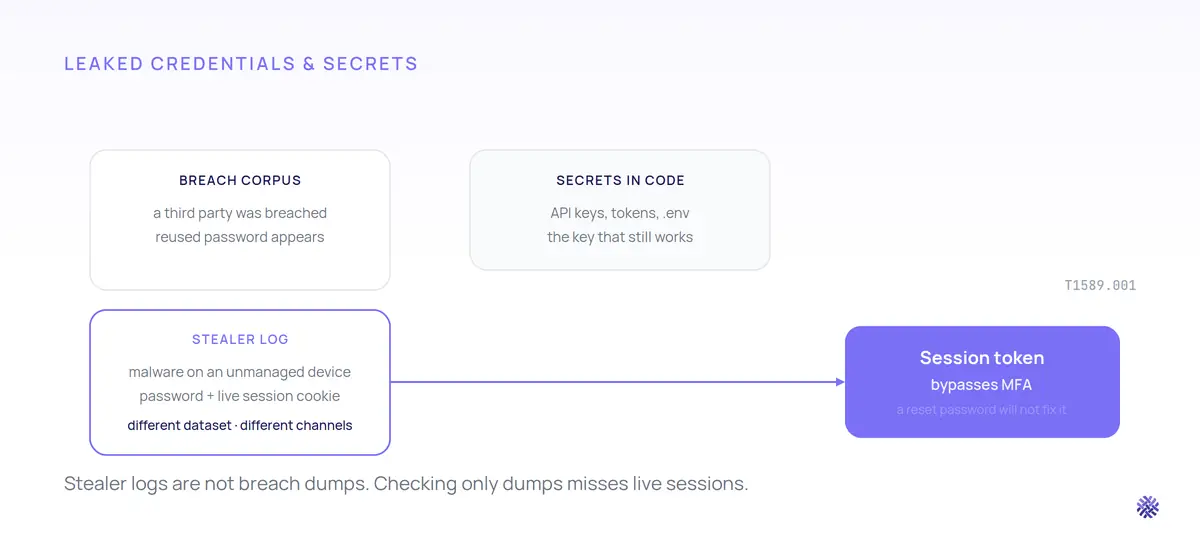
Credentials reach attackers by two very different routes, and blurring them is a common and costly error.
The first route is the breach corpus. When a third-party service is breached, its user database circulates, and if your staff reused a corporate password there, that password is now in a dataset attackers query. This is the well-known category, and it maps to Gather Victim Identity Information: Credentials (T1589.001).
The second route is the stealer log, and it is more dangerous. Infostealer malware such as Redline, Lumma, or Vidar runs on an infected device, often an employee's unmanaged personal laptop, and exfiltrates saved browser passwords, session cookies, and autofill data. The result is more than a password. It is a live session token that can bypass multi-factor authentication, plus the exact URLs the victim logs into. Stealer logs are a different dataset from breach corpora, they trade on different channels, and a credential-monitoring approach that only checks breach dumps will miss them entirely. A rotated password does not kill a stolen session cookie, which is why teams that rotate after an exposure but do not invalidate sessions stay compromised.
Secrets in code are the third source and often the fastest path in. Developers commit API keys, cloud access tokens, database strings, and private keys to repositories, sometimes public ones, sometimes private ones that later leak. An exposed cloud key can grant an attacker direct access to infrastructure with no login page involved. Scanning public code hosting for secrets tied to your domains and namespaces is now standard attacker tradecraft, and the key that still authenticates matters far more than the key that merely leaked. Rotation before the leak surfaced does not help. Rotation after it does.
What is shadow IT, and why is it the attacker's favourite target?
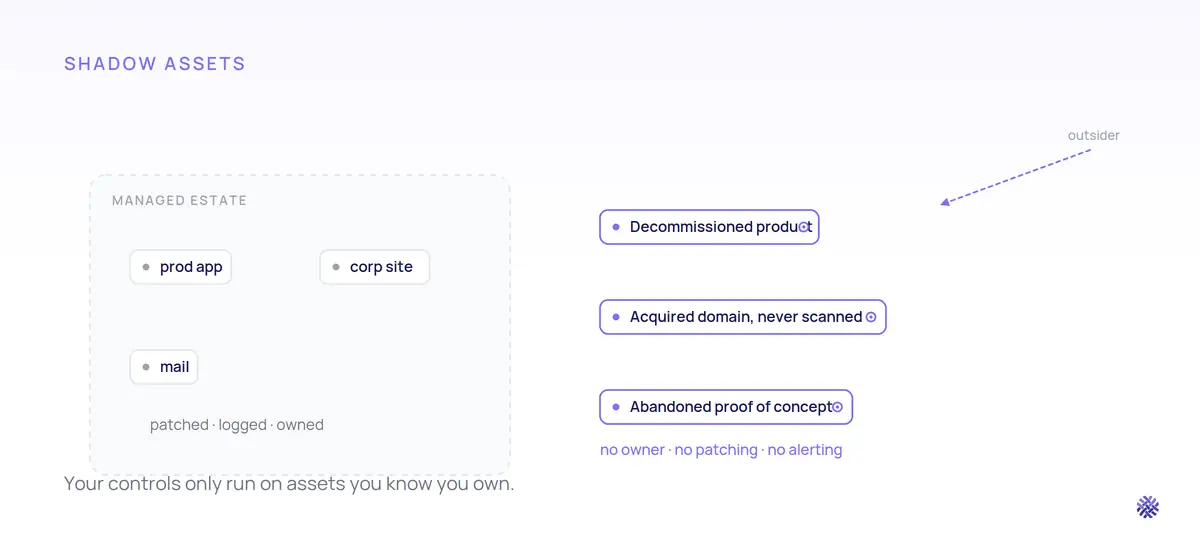
Shadow IT is any technology asset running without the security team's knowledge or oversight. Shadow assets are the internet-facing subset: the microsite, the pilot, the acquired domain, the decommissioned product that still resolves. They are the attacker's preferred entry point for one reason. Nobody is patching them, nobody is watching them, and nobody will notice the intrusion quickly.
The pattern repeats across every organisation. A product gets sunset, but its login page stays live on an old subdomain running a framework three major versions behind. A company is acquired, and its domain estate is folded in on paper but never scanned in practice. A vendor relationship ends, but the integration subdomain pointing at their service is never removed. Each of these is a real asset with a real vulnerability and no owner.
The business cost is that your strongest controls do not apply to assets you have not enumerated. Your patch programme, your logging, your access reviews, all of it operates on the known estate. The unknown estate has none of it. An attacker who finds a forgotten host has found a place inside your perimeter where your defences were never configured, because you did not know there was anything to defend.
This is why discovery has to be continuous and outside-in. An internal asset process records what your teams tell it. It cannot record the asset nobody told it about. Only a view built from the outside, the same view the attacker uses, surfaces the host that fell out of the process.
How do attackers abuse your brand and domains?
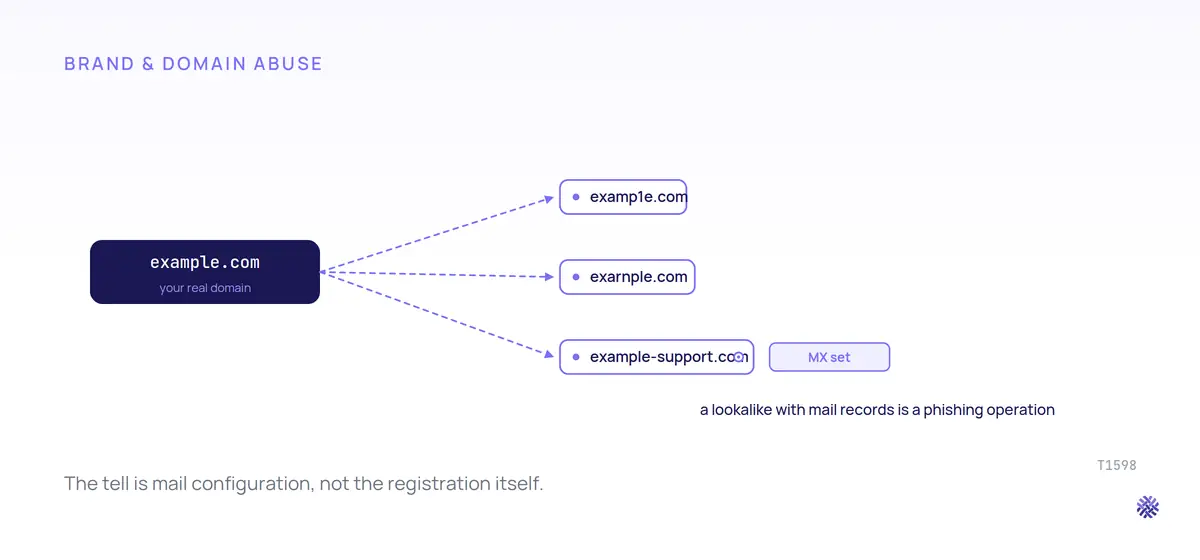
Not every attack targets your infrastructure. Many target your customers by impersonating you, and that abuse happens on infrastructure you do not own and cannot patch.
Typosquatting is the base layer. An attacker registers a domain one or two characters off yours, or swaps a letter for a lookalike, and stands up a page that copies your branding. The tell that separates a parked squat from an active threat is mail configuration. A lookalike domain with MX records set up is not a squatter waiting to sell the name. It is a phishing operation ready to send email that appears to come from you. ATT&CK tracks the reconnaissance side of this under Phishing for Information (T1598), and the domains are frequently registered days or weeks before the campaign launches, which is the window where discovery pays off.
Beyond domains, attackers publish fake mobile apps using your name, logo, and colours to harvest logins or push malware. They clone your login page. They run impersonation accounts on social platforms. Every one of these trades on trust your organisation built, and every one of them damages that trust when a customer gets caught.
The operational gap is usually response, not detection. Plenty of teams can find a lookalike domain if they go looking. Fewer have a defined answer to the next question: if you found one tomorrow, who files the takedown, with which registrar, and how long does it take? Brand abuse is where discovery and response have to connect, because a detected phishing domain that stays live for two weeks has still done its damage.
What is already on the dark web about your organisation?
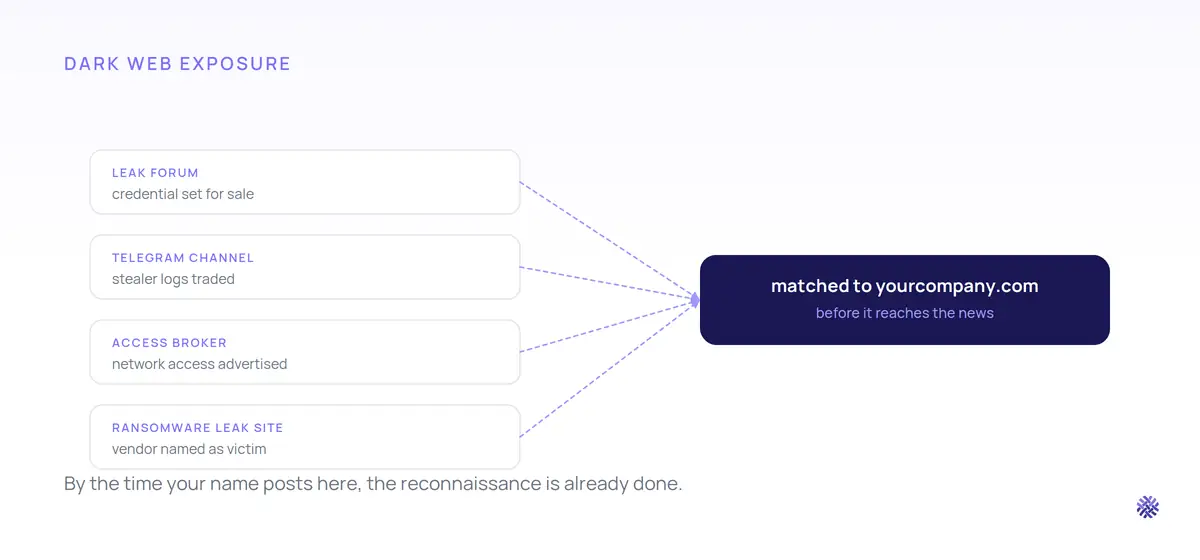
By the time something about your organisation appears on a leak forum or a Telegram channel, the attacker's reconnaissance is often already complete. The dark web is where the output of the earlier stages gets traded: credential sets, stealer logs, access to compromised hosts sold by initial access brokers, and datasets from breaches that touched your vendors.
Three signal types are worth watching specifically. Credential and stealer-log listings tell you which of your accounts are already for sale. Initial access broker posts advertise access to networks, sometimes described by sector and revenue in enough detail to identify the victim before it is named. Ransomware leak sites publish victim names continuously, and a supplier appearing on one of those lists is a third-party incident that will reach your risk team from the news unless you were already tracking it.
The important correction here is that dark web monitoring is not a magic window into every criminal channel. Credible monitoring covers the forums, marketplaces, and channels where this material actually trades. It does not see inside private, invite-only infrastructure, and any vendor claiming total coverage is overstating it. The honest version is more useful: watch the corpora and channels where your data would surface, match them against your domains and your vendors, and alert when something appears. That is achievable and it changes outcomes. Total coverage is a marketing claim, not a capability.
Why do attackers get there first?
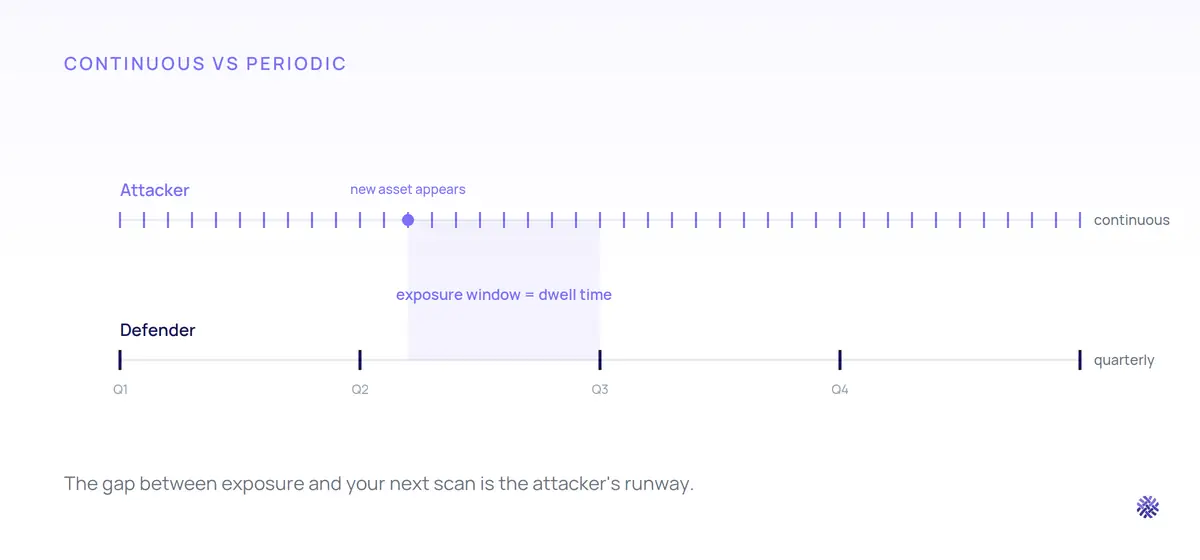
Every layer above shares one property. The attacker operates continuously and the defender operates periodically. That timing difference is the whole problem, and it is worth stating plainly.
A quarterly scan means that for up to three months, a new subdomain, a fresh misconfiguration, or a just-leaked credential sits undetected on your side while it is immediately visible on theirs. Certificate transparency logs update the instant you issue a certificate. Internet scan databases refresh constantly. Stealer logs appear on channels within hours of an infection. Leak forums post in real time. The attacker's map of you is never more than hours old. Your map of yourself is as old as your last scan.
Second-order effects follow from this gap. Detection latency becomes dwell time. A credential that sits exposed for weeks before anyone notices is a credential someone else has already used. The measure that matters is not whether you can find these exposures, but how fast. In the same financial services deployment referenced earlier, Scrutex reduced median credential exposure detection to 1.8 days, down from 26, across a 12-month measurement window. The difference between 26 days and under 2 is the difference between finding a leaked credential before it is abused and finding it during the incident review.
Closing the timing gap does not require more analysts. It requires watching the surface the way the attacker does: from the outside, continuously, and with findings ranked by what is actually reachable and exploitable.
How to close the gap: from periodic scans to continuous discovery
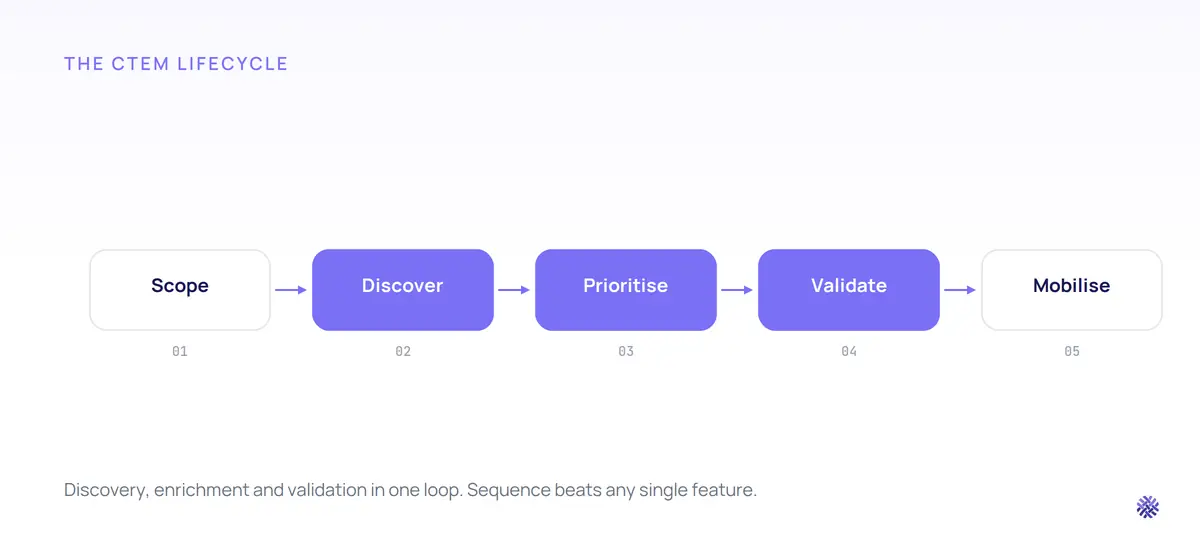
The structured answer to this problem is continuous threat exposure management (CTEM), the framework Gartner defined in 2022. Its logic runs in five stages: scope the surface, discover assets and exposures continuously, prioritise by real-world exploitability rather than raw severity, validate that a finding is genuinely exploitable, and mobilise remediation and takedown. The value is in the sequence. Discovery without prioritisation buries the team in noise. Prioritisation without validation escalates findings that cannot actually be exploited. Each stage exists to make the next one trustworthy.
There is a real strategic choice in how you build this, and honesty about it matters more than a pitch. If you run a mature security team with analysts to operate a workbench, best-of-breed point tools give you depth: a dedicated ASM platform, a separate dark web monitoring service, a standalone brand protection vendor, a code-secrets scanner. That stack is powerful and it suits organisations that can staff it.
The trade-off is correlation. Five disconnected tools produce five disconnected views, and the work of connecting them, matching a leaked credential to an exposed asset to a lookalike domain to a vendor on a leak site, lands on a human analyst you may not have. For a security team of one to ten, a single connected view of external exposure, leaked data, and brand abuse is usually the better fit, because the correlation is done for you rather than added to your queue. Neither approach is wrong. They suit different teams, and the right question is which one you can actually run every week, not which one has the longest feature list.
Whatever you choose, the payoff extends past your own risk register. When your discovery is continuous, the lookalike domain gets taken down before your customer clicks it. The reused credential in a stealer log gets flagged before someone logs into your portal with it. The public keeps trusting a brand that is not being used to defraud them. External attack surface management protects your organisation, and in doing so it protects the people on the other side of your login page.
Key Takeaways
- Your external attack surface is everything an attacker can find from the public internet without touching your network: subdomains, ports, cloud assets, leaked credentials, exposed secrets, shadow assets, lookalike domains, and dark web mentions.
- Your asset register reflects intent, not reality. First scans routinely surface internet-facing assets the register never listed, including staging environments for client-facing apps.
- Attackers prioritise by reachability and working exploits, not by CVSS. Discovery has to enrich findings with exploitability, or the queue misranks the real risk.
- Stealer logs are a different dataset from breach corpora. A credential approach that checks only breach dumps misses live session tokens that bypass multi-factor authentication.
- The core problem is timing. Attackers watch continuously and most defenders scan periodically. Closing that gap, not adding headcount, is what shrinks exposure.
Are you exposed? Check these in your own environment
You can answer most of these from your own records and logs, without any external tool. The uncomfortable answers are the useful ones.
- Can you name every internet-facing asset you own, from a register that was reconciled against reality in the last 90 days, not merely updated when someone remembered?
- If a subdomain from a decommissioned product still resolves, or its DNS record points at an unclaimed cloud resource, would anything alert you?
- Do you know how many corporate email addresses appear in stealer logs from the last 90 days, as distinct from breach corpora? They are different datasets.
- Has anyone registered a domain one character off yours recently, and if any of those have MX records configured, do you know who files the takedown and how long it takes?
- When you last rotated credentials after an exposure, did you also invalidate active sessions? A rotated password does not kill a stolen session cookie.
What Scrutex finds here
Scrutex discovers your internet-facing assets from the outside, the same way an attacker does, and flags the ones missing from your register: dangling subdomains, expired certificates, open ports, and outdated services, each ranked by real-world exploitability rather than raw CVSS. It matches your domains and employee addresses against dark web forums, paste sites, and stealer-log channels, and highlights leaked keys that still authenticate, not just keys that leaked. It watches domain registrations for the typosquat pattern that precedes phishing, and it tracks lookalike domains that have mail records configured. Setup is agentless: a domain and a set of keywords, with findings returning from the first scan.
What that looks like
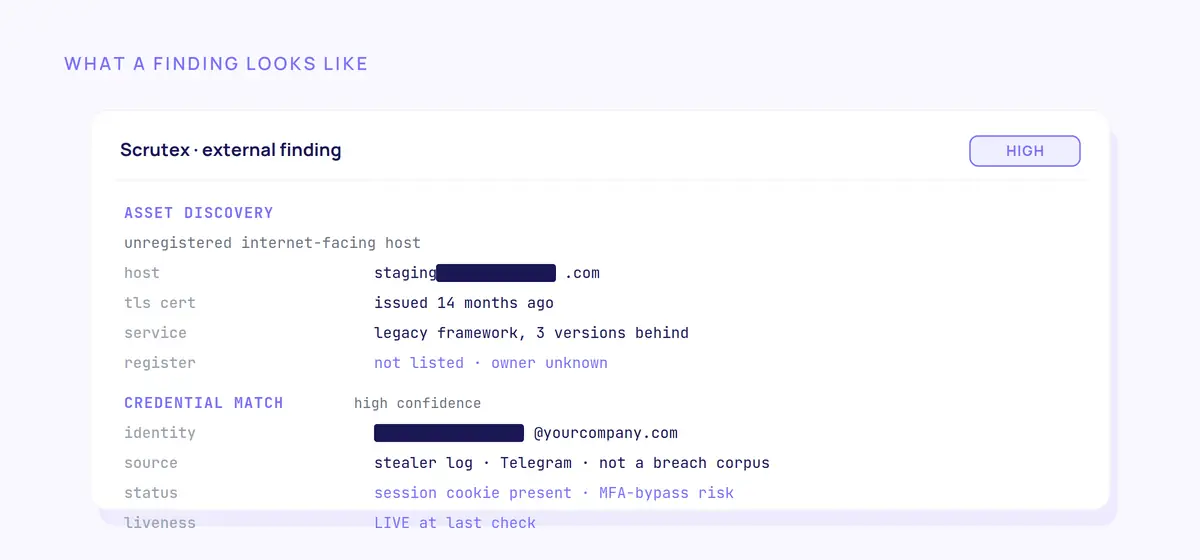
A single finding of the kind this surfaces, redacted:
Scrutex sees this only where it is externally observable. If an exposure never left your internal network, it will not appear here, and neither will it appear to the attacker working from the outside. Findings today reach you through the platform, a REST API, and webhooks. Named SIEM, SOAR, and ticketing integrations are shipping through 2026, not before.
If discovery and exposed assets are your problem: Vulnerability Insights finds the internet-facing assets, ports, and expired certificates nobody registered, and ranks them by what an attacker could actually reach and exploit.
If leaked credentials and secrets are your problem: Data Exposure Insights covers stealer logs and paste sites as well as breach corpora, and flags exposed keys that still authenticate.
Go deeper: EASM best practices for 2026, for the reader now auditing their own discovery process.
Go sideways: How to find leaked credentials on the dark web, for the reader who suspects the exposure is bigger than assets alone.
FAQ Section
Q: What is the external attack surface?
A: The external attack surface is every asset and signal an attacker can find from the public internet without accessing your internal network. It includes subdomains, open ports, cloud storage, exposed applications, leaked credentials, secrets in public code, and impersonation infrastructure such as typosquat domains.
Q: What is the difference between attack surface discovery and vulnerability scanning?
A: Vulnerability scanning tests assets you already know about for known flaws. Attack surface discovery finds the assets themselves, including the ones missing from your register. Discovery answers "what do we have exposed", scanning answers "what is wrong with what we listed". You need discovery first, because you cannot scan an asset you have not found.
Q: How do attackers find my subdomains?
A: Attackers pull your subdomains from public certificate transparency logs, which record every TLS certificate you issue, and from passive DNS databases that log resolutions seen across the internet. They also brute-force common subdomain names. This is why forgotten subdomains stay findable long after your team has stopped tracking them.
Q: Can dark web monitoring see everything about my organisation?
A: No. Credible dark web monitoring covers the forums, marketplaces, and channels where stolen data actually trades, and matches that material against your domains and vendors. It does not have visibility into private, invite-only criminal infrastructure, and any vendor claiming total coverage is overstating what is possible.
Q: How is external attack surface management different from CTEM?
A: External attack surface management is the discovery and monitoring layer that finds and tracks your internet-facing assets. CTEM is the wider Gartner framework that wraps discovery in a five-stage lifecycle: scope, discover, prioritise, validate, and mobilise. EASM feeds the discovery stage of a CTEM programme.