Dark Web Monitoring Tools Compared: What Actually Separates Them
By ScrutexPublished
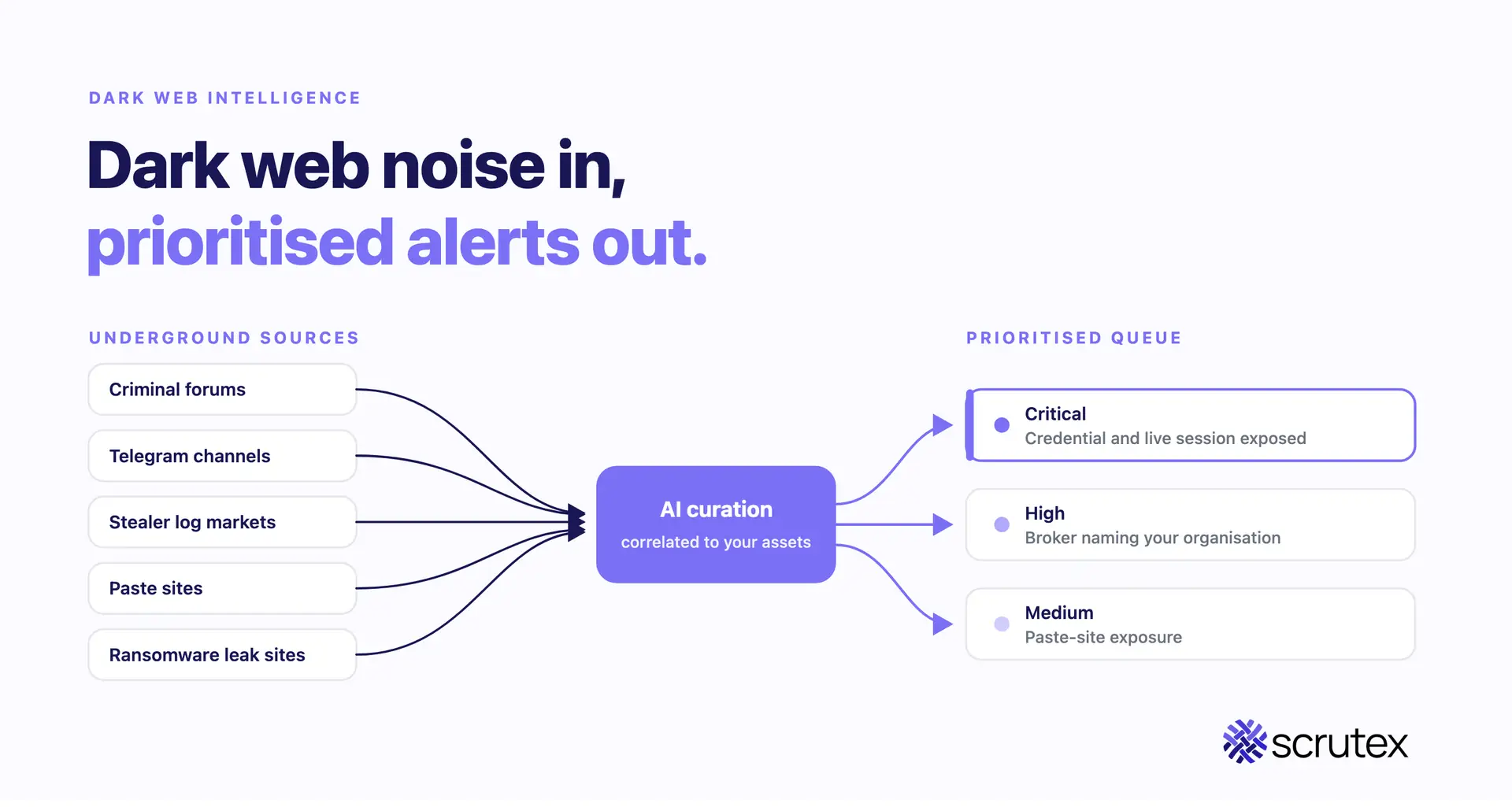
Every dark web monitoring vendor makes the same promise: we watch the dark web for your data. The sentence is identical across their sites. The coverage behind it is not. One tool checks a handful of public breach dumps and calls it monitoring. Another watches Telegram broker channels, stealer log markets, criminal forums, paste sites, and ransomware leak sites in near real time. Both rank on the same page of search results. Only one warns you before a stolen credential gets used against you.
This guide breaks down the criteria that actually separate dark web monitoring tools, so you can tell real coverage from a marketing line, and buy on evidence instead of taglines.
In This Post
- What a dark web monitoring tool does
- Why the gap between tools matters more in 2026
- The criteria that separate real monitoring from a scan
- Source coverage compared by tool tier
- What monitoring should cover besides passwords
- The three tiers of tools, and who each one suits
- Questions to ask every vendor before you buy
- Who this protects beyond the company
- Where the dark web monitoring market is heading
- How Scrutex fits
- Key takeaways and FAQ
What is a dark web monitoring tool?
A dark web monitoring tool watches criminal sources, forums, marketplaces, Telegram channels, paste sites, stealer log dumps, and ransomware leak sites, for mentions of your organisation: employee credentials, customer records, exposed sessions, source code, brand abuse, or signs that access to your network is being sold. When it finds a match, it alerts you.
The whole point is time. A credential found and rotated today is a closed door. The same credential found weeks later, after an attacker has already logged in with it, is an open one. Every tool in this category claims to do this. The real question is how much of the underground each one actually sees, and how fast it tells you.
Why the gap between tools matters more in 2026

The supply chain for stolen access has changed, and it changed in a direction that punishes slow, shallow monitoring.
Most credential theft today does not come from one dramatic corporate breach. It comes from infostealer malware running on an employee's or contractor's machine, often a personal device with a corporate login saved in the browser. Infostealer families such as RedLine, Lumma, and StealC (and the successors that replace each one after a takedown) quietly copy saved passwords, browser cookies, autofill data, and crypto wallets, then package the haul into a stealer log. This maps directly to MITRE ATT&CK T1555, Credentials from Password Stores.
Those logs do not sit still. They move into combolists, get sold in stealer log markets, and get advertised in Telegram channels within days. A separate class of criminal, the initial access broker, buys the useful ones, confirms the access works, and resells it to ransomware crews. By the time an attacker uses a valid login to walk in (MITRE ATT&CK T1078, Valid Accounts), the credential has already changed hands more than once.
This is why source depth beats source count. A tool that only reads public breach databases is reading history. It reports breaches everyone already knows about, long after the fresh stealer logs that actually get weaponised have come and gone. The signal that prevents an incident lives in channels that take real collection effort to reach, not in last year's dumps.
The criteria that separate real monitoring from a scan

Six things decide whether a tool is monitoring the dark web or just checking a public list.
Source coverage. This is the whole game. Ask each vendor to name their source categories: breach databases, combolists, stealer logs, Telegram channels, criminal forums, paste sites, and ransomware leak sites. A tool limited to public breach databases is checking yesterday's news. Fresh stealer logs and active broker listings are where the warning value is, and reaching them is the hard part.
Freshness. Measure the gap between a listing appearing underground and an alert landing in your queue. Near real time beats a monthly digest by weeks, and weeks is exactly the window an initial access broker uses to sell your access on.
Signal-to-noise. Raw underground data is overwhelming. A good tool correlates a raw listing to your actual assets and suppresses everything else. A tool that forwards every keyword match trains your analysts to ignore the channel, which is worse than no alerts at all, because it looks like coverage while delivering none.
What it monitors for. Credentials are the baseline. Stronger tools also cover session tokens (which skip the password entirely), API keys, exposed source code, brand impersonation, and initial access broker chatter that names your company.
Alerting and workflow. A dark web alert that lands in Slack, Jira, or your SIEM gets worked. The same alert sitting in a vendor portal, waiting for someone to log in and notice it, does not. Check the integrations before you check the dashboard screenshots.
Actionability. Does the alert tell you what to do (rotate this credential, revoke this session, take down this domain), or only that something was found? The gap between those two is the gap between a tool your team uses and one it forgets.
Source coverage compared by tool tier

Coverage is easier to judge as a grid than a paragraph. This is the pattern most tools fall into, by tier rather than by brand.
| Source category | Breach-lookup tools | Credential monitoring platforms | Full external intelligence platforms |
|---|---|---|---|
| Public breach databases | Yes | Yes | Yes |
| Combolists | Rarely | Yes | Yes |
| Stealer logs | No | Often | Yes |
| Telegram broker channels | No | Sometimes | Yes |
| Criminal forums | No | Sometimes | Yes |
| Paste sites | Sometimes | Yes | Yes |
| Ransomware leak sites | No | Rarely | Yes |
| Session tokens and API keys | No | Sometimes | Yes |
| Alerts tied to your assets | No | Yes | Yes |
| Push into SIEM/ticketing | No | Sometimes | Yes |
Read down a column and the picture is clear. A breach-lookup tool answers one question well and cheaply. A monitoring platform reaches the fresh sources. A full external intelligence platform adds the context around the credential. None of these is dishonest about what it is; the risk is buying the left column while believing you bought the right one.
What should dark web monitoring cover besides passwords?

Passwords are the obvious target, and the least of your worries if that is all a tool watches.
Session tokens matter more than most buyers expect. When an infostealer copies an active browser cookie, an attacker can import it and land inside an authenticated session without ever seeing the password (MITRE ATT&CK T1539, Steal Web Session Cookie). Because the session is already authenticated, this often walks straight past multi-factor authentication. A team that rotated every password after a stealer infection, but never revoked the stolen sessions, can still be compromised. A monitoring tool that only reads password fields will never flag this.
The other high-value signals are API keys and secrets committed to public code repositories, exposed source code that reveals internal structure, and broker posts that name your organisation as a target for sale. Each of these is an earlier warning than a credential dump, because it shows intent or capability before the login is used. A tool worth paying for treats these as first-class alerts, not footnotes.
The three tiers of tools, and who each one suits

Tools cluster into three rough tiers. The honest answer to "which is best" is that it depends on your risk and your headcount.
Breach-lookup tools (often marketed as a dark web scanner or a free dark web scan) check whether an email appears in known public breaches. They are useful, cheap, sometimes free, and backward-looking. For an individual or a very small team, a free dark web scan is a reasonable starting point and better than nothing. Treat it as a smoke detector, not a monitoring programme: it tells you a breach already happened, not that your access is being sold right now.
Credential monitoring platforms add fresher sources, stealer logs and combolists, and alert on your domains rather than one email at a time. This is the practical baseline for most security teams that have something to protect and someone to act on the alerts.
Full external intelligence platforms fold dark web monitoring into wider coverage: brand abuse, external attack surface, curated threat intelligence, and vendor exposure. You get the credential signal plus the context that tells you whether it matters right now.
Here is the fair version of the trade-off. Dedicated, deep dark web feeds suit large, mature teams that have analysts to run raw intelligence and turn it into decisions. A single connected external view suits smaller teams that need the same signal without hiring the analysts to triage it. Best-of-breed point tools are genuinely strong in the hands of a team that can operate them. A connected platform earns its keep when the constraint is people, not budget. There is no single best category, only the right fit for how your team actually works.
Questions to ask every vendor before you buy
Before you sign anything, put these to the vendor and listen for a straight answer.
Which source categories do you cover, and can you name them? How fresh is a typical alert, measured from underground listing to notification? Do you monitor session tokens and API keys, or only passwords? How do you cut false positives down to what my team can act on? What does an alert integrate with out of the box? And, for teams under CERT-In, RBI, APRA CPS 234, NIS2, or similar reporting rules, can the tool produce the evidence trail a regulator expects?
A vendor that answers the source-coverage question plainly is showing you their collection is real. A vendor that changes the subject to their dashboard is telling you something too.
Who this protects beyond the company
Dark web monitoring is easy to frame as an enterprise dashboard problem. It is also a consumer protection problem, and that framing is the honest one.
When a tool catches an employee's reused password in a stealer log and the team rotates it, it also closes the door on every other account, including customer-facing ones, where that person reused the same password. When it flags a broker selling access before a ransomware crew buys it, the customers whose data sits behind that access never learn their records were one transaction away from a leak site. Catching exposure early protects the people behind the credentials, not just the company's risk register. That is the quieter payoff, and it is real.
Where the dark web monitoring market is heading

The dark web monitoring market used to sell one thing: a lookup against breach data. That product is commoditising fast, which is why so many free dark web scan tools now exist. The paid market is splitting in two directions.
At the top, large enterprises buy dark web monitoring services as one feed inside a wider threat intelligence programme, staffed by analysts who can work raw intelligence. That model is strong, and it is not going away.
The faster-growing gap is dark web monitoring for business teams that are smaller than an enterprise SOC but still carry real exposure: a growth-stage SaaS company, a regional bank, a healthcare provider, a government supplier. These teams cannot staff a dedicated intelligence desk, and a raw feed drowns them. What they need is the same underground coverage, curated down to alerts they can act on, and wired into the ticketing they already run. That shift, from raw feed to curated, asset-tied alerting, is the real movement in this market, and it favours tools that treat curation as the product rather than an add-on.
How Scrutex fits
Scrutex serves organisations of all sizes, from mid-market businesses to global enterprises. Its approach combines dark web monitoring with broader external security intelligence, helping security teams move from raw threat data to prioritised, actionable exposure insights. It is an external security intelligence platform (CTEM and external attack surface management, with dark web and credential exposure monitoring as part of it),used by teams across the globe. The design bet is that mid-market and enterprise teams get more value from curated, correlated exposure than from another raw feed to triage.
The dark web piece is Scrutex Data Exposure Insights. It monitors dark web forums, Telegram broker channels, stealer log markets, paste sites, and ransomware leak sites, then uses AI curation to turn millions of raw signals into prioritised alerts tied to your actual assets. It watches for leaked credentials, exposed sessions, and mentions of your organisation, and pushes each dark web alert into the tools your team already uses through webhooks and REST API. Setup is agentless: add your domain and keywords and discovery starts, no agent to install. You can begin on the free tier, no credit card, and see your current exposure in minutes.
Key takeaways
- Every tool claims dark web coverage. Source breadth and freshness are what actually differ.
- Ask for named source categories. "Breach databases only" is backward-looking by design.
- Fresh matters because stolen credentials move through brokers in days and weeks, not months.
- Session tokens can bypass passwords and MFA. A password-only tool will miss them.
- Curation, not raw volume, decides whether alerts get acted on.
- Match the tier to your risk and team size. Deep feeds suit large teams with analysts; a connected view suits smaller ones.
See what is already exposed. Start free with Scrutex Data Exposure Insights at https://scrutex.ai/solution/data-exposure
FAQ
Q: What is the best dark web monitoring tool?
A: The best tool is the one with the broadest fresh source coverage for your risk, and alerts that reach your team fast. Compare tools on named source categories, freshness, and signal-to-noise, not on marketing claims or dashboard screenshots.
Q: How is dark web monitoring different from a breach lookup?
A: A breach lookup checks known public breaches, which is backward-looking. Full dark web monitoring watches fresh sources like stealer logs and broker channels in near real time, so you catch exposure before it is used against you.
Q: What should dark web monitoring cover besides passwords?
A: Strong tools also monitor session tokens, API keys, exposed source code, brand impersonation, and initial access broker chatter. Session tokens matter because a stolen active session can bypass both the password and multi-factor authentication.
Q: Why is source freshness so important?
A: Stolen credentials rarely stay private. Infostealer logs move into combolists and broker channels within days, and initial access brokers resell working access soon after. A tool that only reads old breach dumps reports the theft long after the window to act has closed.
Q: Are free dark web monitoring tools any good?
A: Free tiers are a fair starting point for basic credential exposure. For session tokens, broker chatter, and curated alerting that ties findings to your assets, you typically need a dedicated platform.