Continuous Automated Red Teaming vs the Annual Pen Test: What Changes for a Small Security Team
By Mohana SubiPublished Updated
A four-person security team finishes its annual penetration test. The findings get fixed, the retest confirms them, and everyone goes back to alerts and tickets. That report is accurate on the day it was written. Then the environment moves. A new app ships. A cloud role gets a broader permission than anyone intended. An EDR policy is tweaked. A subdomain is spun up and forgotten. None of those changes are in the report, because none of them existed when the test ran.
That gap is the real question for a small team: rely on the annual penetration test, adopt continuous automated red teaming, or run both? The answer depends on your risk profile, how fast your environment changes, what you are trying to prove, the testing you already do, and whether you can act on findings when they arrive. This article gives you a way to decide, not just a definition of each.
Continuous automated red teaming is the repeated, automated execution of selected adversary behaviours against your environment to check whether specific security controls detect, block, or record them. It is not a tool that finds every vulnerability on every asset. It validates the behaviours and controls you configure it to test, on a recurring basis, so you get fresh evidence between the point-in-time assessments a penetration test gives you.
What Is Continuous Automated Red Teaming?
Continuous automated red teaming (CART) automates red team operations so that selected adversary behaviours run against your attack surface repeatedly rather than once a year. The EC-Council describes CART as automating red teaming for continuous visibility, with the ability to discover the attack surface, launch multi-stage attacks, and support continuous penetration testing. The work a human red team runs during a scoped engagement gets packaged into scenarios that run again on a schedule or after a change.
Depending on the platform and how you configure it, continuous automated red teaming can help a team:
- Simulate selected adversary behaviours mapped to known techniques.
- Validate the security controls you have told it to test.
- Test whether specific detection and prevention controls fire.
- Repeat the same validation scenarios over time.
- Re-run selected controls after a relevant change.
- Track recurring results so patterns show up.
- Flag areas that need a human to look closer.
- Support remediation verification by re-testing a fix.
What it does not do matters as much. It focuses on recurring validation of the behaviours and controls you select. It does not necessarily discover every vulnerability, and it does not continuously test every asset. Coverage is a function of the scenarios the platform supports and the scope you give it.
It also sits apart from the things it gets confused with. Vulnerability scanning enumerates known weaknesses; it tells you what is present, not whether an attack path works. Automated penetration testing chains findings into a working exploit path to prove impact, usually on demand. Breach and attack simulation (BAS) replays scripted techniques against live controls to check detection and prevention coverage. Human-led red teaming puts skilled operators against your defences with objectives and creativity automation does not reproduce. CART overlaps with several of these, but its defining trait is that the validation recurs.
What Is an Annual Penetration Test?
An annual penetration test is a scheduled, scoped engagement in which skilled testers assess a defined set of systems and report the weaknesses they find and validate. It is a point-in-time assessment: the findings describe the systems, scope, and conditions as they were during the engagement.
NIST SP 800-115, the Technical Guide to Information Security Testing and Assessment published in 2008 by Souppaya and Scarfone, gives the structure most engagements follow. A typical penetration test runs like this:
- Define the scope and rules of engagement, including authorisation.
- Assess the authorised applications, systems, and infrastructure.
- Identify and validate security weaknesses.
- Demonstrate impact where appropriate and authorised.
- Document findings and recommendations.
- Support remediation and retesting.
The value comes from the human doing it: expert judgement about what matters, investigation that follows a hunch a scanner would never form, complex application and business-logic testing, chained vulnerabilities where three low findings combine into one critical path, and remediation advice written for your environment.
The limitation is structural, not a criticism. A penetration test reflects what was in scope and true during the test window. It tells you nothing about the app you deployed two months later or the firewall rule someone changed last week. That is the gap continuous validation is meant to fill, and it is why the two approaches answer different questions rather than competing for the same one.
Continuous Automated Red Teaming vs Annual Penetration Testing
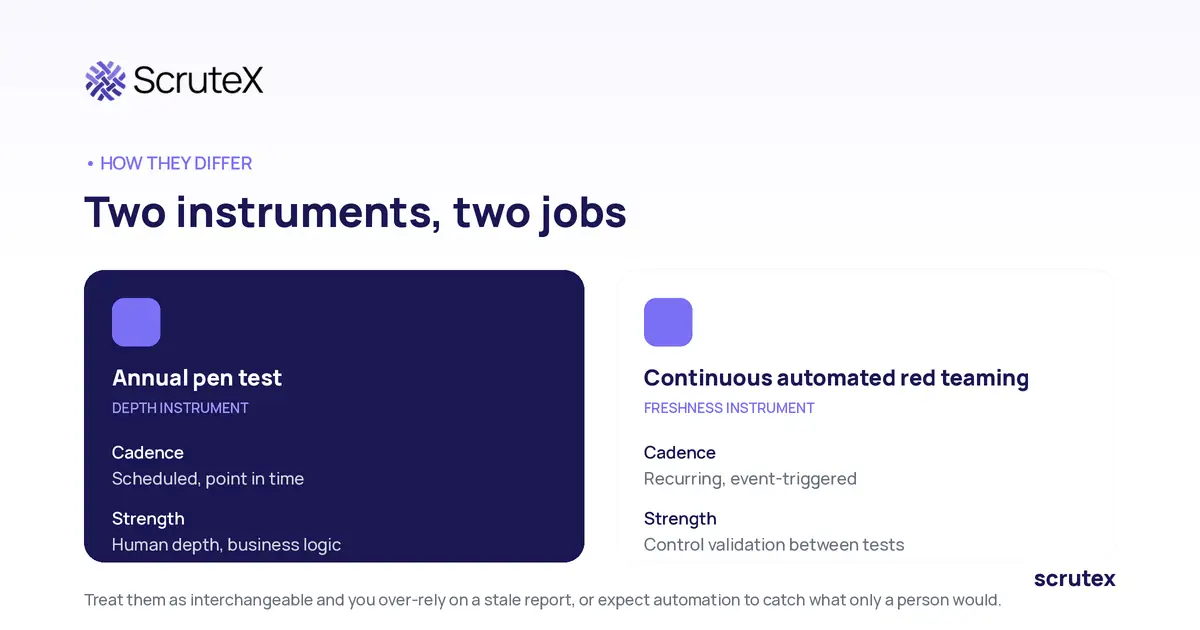
Neither approach is universally better. They have different purposes, cadences, and failure modes.
| Dimension | Annual Penetration Test | Continuous Automated Red Teaming |
|---|---|---|
| Primary purpose | Discover and validate scoped security weaknesses | Repeatedly validate selected adversarial behaviours and controls |
| Testing cadence | Scheduled engagement | Recurring or event-triggered, where supported |
| Execution | Often human-led | Primarily automated, depending on the platform |
| Complex business logic | Well suited to expert investigation | May require additional human analysis |
| Security control validation | Depends on scope | Often a central use case |
| Reporting | Engagement findings and recommendations | Recurring evidence and trends, where supported |
| Remediation verification | May include agreed retesting | Can support repeatable validation of selected fixes |
| Operational effort | Preparation, engagement, remediation | Setup, safe operation, monitoring, analysis, remediation |
| Main limitation | Point-in-time scope and assessment conditions | Limited by supported scenarios, configuration, and coverage |
Read practically, the penetration test is your depth instrument: a human going deep on a bounded scope at a point in time. Continuous automated red teaming is your freshness instrument: shallower per run, but repeated, so the evidence about selected controls stays current. A team that treats the two as interchangeable will either over-rely on a stale report or expect automation to catch things only a person would. The point is to know which question each one answers.
Why Annual Penetration Testing Alone May Leave Gaps
The gap is time. Your environment changes between assessments, and a report written in March says nothing about a change made in July. That is not a flaw in the test. It is a point-in-time assessment meeting a moving target.
Changes that can alter your exposure or your control effectiveness include:
- New applications and infrastructure that were never in scope.
- Cloud configuration changes across storage, network, and roles.
- Identity permission changes that widen what an account can reach.
- New security controls that may not be configured the way you assumed.
- Software deployments that introduce new code paths.
- Changes to endpoint protection or detection rules.
- Previously identified weaknesses marked fixed but never re-tested under realistic conditions.
Not every change introduces a vulnerability, and not every annual assessment leaves a serious gap. A stable environment has a small gap. One shipping code weekly and reconfiguring cloud roles constantly has a large one. The useful rule is to match testing frequency to risk and to the rate of change. The faster the drift, the more a once-a-year snapshot leaves unanswered, which is also why external attack surface management treats discovery as continuous rather than annual.
How Does Continuous Automated Red Teaming Change the Work of a Small Security Team?
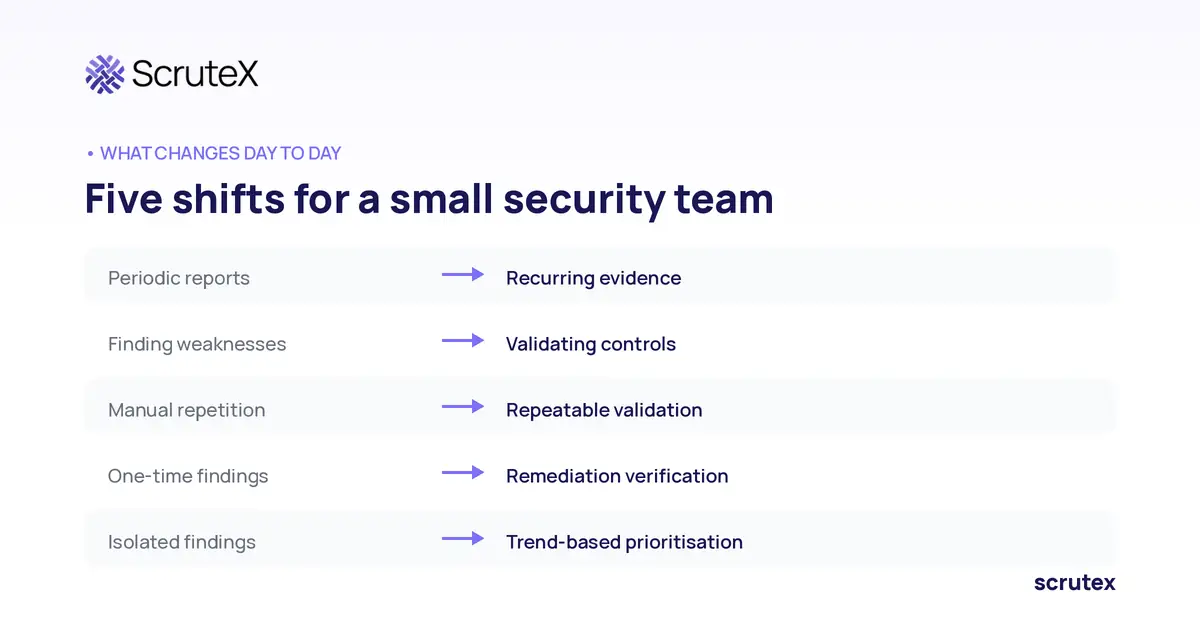
For a small team, the change is less about running more tests and more about what the day-to-day work becomes. Five shifts matter.
From Periodic Reports to Recurring Evidence
An annual assessment gives you findings for one engagement. Continuous validation gives you updated evidence about the behaviours and controls you chose to test, refreshed each run. For a team with one data point a year about whether a control works, that changes the conversation from "the test said this in spring" to "this control responded correctly in the last run."
Recurring evidence is not proof the whole environment is secure. It is proof about the slice you tested. A clean run on ten scenarios tells you those ten controls behaved as expected. It says nothing about the hundred things you did not test.
From Finding Weaknesses to Validating Defensive Controls
Discovering a vulnerability and validating a control are different jobs. A penetration test is mostly the first: here is a weakness, here is the impact. Control validation asks a narrower question: when this specific simulated behaviour runs, does the control detect it, block it, or log it?
That distinction helps a small team because control failures are often cheaper to fix than code vulnerabilities and faster to confirm. A detection rule that should have fired but did not is a configuration problem you can often close in an afternoon. One caveat holds throughout: a successful simulation does not prove every defence works. It proves the one you tested did its job, this time.
From Manual Repetition to Repeatable Validation
Small teams burn time re-running the same checks by hand. Automation reduces that by packaging a scenario once and running it many times. The saving is real, but not free. Someone still configures the scenarios, monitors execution so tests run safely, and reviews results. Automation moves the effort from running the test to designing and interpreting it. For a team of three or four, that trade is usually worth it: design and interpretation use judgement that is hard to outsource, repetitive execution is not.
From One-Time Findings to Remediation Verification
Remediation verification is one of the clearest wins. When you fix something, you want to know the fix worked. Recurring validation lets you re-run the exact scenario that exposed a gap and check whether the change produced the result you expected.
The discipline here is distinguishing a confirmed control failure from a test problem. A failed validation can mean the control is genuinely broken. It can also mean the test did not execute properly, the telemetry was incomplete, or the result is ambiguous. A team that treats every red result as a real failure will chase ghosts. Triage the result before you triage the control.
From Isolated Findings to Trend-Based Prioritisation
A single finding is a data point. The same finding across five consecutive runs is a pattern, and patterns are how a stretched team decides where to spend its limited hours. Recurring results surface repeated control gaps, issues that were never actually resolved, and areas that keep failing and need a human to investigate.
This is the practical payoff. If one detection control fails every week while everything else passes, that is your next piece of work, chosen by evidence rather than by whoever shouted loudest. Trend data lets four people prioritise like a larger team, because the recurring signal does the ranking.
What Are the Limitations of Continuous Automated Red Teaming?
Automation is not a replacement for skilled security people, and any vendor who implies otherwise is selling, not advising. The limitations are concrete. Automated red teaming struggles with:
- Complex business-logic vulnerabilities that depend on how your application is meant to work.
- Novel attack paths nobody has scripted a scenario for yet.
- Multi-step weaknesses that need contextual reasoning across systems.
- Application design flaws that only make sense with domain knowledge.
- Authorisation problems that require knowing who should access what and why.
- Scenarios the platform simply does not support.
- Assets outside its coverage, which it will not test and will not warn you about.
- False positives and ambiguous results that need a human to adjudicate.
- Misconfigured or incorrectly scoped tests that produce confident, wrong answers.
Capabilities also vary widely between vendors. Two products both labelled "automated red teaming" can differ enormously in what they test and how safely they run. Human-led penetration testing remains valuable precisely where automation is weak: deeper investigation, contextual analysis, and objectives no scenario library covers. Automation is not always cheaper, safer, faster, or more thorough. It is better at some things and worse at others, and treating it as a blanket upgrade is a mistake.
Can Continuous Automated Red Teaming Replace an Annual Penetration Test?
Not as a universal replacement. The two have different objectives and coverage, and swapping one for the other trades away something you probably still need.
A penetration test is the right tool when you need deep application assessment, complex business-logic testing, expert-led investigation, or when a contract or applicable regulation requires a specific kind of test. Continuous automated red teaming complements that work by repeatedly validating supported controls and adversary scenarios in the long stretch between assessments.
A combined approach makes sense when you need both the depth of expert assessment and current evidence about your controls, and you can act on both. It makes less sense when your existing testing programme has obvious holes. If your last penetration test had half your estate out of scope and a backlog of unfixed findings, adding a continuous platform on top does not fix that. Close the gaps in what you already do first. Not every organisation needs both, and buying a second tool to avoid improving the first is a common and expensive mistake.
How Should a Small Security Team Choose the Right Approach?
Use the pressure you are actually under to decide.
Prioritise expert-led penetration testing when:
- Complex applications need contextual assessment a scanner cannot provide.
- Business logic or chained vulnerabilities are a real concern.
- You need a defined, expert-led assessment with a human verdict.
- A contract or applicable regulation requires specific testing.
- Existing findings need deeper investigation.
Prioritise continuous automated red teaming when:
- You need recurring validation of selected security controls.
- Your infrastructure and defensive configurations change often.
- You need repeatable evidence after you remediate something.
- The scenarios a platform supports match your actual priorities.
- You can investigate and remediate the findings it produces.
Run a combined approach when:
- Deep expert assessment genuinely matters for your risk.
- Controls need validating in the gaps between engagements.
- Your environment changes frequently.
- You have capacity to act on both kinds of findings.
The variable that decides this is not company size. It is risk, objectives, maturity, and operational capacity. A ten-person company shipping a fintech product may need both. A fifty-person company with a stable internal estate may be well served by a good annual test and tight change control. What you are protecting and how fast it moves is the strong predictor.
A Practical Adoption Plan for a Small Security Team
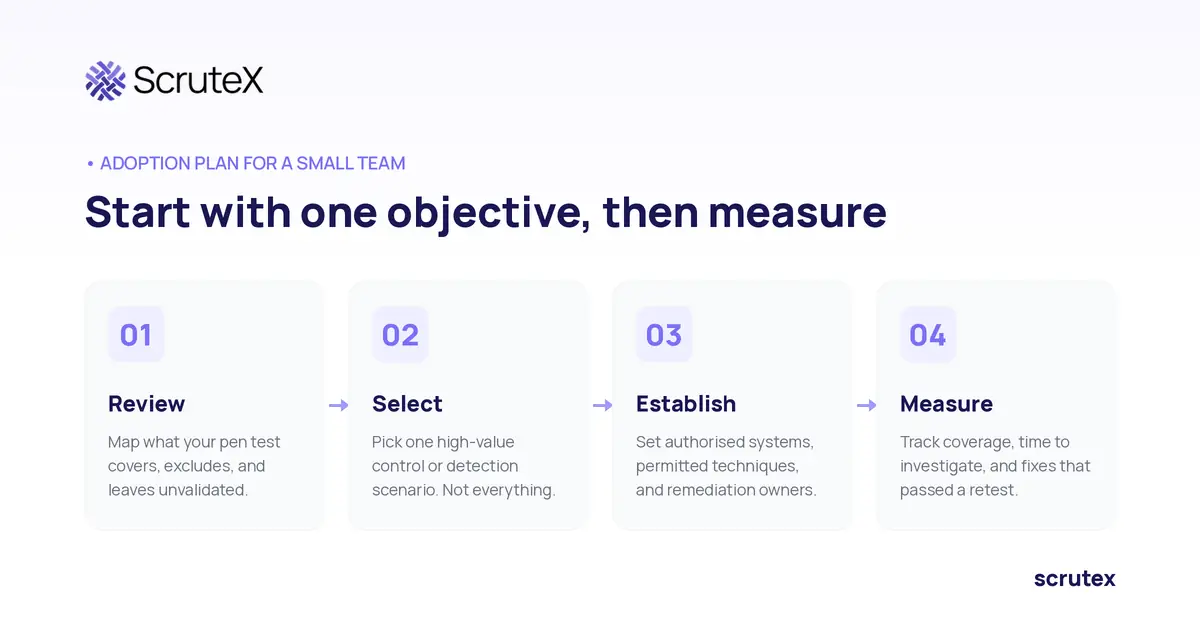
If continuous validation fits, start small and prove value before you expand.
Step 1: Review the existing testing programme. Write down what your penetration test covers, what it excludes, which findings are still open, and which controls get no recurring validation. This is the honest inventory that tells you where a continuous layer would help.
Step 2: Select one high-value validation objective. Pick a single defensive control, a supported detection scenario, or a remediation-verification need. One. Do not try to validate everything at once. A narrow first objective you can run cleanly beats a broad one you cannot interpret.
Step 3: Establish safe testing boundaries. Define authorised systems, permitted techniques, execution conditions, escalation contacts, access permissions, and remediation ownership. Safe operation is the difference between a validation tool and an incident you caused yourself.
Step 4: Measure the results. Track measures that tell you whether this is working:
- Coverage of the controls or scenarios you selected.
- Time to investigate a failed validation.
- Time to remediate a confirmed finding.
- Percentage of fixes that passed a retest.
- Repeated failures across runs.
- Unresolved high-risk gaps.
These metrics guide decisions. They do not prove complete security, and anyone who reads a dashboard of green as "we are secure" has misunderstood what it measures.
| Step | Action | Expected Output |
|---|---|---|
| Review | Examine the current testing programme | Identified coverage gaps |
| Select | Choose a high-value validation objective | Defined testing goal |
| Establish | Set boundaries and assign ownership | Approved workflow |
| Measure | Track findings and remediation | Evidence for future decisions |
What Should Organisations Look for in a Continuous Automated Red-Team Platform?
Judge platforms on what they do, not on the words in their marketing. Use this buyer's checklist:
- A documented testing methodology you can actually read.
- The specific adversarial scenarios it supports, named, not implied.
- Defined execution boundaries and safety controls.
- Coverage relevant to your endpoints, infrastructure, or the controls you care about.
- Evidence that explains each test result, not just a pass or fail flag.
- Reporting and historical trends you can use to prioritise.
- Remediation verification, so you can re-test fixes.
- Integration with your existing workflows, where supported.
- Configurable testing frequency.
- Clearly stated limitations and coverage gaps.
- Appropriate access controls for whatever the platform can reach.
- Operational requirements you can meet with your headcount.
No platform supports all of these equally, and some claims will not survive a demo. Ask the vendor to run a scenario you care about on your own scope and show you the evidence it produces. Terminology is cheap. A real result on your own environment is telling you something a brochure cannot.
How ScruteX Fits Into the Broader Security Workflow
ScruteX is an external security intelligence platform built around Continuous Threat Exposure Management. Its external-risk work runs continuously across discovery, prioritisation by real-world exploitability, and validation, which matters here because validation is the stage where control evidence gets produced.
Within its validation stage, ScruteX uses AI-driven continuous automated red teaming and automated penetration testing, with a human-in-the-loop workflow. For the AI pen testing capability, you describe the target, the agent drafts a scan plan, a human approves it, and the agent executes within configured guardrails. That approval step is a feature, not a limitation to hide: it keeps the validation bounded and accountable. ScruteX validates with CART and automated pen testing rather than breach and attack simulation, so its evidence is exploit-backed rather than detection-replay. This sits in the continuous automated red teaming capability.
A limitation stated plainly: ScruteX is external. If an exposure never leaves your network, an external platform will not find it, and that is true of any external tool. For internal control validation and deep internal application testing, you still need the internal and human-led testing described above.
Where ScruteX contributes to this decision is continuous external visibility and validated exposure. It keeps the picture of your external attack surface current between assessments and confirms exploitability before a finding reaches your responders, so a small team spends its hours on validated problems rather than raw signals. It complements a good penetration test. It does not replace one.
Am I Exposed? A Self-Check
You can answer these without any platform, right now:
- Has your environment changed since your last penetration test (new apps, cloud roles, subdomains, detection rules) in ways the report never saw?
- Do you have current evidence that the controls you fixed after the last test still work, or only the retest from months ago?
- When you remediate something, can you re-run the exact scenario that exposed it to confirm the fix?
- Do you know which of your defensive controls have never been validated against a realistic adversary behaviour?
- If a detection rule silently stopped firing last week, how would you find out before an incident?
If two or more of those make you uncomfortable, the gap between your last assessment and today's environment is wider than your evidence covers.
What ScruteX Finds Here
Vulnerability Insights runs continuous external discovery and surfaces internet-facing assets, including ones not on your register, within hours rather than at a quarterly scan. The validation stage then confirms whether a discovered exposure is actually exploitable before it escalates to your team, using continuous automated red teaming and automated pen testing with a human-approved plan. It maps findings to MITRE ATT&CK and prioritises by real-world exploitability rather than raw CVSS, so the queue reflects what an attacker would reach.
Check Your External Exposure
See what an attacker can see on your domain. ScruteX is agentless: a domain and a set of keywords start discovery, and the free tier covers the core modules with no credit card. Check your own external surface before you decide whether a continuous layer belongs in your programme. Domain only, no agent to install.
Honest limit: this checks your external surface. It will not validate internal controls or replace an internal penetration test.
Key Takeaways
- The annual penetration test is a point-in-time depth instrument. Continuous automated red teaming is a recurring freshness instrument. They answer different questions.
- Annual testing alone leaves gaps that grow with the rate of change in your environment, not with the quality of the test.
- For a small team, continuous validation changes the work: recurring evidence, control validation, remediation verification, and trend-based prioritisation.
- Automation does not replace skilled people. It is weak on business logic, novel paths, and anything outside its supported scenarios.
- Fix the holes in your existing testing programme before adding a second tool. Risk and capacity decide the right approach, not company size.
Frequently Asked Questions
Q: What is continuous automated red teaming?
A: Continuous automated red teaming is the repeated, automated execution of selected adversary behaviours against your environment to validate whether specific security controls detect, block, or record them. It focuses on recurring validation of the controls and scenarios you configure, not on discovering every vulnerability on every asset.
Q: How is continuous red teaming different from penetration testing?
A: A penetration test is a scoped, often human-led, point-in-time assessment that discovers and validates weaknesses during an engagement. Continuous automated red teaming re-runs selected adversary scenarios on a recurring basis to keep evidence about specific controls current between those assessments.
Q: Can automated red teaming replace an annual penetration test?
A: Not as a universal replacement. The two have different objectives. Penetration testing provides expert-led depth and complex business-logic testing; automated red teaming provides recurring control validation. Many teams combine them rather than choosing one, if they have capacity to act on both.
Q: How often should security teams validate their security controls?
A: Match validation frequency to your risk and your rate of change. A fast-changing environment that ships code weekly needs more frequent validation than a stable internal estate. No standard mandates a universal frequency, so base the cadence on how quickly your controls and configurations drift.
Q: What is the difference between automated red teaming and breach and attack simulation?
A: Breach and attack simulation replays scripted attack techniques against live controls to check detection and prevention coverage. Automated red teaming overlaps but emphasises chaining behaviours and, in some platforms, confirming exploitability. Capabilities vary by vendor, so compare what each actually tests rather than the label.
Q: Does continuous automated red teaming find every vulnerability?
A: No. It validates the behaviours and controls you select, within the scenarios the platform supports and the scope you define. It can miss business-logic flaws, novel attack paths, and assets outside its coverage. Human-led testing remains necessary for deeper, context-dependent investigation.
Q: Is continuous automated red teaming suitable for a small security team?
A: It can be, if the team can configure scenarios safely, interpret results, and remediate findings. The value for small teams is recurring evidence and trend-based prioritisation. Without the capacity to act on findings, the platform produces noise rather than assurance.
Q: How can organisations combine penetration testing with continuous security validation?
A: Use penetration testing for deep, expert-led assessment and contractual or regulatory needs, and use continuous automated red teaming to validate selected controls and verify remediation between engagements. Review your existing programme first, start with one validation objective, and expand once it produces useful evidence.
Conclusion
The decision is clearer than the marketing makes it sound. Annual penetration testing gives you expert-led assessment within a defined scope, and that depth is hard to replicate with automation. Continuous automated red teaming gives you recurring validation of selected controls and adversary behaviours, which keeps your evidence current between those assessments. Automation does not remove the need for skilled people, and its value depends on suitable scenarios, safe execution, meaningful evidence, and the capacity to remediate what it finds. A small team should address its most important assurance gaps rather than buy a tool because it promises continuous testing.
The goal is not to run more tests. It is to keep meaningful evidence about the security controls that matter, understand where that evidence is incomplete, and point limited resources at the risks that matter most.