BAS vs CART vs Penetration Testing: What Each One Proves
By ScruteXPublished
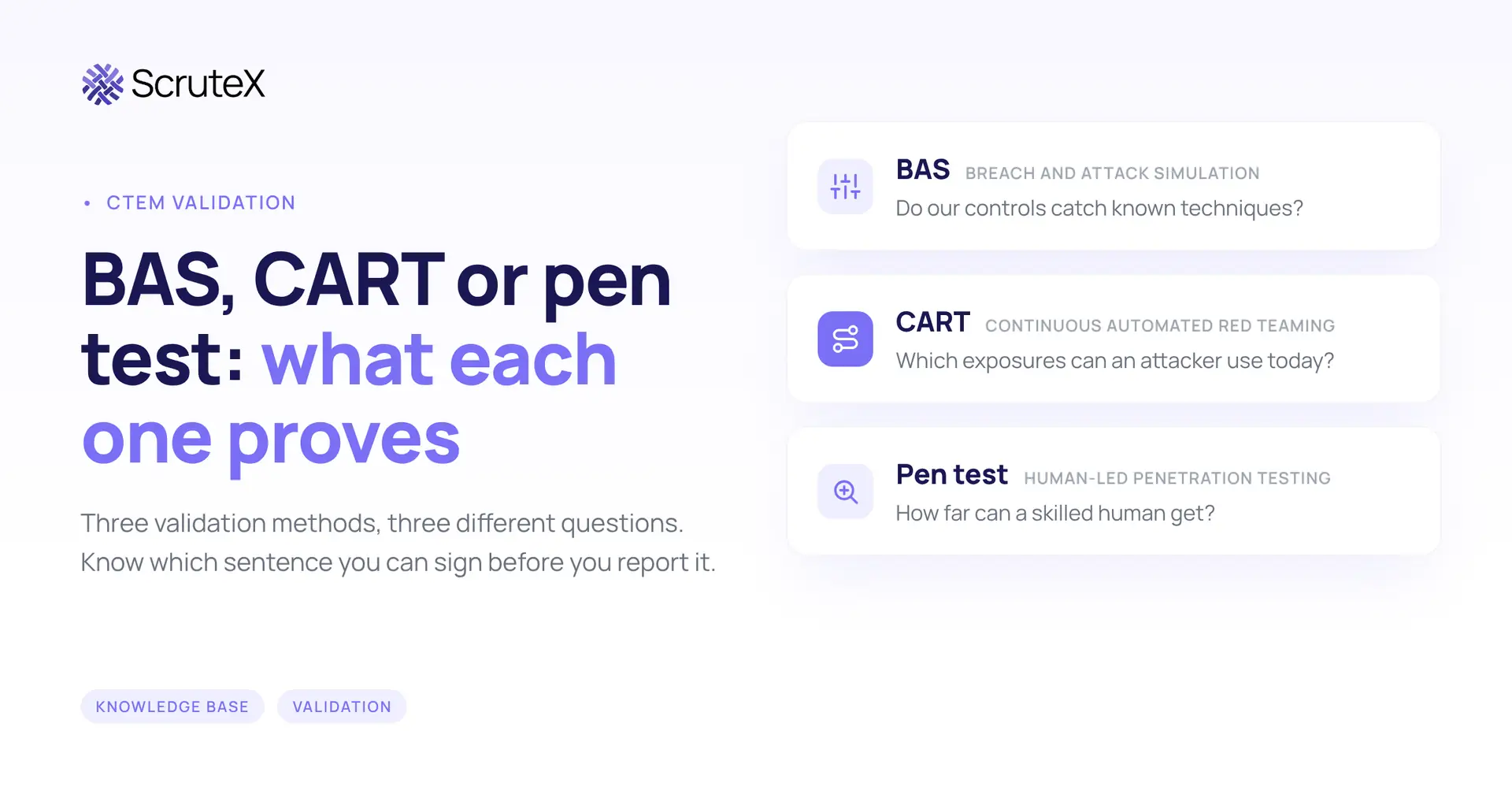
A green BAS dashboard, a signed pen test report and a set of CART findings can all exist in the same quarter. All three can be accurate. The organisation can still be breached through an asset none of them touched. The tests answer different questions, and the trouble starts when a team buys one and reports it to the board as proof of another.
The short answer on BAS vs CART vs penetration testing is this. Breach and attack simulation (BAS) proves that your security controls detect and block known attacker techniques on the assets you point it at. Continuous automated red teaming (CART) proves which exposures an attacker can chain into a working attack path, tested continuously. Penetration testing proves what a skilled human can reach inside an agreed scope and time window, including business logic flaws that no automated library contains.
Each one produces a different sentence that a CISO can sign. This post sets out those sentences, the blind spot behind each, and how to choose when the budget covers one or two of the three.
What does BAS prove?
BAS proves that your security controls respond to known attacker techniques on the assets where you run it.
A BAS platform automates known attack patterns to confirm that defences behave as expected. The techniques usually map to MITRE ATT&CK. The platform replays them in a controlled way inside your environment, then records what your stack did. Did the endpoint agent block the technique? Did the SIEM receive the log? Did the alert fire, and did it reach an analyst?
That makes BAS the only one of the three that measures your defences instead of your exposures. Teams that run it well catch drift they had no other way to see: an EDR policy that reverted after an upgrade, a log source that stopped shipping, a detection rule that broke when a vendor renamed a field.
Two limits come with the method. BAS tests the techniques in its library, so it says nothing about a technique nobody has written up yet. And it tests the estate you nominate. It discovers nothing. If a forgotten subdomain or a contractor-built microsite is missing from your inventory, the dashboard stays green and gives no sign that anything is absent.
Buyers often miss a third limit. A simulation is safe by design. It shows that a control would catch a technique. It does not show that a specific exposed service on your perimeter can be exploited today.
The sentence BAS lets you sign: "On the assets we tested, our controls blocked or detected these known techniques, as of this date."
What does CART prove?
CART proves which exposures an attacker can turn into a working attack path, and it keeps re-testing as your environment and the threats against it change.
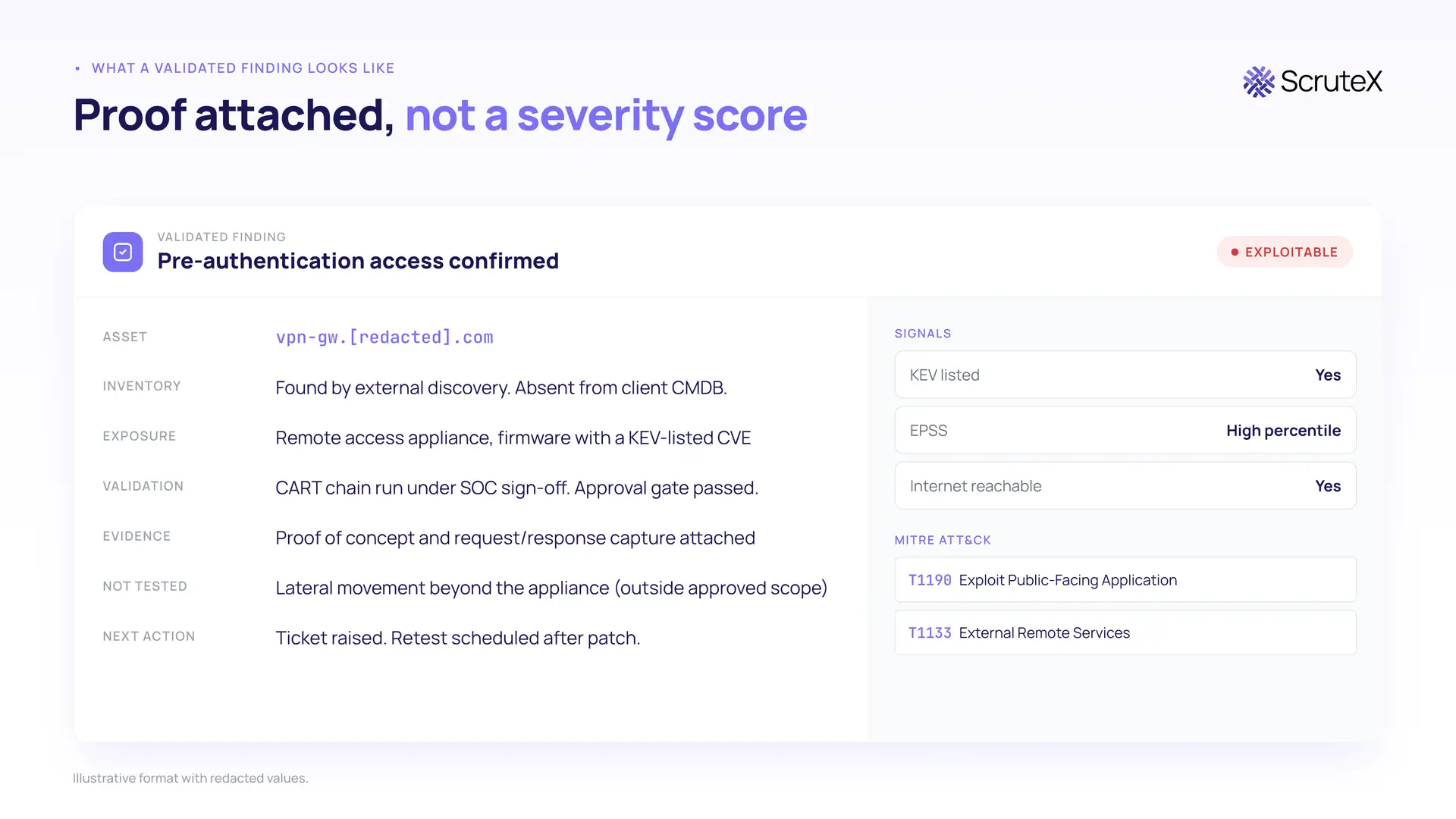
BAS starts from your controls. CART starts from the attacker's position. A CART programme scopes itself from live threat intelligence or from external discovery, selects the techniques that adversaries active in your sector use, and runs multi-step chains from start to finish. The output is a set of validated findings: this exposure, this chain, this proof.
Take an illustrative case: an internet-facing remote access appliance running firmware with a known exploited vulnerability. A scanner reports the CVE. BAS has nothing to say unless a simulator sits on that asset. CART attempts the chain inside agreed guardrails and reports whether it achieved access, with evidence attached.
The term needs care, because vendors use it loosely. Some products sold as CART are BAS libraries running on a schedule. Others validate only externally discovered exposures. Others run internal attack paths from a foothold. Ask every vendor one question: what does the engine execute against production, and what does it infer? Then write the answer into the contract.
CART has limits of its own. It validates the classes of exposure its builders designed it for. The guardrails that make it safe to run against production also leave some actions untested. An external CART engine says little about lateral movement inside the network. And no automated engine understands what your application is for, so business logic flaws stay out of reach.
CART and automated penetration testing overlap. The practical difference is cadence and purpose. CART runs continuously and follows threat intelligence. An automated pen test runs on demand or on a schedule and produces point-in-time evidence for a release or an audit.
The sentence CART lets you sign: "Of the exposures an attacker can find, these are exploitable now, and here is the chain that proves it."
What does penetration testing prove?
A penetration test proves what a skilled human can achieve against a defined scope in a defined window.
The human is the point. A tester reads the application, forms a theory about how it should work, and looks for the place where it does not. A password reset flow that trusts a user ID from the request body. An API that accepts a tenant identifier from the client. An authorisation check that fails only when three steps happen in a certain order. Business logic flaws, complex attack chains and novel exploitation techniques are the findings automation misses, and on a customer-facing application they are often the ones with the largest business cost.
Scope also sets the tester's starting knowledge. A black-box test starts with nothing and shows what an outsider finds. A grey-box test supplies credentials and reaches deeper into authenticated functions in the same number of days. Decide which question you want answered before you sign the scope.
Pen testing also carries a weight the automated options lack. PCI DSS requires penetration testing at least annually and after significant change. DORA requires threat-led penetration testing for designated financial entities in the EU. Regulators such as the RBI in India and APRA in Australia (under CPS 234) expect systematic, independent testing. A signed report from a qualified tester remains the evidence most auditors ask for first.
Its limits are scope and cadence. A test assesses the targets you listed. The staging environment that a certificate transparency log has published for two years is not a finding, because nobody put it in the scope document. Human time costs money, so testing happens in windows. Your exposure does not wait for the next window. A repository goes public on a Tuesday. A credential shows up in a stealer log the week after.
The sentence a pen test lets you sign: "A qualified tester, given this scope and this much time, got this far, on these dates."
BAS vs CART vs penetration testing: side-by-side comparison
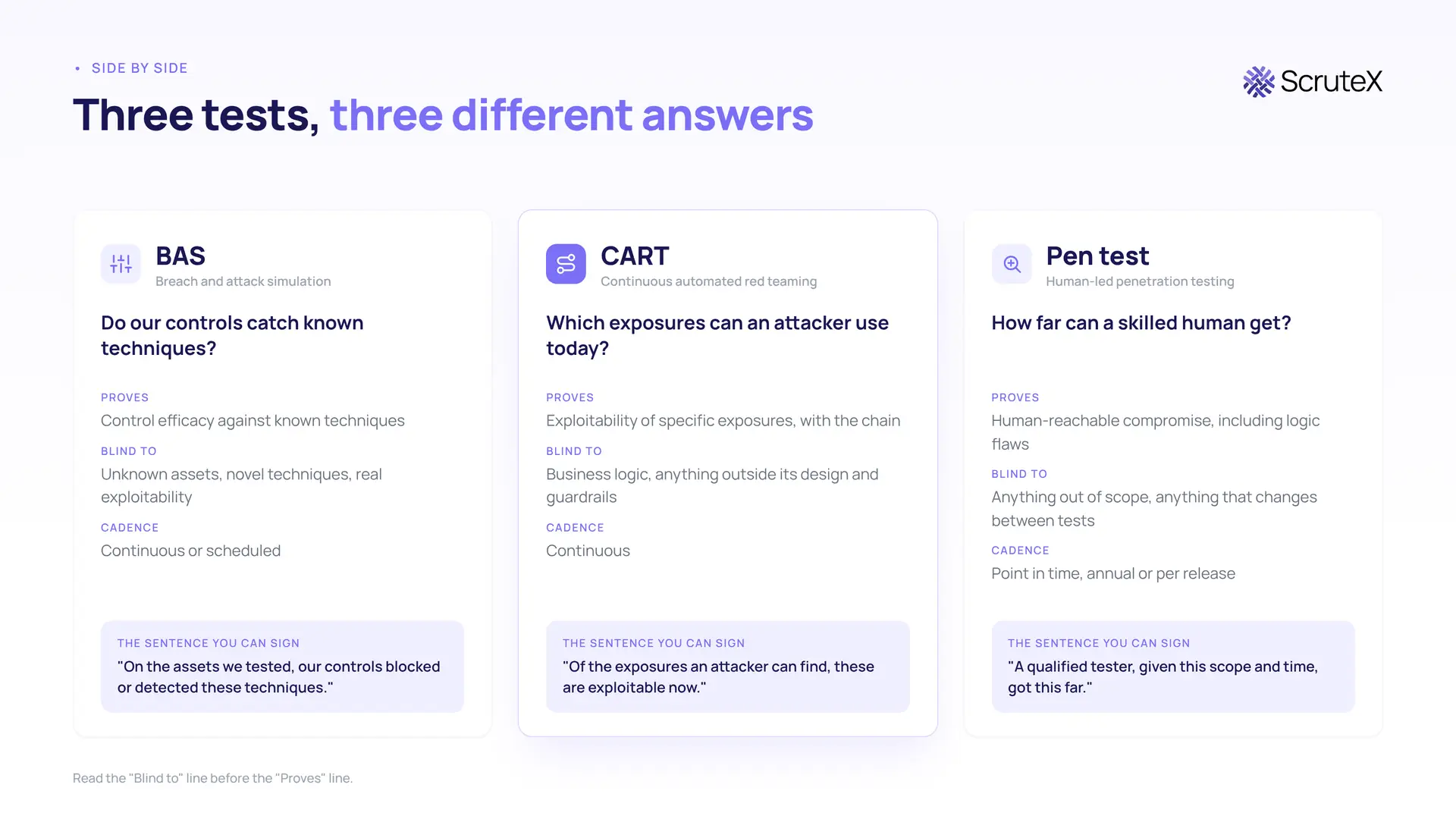
| BAS | CART | Penetration testing | |
|---|---|---|---|
| Question it answers | Do our controls catch known techniques? | Which exposures can an attacker use today? | How far can a skilled human get? |
| Starting point | Assets you nominate | Threat intelligence or external discovery | A scope document you supply |
| Method | Simulated techniques from a library | Automated multi-step attack chains under guardrails | Human-led, adaptive testing |
| Cadence | Continuous or scheduled | Continuous | Point in time, usually annual or per release |
| What it proves | Control efficacy against known techniques | Exploitability of specific exposures | Human-reachable compromise, including logic flaws |
| Where it is blind | Unknown assets, novel techniques, real exploitability | Business logic, anything outside its design and guardrails | Anything out of scope, anything that changes between tests |
| Evidence produced | Prevent and detect scores by technique | Validated finding with attack chain and proof | Signed report with narrative and reproduction steps |
| Best fit | Mature control stack and an active SOC | Internet-facing exposure that changes often | Critical applications and regulatory evidence |
Read the "blind" row before the "proves" row. Most validation failures come from a good tool answering a question the team never asked.
Where do BAS, CART and pen testing fit in CTEM?
All three belong to validation, the fourth of the five CTEM stages.
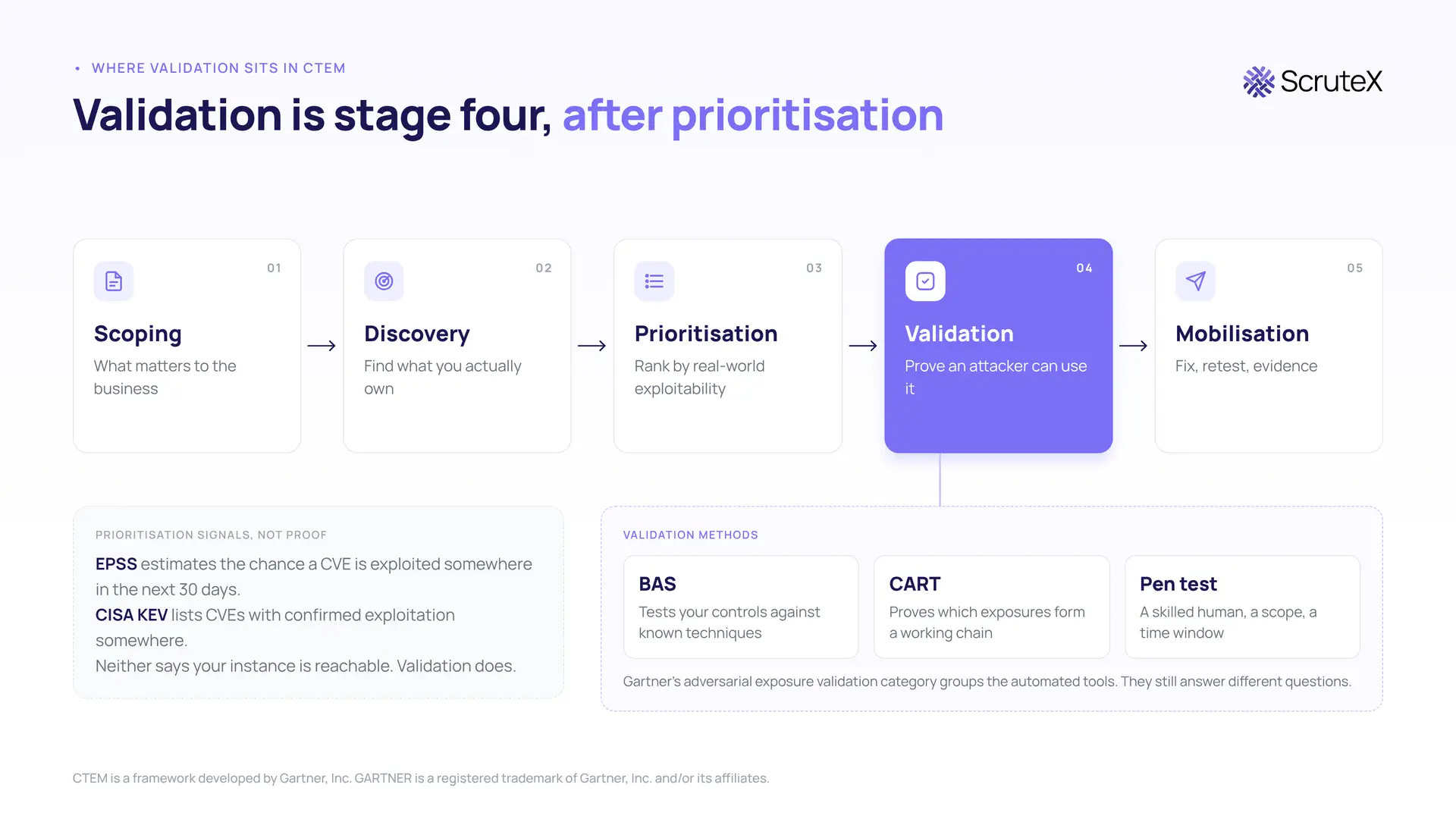
CTEM organises exposure management into five stages: scoping, discovery, prioritisation, validation and mobilisation. (Our guide to the five stages of CTEM covers each one.) Validation is where a team confirms that a prioritised exposure is exploitable in its own environment.
Gartner now treats the automated tools in this stage as one market. Its Market Guide for Adversarial Exposure Validation (AEV), first published in 2025 and updated in March 2026, folds breach and attack simulation and automated penetration testing and red teaming into a single category. The label is useful for procurement. It does not make the instruments interchangeable. A product listed under AEV can still be a control-testing tool, an exploitability tool, or a mix, and the sentence each one lets you sign is still different.
Order matters, and this is where EPSS and CISA KEV come in. EPSS, maintained by FIRST, is a data-driven model that estimates how likely a vulnerability is to be exploited in the wild, and its window is the next 30 days. The CISA Known Exploited Vulnerabilities catalog lists vulnerabilities with confirmed exploitation. Both are strong prioritisation signals. Neither describes your environment. EPSS is an estimate across the whole population, and says nothing about your particular instance. A KEV-listed CVE on an appliance nobody can reach from the internet is a patching task. The same CVE on an exposed gateway with no compensating control is the finding to fix today.
Prioritisation narrows thousands of findings to the few worth testing. Validation then answers the question prioritisation cannot: can someone use this against us, here, now? Validation without prioritisation wastes budget and adds production risk. Prioritisation without validation leaves the team arguing over scores.
Mobilisation depends on it too. An engineering team acts faster on a ticket with a proof of concept attached than on a severity rating.
Validation also changes what you report upward. A vulnerability count tells a board how much work exists. Validation gives it figures that describe risk: how many prioritised exposures the team tested, how many proved exploitable, how long each took to fix, and how many passed retest. Those four figures show whether exposure is rising or falling, which is the question a board asks.
How do BAS, CART and pen testing work together on one exposure?
The three methods hand work to each other. Follow one illustrative exposure through a year to see how.
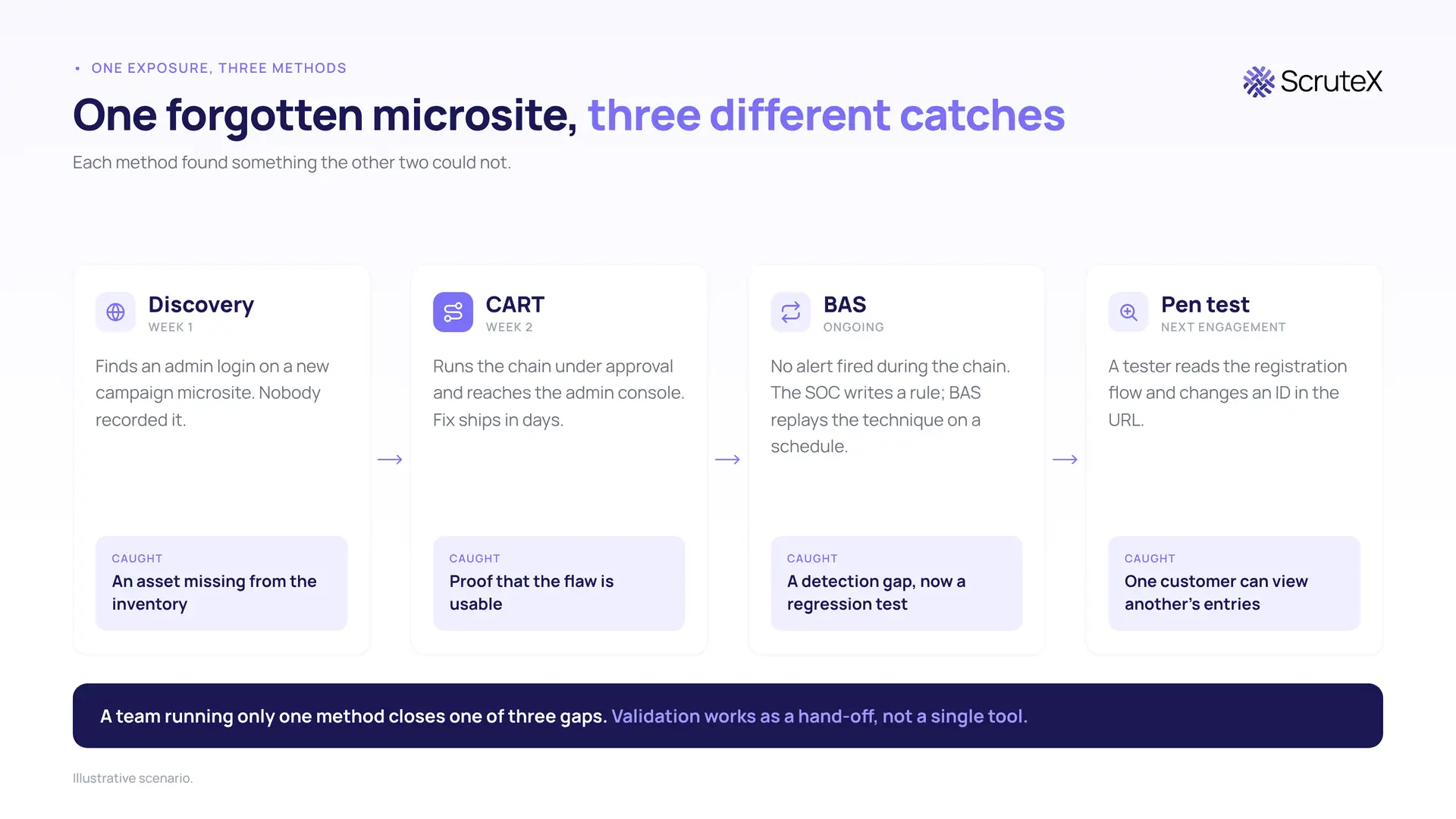
A marketing team launches a campaign microsite on a new subdomain. The site includes an admin login that nobody recorded in the asset inventory. External discovery finds it in the first week.
CART goes first. Prioritisation flags the admin panel because it is reachable from the internet and runs a framework version with a known exploited flaw. CART attempts the chain under approval and confirms access to the admin console. The team now holds proof, so the fix ships in days instead of joining a backlog.
BAS goes second. The fix closed one door, but the attempt also showed that no alert fired while the chain ran. The SOC writes a detection rule. BAS then replays the technique on a schedule to confirm that the rule keeps firing after every tooling change. The finding has become a regression test.
The pen test goes third. At the next engagement, the microsite enters the scope document for the first time. The tester ignores the patched flaw and reads the registration flow instead. She finds that the site lets one customer view another customer's entries by changing an ID in the URL. No automated method would have reported that.
Each method caught something the other two could not. A team running only one of them would have closed one of the three gaps.
Which should you run first?
Start from the uncertainty you hold, because each test removes a different one.
- You own a mature control stack and do not know whether it works. Run BAS. Nothing else measures detection and prevention directly.
- You cannot say which of your internet-facing findings are usable, or your exposure changes faster than your test calendar. Run CART.
- You need assurance on a commercially important application, or a regulator or customer needs a signed report. Commission a pen test.
Few teams outside large enterprises fund all three properly. A mid-market team with a small security function usually gets more from one continuous method plus one human test a year than from three thinly run programmes.
The pairing depends on where your risk sits. BAS suits teams with large internal estates and a SOC that tunes detections every day. CART suits teams whose exposure is mostly internet-facing and changes often. Pen testing stays in both plans, aimed at the applications where a logic flaw would cost the most.
Count the operating cost as well as the licence. BAS needs deployment inside the estate and an analyst who tunes detections when a simulation gets through. A BAS result that nobody acts on is shelfware. CART needs written authorisation, a named owner for approval gates, and a route from validated finding to ticket. A pen test needs scoping effort up front and budget for a retest after fixes. If you cannot staff the follow-through for a method, postpone it.
One sequencing rule holds in every case: verify what you own before you validate it. All three methods test an inventory. If external discovery has not confirmed that inventory, each method tests an estate with holes in it.
What should you ask before you buy?
Each method has a sales pitch that hides its limit. These questions bring the limit into the open.
For a BAS platform
- How often does the technique library update, and what intelligence drives the updates?
- What does the platform report for assets that carry no simulator or agent?
- Does it measure detection and alert delivery, or only prevention?
For a CART platform
- What does the engine execute against production, and what does it infer?
- Where does the scope come from: my asset list, your discovery, or both?
- Who approves an action before it runs, and what stops a campaign out of hours?
- How does a validated finding get retested after the fix?
For a penetration test
- Who will do the testing, and what accreditations do they hold (for example CREST, or CERT-In empanelment in India)?
- How did you build the scope, and when did anyone last reconcile it with external discovery?
- Does the price include a retest, and does the report give reproduction steps my engineers can follow?
For any product sold as adversarial exposure validation
- Which of the three questions in this post does it answer: control efficacy, exploitability, or both?
Write the answers into the contract or the statement of work. If a vendor cannot name what the product leaves untested, ask again before you sign.
What none of the three proves
None of them proves you have found everything. Discovery is a separate CTEM stage, and a validation result is only as complete as the asset list behind it.
None of them replaces a goal-driven human red team. That exercise puts people, escalation paths and decision-making under pressure, and automation does not reproduce it.
And none of them stays true for long. Every result carries a date. A deployment, a new subdomain or a leaked credential can change the answer the following week, which is the argument for running at least one method continuously.
Key takeaways
- BAS proves control efficacy against known techniques on the assets you nominate. It does not discover assets or prove exploitability.
- CART proves that specific exposures are exploitable, continuously. It does not find business logic flaws.
- Penetration testing proves what a skilled human can reach in scope. It does not cover what changes between tests.
- Gartner's adversarial exposure validation category groups the automated tools. It does not make them answer the same question.
- EPSS and KEV tell you what to test first. Validation tells you whether it matters in your environment.
- Confirm your external inventory before you buy any validation method.
Check your own validation coverage
Five checks you can run this week, without any vendor:
- ☐ Pull the scope document from your last pen test. Compare its target list against your current DNS records and certificate transparency logs. Any internet-facing asset missing from scope has had no human test.
- ☐ Count the days since that test finished. Then count the production releases and infrastructure changes since. That is the size of your untested window.
- ☐ If you run BAS, list the assets that carry a simulator or agent. Every internet-facing asset without one sits outside your BAS result.
- ☐ Take your ten highest-severity open findings. For how many do you hold proof of exploitability (a chain, a proof of concept) as opposed to a scanner rating?
- ☐ List your open findings that appear in CISA KEV. For each one, has anyone confirmed whether the asset is reachable from the internet?
If any answer is "we do not know", you have found your validation gap.
What ScruteX finds here
ScruteX runs CTEM validation with CART and automated penetration testing. It does not run BAS. Findings that survive prioritisation, where ScruteX ranks by real-world exploitability and active campaigns in your sector rather than raw CVSS, go to validation before anyone escalates them. CART campaigns emulate the techniques of threat actors active in your sector and run multi-step attack chains, with a SOC sign-off workflow before a campaign runs. For on-demand automated pen tests, you describe the target, the AI agent drafts a scan plan, and a person on your team approves that plan before the agent executes it within configured guardrails. Each finding carries exploit-backed evidence and maps to MITRE ATT&CK techniques.
The limits matter as much. ScruteX is agentless and sees what an external attacker would see. It does not sit on your endpoints, so it does not replace an agent-based BAS programme for measuring EDR and SIEM efficacy inside the network. It does not replace an accredited human tester either: where a regulator or a customer contract asks for a signed report from a qualified practitioner, commission one, and use the validated findings to sharpen that tester's scope.
What a validated finding looks like
Illustrative format with redacted values.
See it against your own domain
Validation only works on an inventory you trust. Start there. The free attack surface scan maps the subdomains, open ports, expired certificates and exposed services an attacker can see on your domain. You need your domain and a work email. No credit card.
Where to go next
- If your gap is proof of exploitability: start with Red Teaming and Pen Testing, which covers CART campaigns and on-demand automated pen tests.
- If you could not complete the first check above because you lack a current external inventory: start with Vulnerability Insights, which discovers internet-facing assets and ranks them by exploitability.
- If you want the full lifecycle around validation: read the five stages of CTEM.
- If your team still ranks work by CVSS alone: read CTEM vs vulnerability management.
FAQ
What is the difference between BAS and CART?
BAS simulates known attacker techniques to measure whether your security controls block and detect them. CART runs automated attack chains continuously to prove which exposures are exploitable. BAS tests your defences. CART tests your exposures.
Can BAS or CART replace penetration testing?
No. Automated methods do not find business logic flaws, and many frameworks and regulators expect a report from a qualified human tester. BAS and CART cover the time between human tests and the assets a scoped test leaves out.
Is CART the same as automated penetration testing?
They overlap, but they differ in cadence and purpose. CART runs continuously and selects scenarios from threat intelligence. Automated penetration testing runs on demand or on a schedule and produces point-in-time evidence, often for a release or an audit.
What is adversarial exposure validation (AEV)?
AEV is the Gartner market category that groups breach and attack simulation with automated penetration testing and red teaming tools. It describes technology that produces automated evidence of whether an attack can succeed. Products in the category still differ in whether they test your controls, your exposures, or both.
Where do BAS, CART and pen testing fit in CTEM?
All three sit in validation, the fourth of the five CTEM stages. They take the findings that prioritisation ranked highest and confirm whether an attacker could use them in your environment.
Do EPSS and CISA KEV tell me whether I am exploitable?
No. EPSS estimates the probability that a CVE is exploited somewhere in the next 30 days. KEV records that exploitation has happened somewhere. Only validation in your own environment shows whether your instance is reachable and exploitable.